Near Fort Ransom in Ransom County, North Dakota — The American Midwest (Upper Plains)
Writing Rock
⎯⎯⎯
Native American Legends
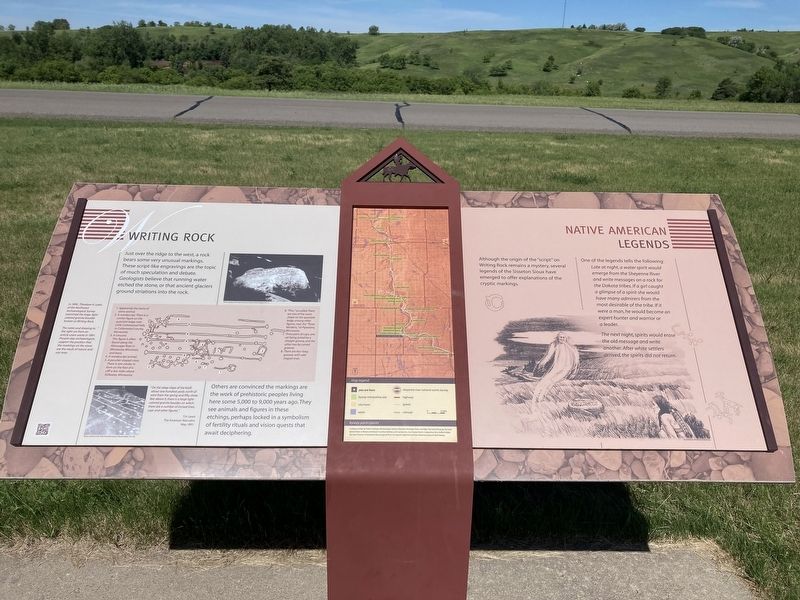
Photographed by Connor Olson, June 15, 2021
1. Writing Rock/Native American Legends Marker
Others are convinced the markings are the work of prehistoric peoples living here some 5,000 to 9,000 years ago. They see animals and figures in these etchings, perhaps locked in a symbolism of fertility rituals and vision quests that await deciphering.
One of the legends tells the following:
Late at night, a water spirit would
emerge from the Sheyenne River
and write messages on a rock for
the Dakota tribes. If a girl caught
a glimpse of a spirit she would
have many admirers from the
most desirable of the tribe. If it
were a man, he would become an
expert hunter and warrior or
a leader.
The next night, spirits would erase the old message and write another. After white settlers arrived, the spirits did not return.
this page online
In 1890, Theodore H. Lewis of the Northwest Archaeological Survey examined the large light- colored granite boulder known as Writing Rock
The notes and drawing to the right are from an article Lewis wrote in 1891. Present-day archaeologists support the position that the markings on the stone are the result of nature and not man.
1. Apparently the horns of some animal.
2. A nondescript. There is a similar figure on the quartzite ledge near Little Cottonwood Falls, in Cottonwood County Minnesota
3. A crescent.
This figure is often o found along the Mississippi River in Minnesota, Wisconsin, and Iowa.
4. A nondescript animal.
5. A peculiar-shaped cross. There is one similar in form on the face of a cliff a few miles above Stillwater, Minnesota
6. "Pins, "so-called. There are two of the same shape on the quartzite ledge, among other figures, near the "Three Maidens,"at Pipestone, Minnesota.
7. Three pairs of cups, one set being joined by a straight groove and the other two by curved grooves
8. There are four long grooves with odd- shaped ends.
Erected by Federal Highway Administration Garrison Diversion Recreation Grant, and Valley City Food & Beverage Tax Fund.
Topics. This historical marker is listed in these topic lists: Anthropology & Archaeology • Indigenous Peoples and Communities. A significant historical year for this entry is 1890.
Location. 46° 31.115′ N, 97° 56.488′ W. Marker is near Fort Ransom, North Dakota, in Ransom County. It is on Walt Hjelle Parkway near 62nd Street Southeast, on the right when traveling north. Touch for map. Marker is in this post office area: Fort Ransom ND 58033, United States of America. Touch for directions.

Regionally, this marker is in the Red River Valley and in Greater Fargo Area. It is also in the American Lewis & Clark Corridor, on the prairies, and on the Northern Plains. Globally, it is in North America, the Western Hemisphere, the Western World, and the Anglosphere. Historically, it finds itself in what was once Rupert’s Land and also the Louisiana Purchase.
Other nearby markers. At least 8 other markers are within 8 miles of this marker, measured as the crow flies: Historic Fort Ransom / Life at the Fort (here, next to this marker); Fort Ransom Historic Site (a few steps from this marker); Pyramid Hill / Fort Ransom’s Remarkable Survival (approx. 0.9 miles away); Standing Rock Lutheran Church (approx. 2 miles away); Timber Trestle Bridge (approx. 2.1 miles away); An Ancient Sea / Glacial Meltwater Trench (approx. 2½ miles away); Native Prairies / Ecosystem Under Siege (approx. 2.6 miles away); Standing Rock Hill Historic Site (approx. 7.4 miles away). Touch for a list and map of all markers in Fort Ransom.
Credits. This page was last revised on July 12, 2021. It was originally submitted on July 12, 2021, by Connor Olson of Menomonee Falls, Wisconsin. This page has been viewed 2,134 times since then and 135 times this year. Photo 1. submitted on July 12, 2021, by Connor Olson of Menomonee Falls, Wisconsin. • Mark Hilton was the editor who published this page.
Editor’s want-list for this marker. A wide shot of the marker and its surroundings. • Can you help?
