Near Chama in Rio Arriba County, New Mexico — The American Mountains (Southwest)
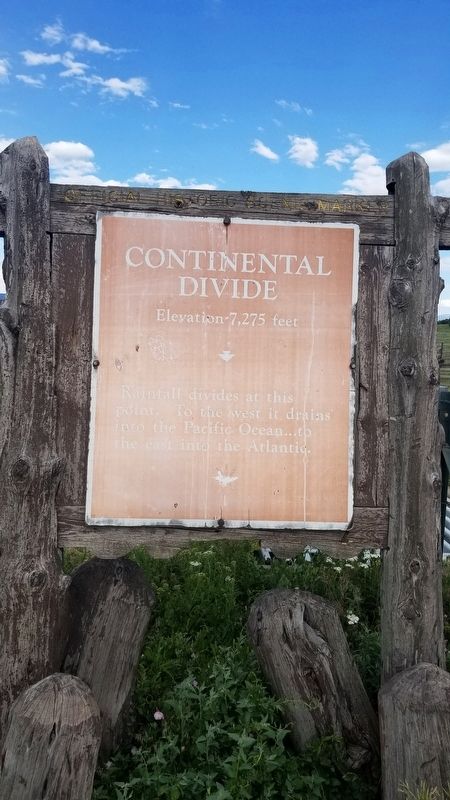
Continental Divide
Elevation - 7,275 feet
Photographed by James Hulse, July 3, 2021
1. Continental Divide Marker
Rainfall divides at this point. To the west it drains into the Pacific Ocean...to the east into the Atlantic.
Erected by New Mexico Historic Preservation Division.
Topics. This historical marker is listed in these topic lists: Science & Medicine • Waterways & Vessels.
Location. 36° 53.128′ N, 106° 44.016′ W. Marker is near Chama, New Mexico, in Rio Arriba County. It is on U.S. Highway 64 (U.S. 84) 6 miles east of County Route 349, on the left when traveling west. The marker is located along the the highway. Touch for map. Marker is in this post office area: Chama NM 87520, United States of America. Touch for directions.

Regionally, this marker is in Northern New Mexico. It is also in the American Southwest, in the Mountain West, and at the Four Corners. Globally, it is in North America, the Rocky Mountains, the Western Hemisphere, the Western World, and the Anglosphere. Historically, it finds itself in what was once New Spain, the territory of the Ancestral Puebloans, and the Republic of Texas.
Other nearby markers. At least 8 other markers are within 15 miles of this marker, measured as the crow flies: Old Spanish Trail (approx. 8.2 miles away); Chama (approx. 8.6 miles away); The Chama Railyard (approx. 8.6 miles away); Denver & Rio Grande Railroad San Juan Extension (approx. 8.7 miles away); Coal Tipple (approx. 8.7 miles away); 1881 Log Bunkhouse (approx. 8.7 miles away); a different marker also named Chama (approx. 8.8 miles away); Fort Lowell (approx. 14.8 miles away). Touch for a list and map of all markers in Chama.
Also see . . . Continental divide.
A continental divide is a drainage divide on a continent such that the drainage basin on one side of the divide feeds into one ocean or sea, and the basin on the(Submitted on July 17, 2021, by James Hulse of Medina, Texas.)other side either feeds into a different ocean or sea, or else is endorheic, not connected to the open sea. Every continent on earth except Antarctica (which has no known significant, definable free-flowing surface rivers) has at least one continental drainage divide; islands, even small ones like Killiniq Island on the Labrador Sea in Canada, may also host part of a continental divide or have their own island-spanning divide. Source: Wikipedia
Click or scan to see
this page online
Photographed by James Hulse, July 3, 2021
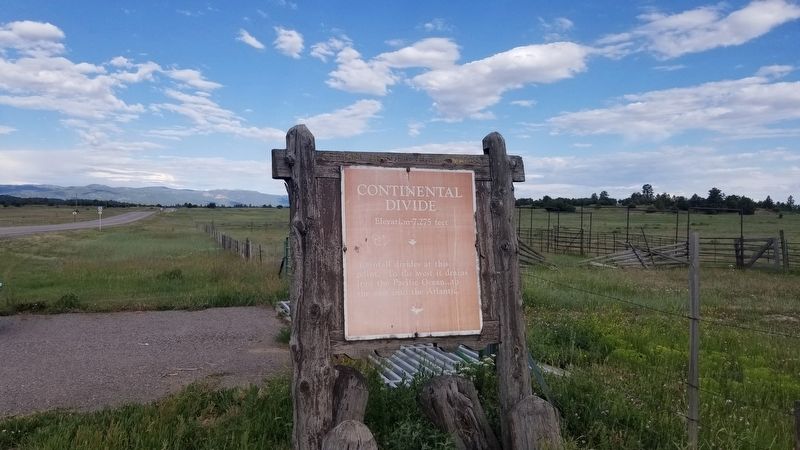
2. Looking toward the east of the Continental Divide Marker
Photographed by James Hulse, July 3, 2021
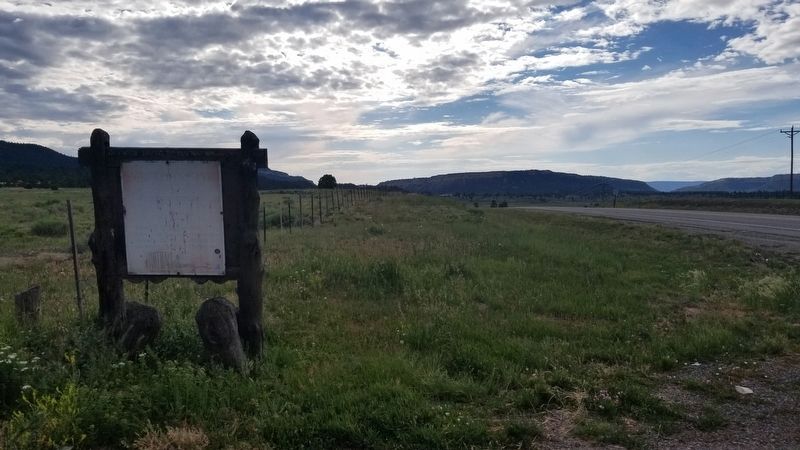
3. Looking to the west of the Continental Divide Marker (reverse side)
The letters on the marker are not legible on the reverse side
Credits. This page was last revised on September 3, 2021. It was originally submitted on July 17, 2021, by James Hulse of Medina, Texas. This page has been viewed 831 times since then and 101 times this year. Photos: 1, 2, 3. submitted on July 17, 2021, by James Hulse of Medina, Texas.
