Mukilteo in Snohomish County, Washington — The American West (Northwest)
Tradition of Carving
Mulkilteo Walking Tour Stop 3
Photographed by William Fischer, Jr., July 29, 2021
1. Tradition of Carving Marker
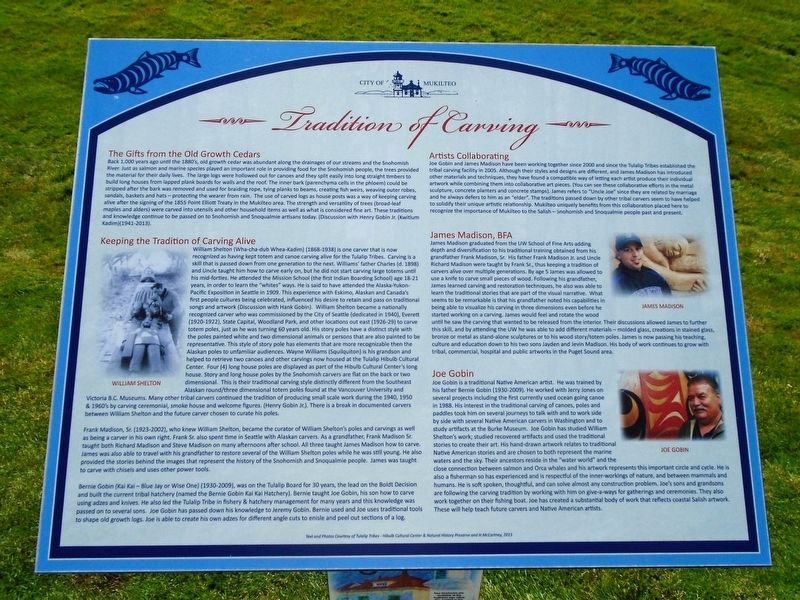
The Gifts from the Old Growth Cedars
Back 1,000 years ago until the 1880’s, old growth cedar was abundant along the drainages of our streams and the Snohomish River. Just as salmon and marine species played an important role in providing food for the Snohomish people, the trees provided the material for their daily lives. The large logs were hollowed out for canoes and they split easily into long straight timbers to build long houses from lapped plank boards for walls and the roof. The inner bark (parenchyma cells in the phloem) could be stripped after the bark was removed and used for braiding rope, typing planks to beams, creating fish weirs, weaving outer robes, sandals, baskets and hats – protecting the wearer from rain. The use of carved logs as house posts was a way of keeping carving alive after the signing of the 1855 Point Elliott Treaty in the Mukilteo area. The strength and versatility of trees (broad-leaf maples and alders) were carved into utensils and other household items as well as what is considered fine art. These traditions and knowledge continue to be passed on to Snohomish and Snoqualmie artisans
this page online
Keeping the Tradition of Carving Alive
William Shelton (Wha-cha-bud Whea-Kadim) (1868-1938) is one carver that is now recognized as having kept totem and canoe carving alive for the Tulalip Tribes. Carving is a skill that is passed down from one generation to the next. Williams’ [sic] father Charles (d. 1898) and Uncle taught him how to carve early on, but he did not start carving large totems until his mid-forties. He attended the Mission School (the first Indian Boarding School) age 18-21 years, in order to learn the “whites” ways. He is said to have attended the Alaska-Yukon-Pacific Exposition in Seattle in 1909. This experience with Eskimo, Alaskan and Canada’s first people cultures being celebrated, influenced his desire to retain and pass on traditional song and artwork (Discussion with Hank Gobin). William Shelton became a nationally recognized carver who was commissioned by the City of Seattle (dedicated in 1940), Everett (1920-1922), State Capital [sic], Woodland Park, and other locations out east (1926-29) to carve totem poles, just as he was turning 60
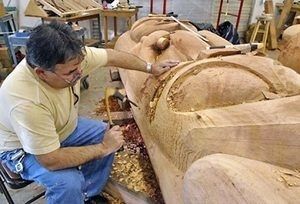
via Seattle Times, 2007
2. " Tulalips shape cultural revival "
Seattle Times website entry
Click for more information.
Click for more information.
Frank Madison, Sr. (1923-2002), who knew William Shelton,
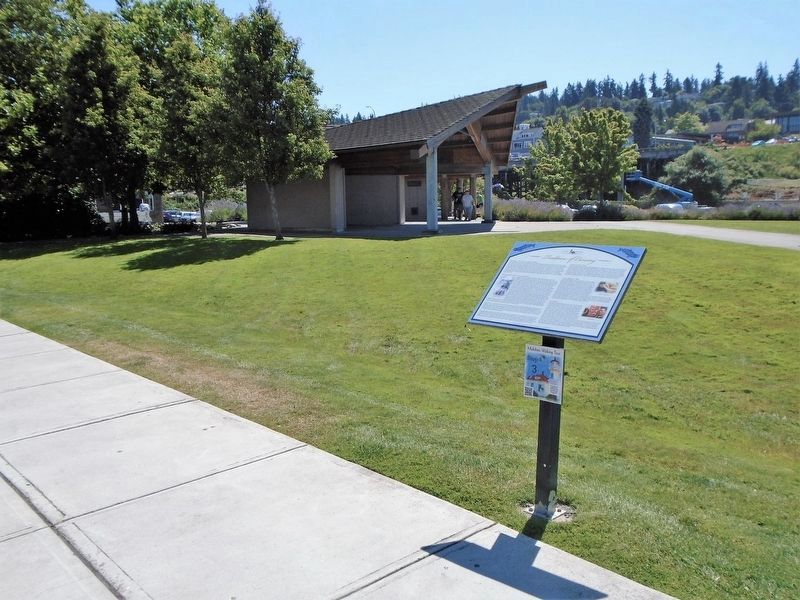
Photographed by William Fischer, Jr., July 29, 2021
3. Tradition of Carving Marker
Bernie Gobin (Kai Kai – Blue Jay or Wise One) (1930-2009), was on the Tulalip Board for 30 years, the lead on the Bold Decision and built the current tribal hatchery (named the Bernie Gobin Kai Kai Hatchery). Bernie taught Joe Gobin, his son[,] how to carve using adzes and knives. He also led the Tulalip Tribe in fishery & hatchery management for many years and this knowledge was passed on to several sons. Joe Gobin has passed down his knowledge to Jeremy Gobin. Bernie used and Joe uses traditional tools to shape old
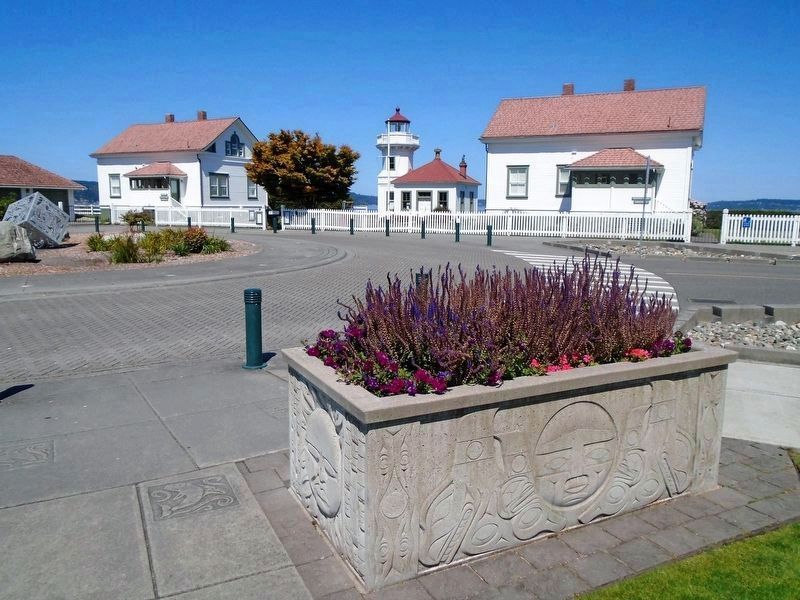
Photographed by William Fischer, Jr., July 29, 2021
4. James Madison Artwork
As mentioned on marker. Mukilteo Lighthouse in background.
Artists Collaborating
Joe Gobin and James Madison have been working together since 2000 and since the Tulalip Tribes established the tribal carving facility in 2005. Although their styles and designs are different, and James Madison has introduced other materials and techniques, they have found a compatible way of letting each artist produce their individual artwork while combining them into collaborative art pieces. (You can see these collaborative efforts in the metal sculpture, concrete planters and concrete stamps). James refers to “Uncle Joe” since they are related by marriage and he always defers to him as an “elder”. The traditions passed down by other tribal carvers seem to have helped to solidify their unique artistic relationship. Mukilteo uniquely benefits from this collaboration placed here to recognize the importance of Mukilteo to the Salish-Snohomish and Snoqualmie people past and present.
James Madison, BFA
James Madison graduated from the UW School of Fine Arts adding depth and diversification to his traditional training obtained from his grandfather Frank Madison, Sr. His father Frank Madison, Jr. and Uncle Richard Madison were taught by Frank Sr., thus keeping a tradition of carvers alive over multiple generations. By age 5 James was allowed to use a knife to carve small pieces of wood. Following his grandfather, James learned carving and restoration techniques, he also was able to learn the traditional stories that are part of the visual narrative. What seems to be remarkable is that his grandfather noted his capabilities in being able to visualize his carvings in three dimensions even before he started working on a carving. James would feel and rotate the wood until he saw the carving that wanted to be released from the interior. Their discussions allowed James to further this skill, and by attending the UW he was able to add different materials – molded glass, creations in stained glass, bronze or metal as stand-alone sculptures or to his wood story/totem poles. James in now passing his teaching, culture and education down to his two sons Jayden and Jevin Madison. His body of work continues to grow with tribal, commercial, hospital and public artworks in the Puget Sound area.
Joe Gobin
Joe Gobin is a traditional Native American artist. He was trained by his father Bernie Gobin (1930-2009). He worked with Jerry Jones on several projects including the first currently used ocean going canoe in 1988. His interest in the traditional carving of canoes, poles and paddles took him on several journeys to talk with and to work side by side with several Native American carvers in Washington and to study artifacts at the Burke Museum. Joe Gobin has studied William Shelton’s work; studied recovered artifacts and used the traditional stories to create their art. His hand-drawn artwork relates to traditional Native American stories and are chosen to both represent the marine world and the sky. Their ancestors reside in the “water world” and the close connection between salmon and Orca whales and his artwork represents this important circle and cycle. He is also a fisherman so has experienced and is respectful of the inner-workings of nature, and between mammals and humans. He is soft spoken, thoughtful, and can solve almost any construction problem. Joe’s sons and grandsons are following the carving tradition by working with him on give-a-ways for gatherings and ceremonies. They also work together on their fishing boat. Joe has created a substantial body of work that reflects coastal Salish artwork. These will help teach future carvers and Native American artists.
Erected by City of Mukilteo.
Topics. This historical marker is listed in these topic lists: Anthropology & Archaeology • Arts, Letters, Music • Indigenous Peoples and Communities. A significant historical year for this entry is 1855.
Location. 47° 56.903′ N, 122° 18.338′ W. Marker is in Mukilteo, Washington, in Snohomish County. It is on Front Street, on the left when traveling west. Marker is at Mulkilteo Lighthouse Park, near the pavilion, and southeast of the lighthouse. Touch for map. Marker is at or near this postal address: 609 Front Street, Mukilteo WA 98275, United States of America. Touch for directions.

Regionally, this marker is in the Puget Sound Region and in Greater Seattle. It is also on the American Pacific Coast, in the Pacific Northwest, and in the Lewis & Clark Corridor. Globally, it is in North America, in the Cascade Range, in the Inside Passage, on the Ring of Fire, on the Pacific Rim, in the Western Hemisphere, in the Western World, and in the Anglosphere.
Other nearby markers. At least 8 other markers are within walking distance of this marker: Point Elliott Treaty (a few steps from this marker); Native Americans (a few steps from this marker); a different marker also named Point Elliott Treaty (a few steps from this marker); Light Station and Park (within shouting distance of this marker); Early Explorers (within shouting distance of this marker); Geology of Mukilteo (within shouting distance of this marker); The Keeper's House (within shouting distance of this marker); Mukilteo Light Station (within shouting distance of this marker). Touch for a list and map of all markers in Mukilteo.
Also see . . .
1. Releasing the Forms Within: James Madison, Storyteller and Craftsman. (Submitted on August 4, 2021, by William Fischer, Jr. of Reynoldsburg, Ohio.)
2. Cultural teachings continue with new story poles at Tulalip (2016). (Submitted on August 4, 2021, by William Fischer, Jr. of Reynoldsburg, Ohio.)
3. Coast Salish tribal culture alive at new Mukilteo ferry terminal (2019). (Submitted on August 4, 2021, by William Fischer, Jr. of Reynoldsburg, Ohio.)
Credits. This page was last revised on January 1, 2026. It was originally submitted on August 4, 2021, by William Fischer, Jr. of Reynoldsburg, Ohio. This page has been viewed 618 times since then and 44 times this year. Photos: 1. submitted on August 4, 2021, by William Fischer, Jr. of Reynoldsburg, Ohio. 2. submitted on October 10, 2021, by Larry Gertner of New York, New York. 3, 4. submitted on August 4, 2021, by William Fischer, Jr. of Reynoldsburg, Ohio.
