Tuscumbia in Miller County, Missouri — The American Midwest (Upper Plains)
Miller County

Photographed by Cosmos Mariner, August 16, 2021
1. Miller County Marker (side 1)
[side 1]
Here in Missouri's central Ozarks, Miller County was organized 1837, and named for Mo. Gov. John Miller. In territory ceded by Osage (French pronunciation for Wazhazhe Indians) 1808, the county was first settled 1807, by William West. Early pioneers were from Ky., Tenn., and Va. Two major Indian trails ran through the county.
Tuscumbia, the county seat, was laid out 1837, and named for Tuscumbia (Chickasaw for Warrior Who Kills), Ala. The town site, given by J. B. and J. P. Harrison, had been an Indian trading camp. On scenic Osage River bluffs, below Bagnell Dam, the town was once a noted Osage River port and a number of steamboats were built there.
In the Civil War, minor skirmishes and guerrilla raids halted county growth. From the 1870's to the early 1900's, lead mining, first begun in 1850's, was carried on and the vast timber resources were harvested. In 1882, a branch of the Mo. Pac. R. R. was built to Bagnell, then a leading railroad tie shipping point. In 1903, today's Chicago, Rock Island and Pacific Railroad was built through northern Miller County.
[side 2]
Miller County, through which flows the Osage
this page online
Iberia, south of the Osage, laid out 1860, was the home of Iberia (Congregational) Academy, later a junior college, 1890-1951, established by G. Byron and Mable (White) Smith. Other county towns include Ulman, settled in 1840's; Brumley and St. Elizabeth, founded in 1870's; Olean and Eldon, resort town and railroad center, 1882; Etterville and Kaiser, early 1900's; Lake Ozark, 1932. Early schools were Miller County Institute at Spring Garden, 1870; Miller Co. Academy at Aurora Springs, 1881; Eldon Academy, 1886.
Of interest are Bagnell Dam; Lake of the Ozarks State Park in Miller and Camden counties, founded 1935; Aurora Springs, noted spa of late 1800's, and Stark Caverns, both near Eldon; and Wilson's Cave near Iberia.
Erected 1961 by State Historical Society of Missouri; and State Highway Commission.

Photographed by Cosmos Mariner, August 16, 2021
2. Miller County Marker (side 2)
Topics and series. This historical marker is listed in these topic lists: Indigenous Peoples and Communities • Industry & Commerce • Settlements & Settlers • Waterways & Vessels. In addition, it is included in the Missouri, The State Historical Society of series list. A significant historical date for this entry is February 6, 1837.
Location. 38° 15.127′ N, 92° 28.325′ W. Marker is in Tuscumbia, Missouri, in Miller County. It is on State Highway 52 0.4 miles west of Catfish Road, on the left when traveling west. Marker is located in a pull-out on the south side of Missouri Highway 52. Touch for map. Marker is in this post office area: Tuscumbia MO 65082, United States of America. Touch for directions.

Regionally, this marker is in the American Midwest, in the Lewis & Clark Corridor, and in the Corn Belt. Globally, it is in North America, the Western Hemisphere, the Western World, and the Anglosphere. Historically, it finds itself in what was once the territory of the Mississippian Culture, the Louisiana Purchase, and the Antebellum South.
Other nearby markers. At least 2 other markers are within 10 miles of this marker,
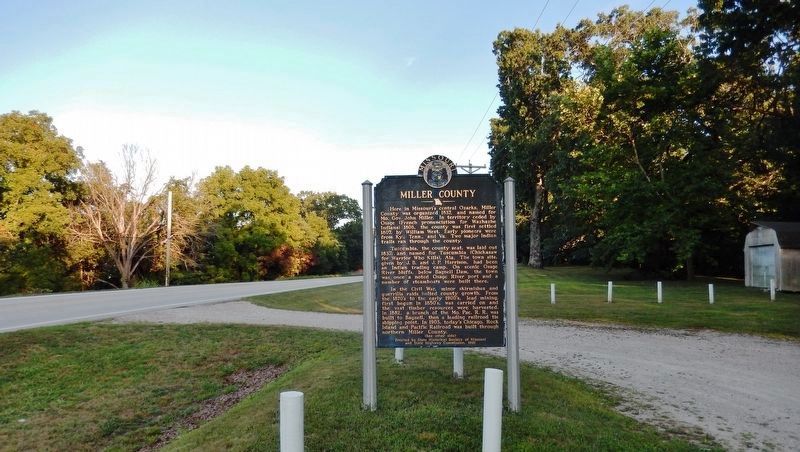
Photographed by Cosmos Mariner, August 16, 2021
3. Miller County Marker
Also see . . .
1. Tuscumbia. (This link presents various interesting historical Miller County photos.) Tuscumbia, founded along the Osage River's banks, quickly spread up the adjoining hillside and split into four topographical regions. The top of the bluff, known as "Crackerneck," gave way to "The Hill", which in turn tumbled down to "Goose Bottom" and "Possum Flat" along the river's edge. Steps were built by residents to join the portion of the town on top of the hill with the older and lower section which flooded on a frequent basis. (Submitted on August 18, 2021, by Cosmos Mariner of Cape Canaveral, Florida.)
2. Miller County Courthouses. The first courthouse was built by John Davis under the supervision of Hardin M Williams in 1839 to 1841 at a cost of $199. The cost of construction of the second courthouse in 1857 was $6,000. The current courthouse was completed in 2003. (Submitted on August 18, 2021, by Cosmos Mariner of Cape Canaveral, Florida.)

Photographed by Cosmos Mariner, August 16, 2021
4. Old Miller County Courthouse (1859)

Photographed by Cosmos Mariner, August 16, 2021
5. Miller County Courthouse (2003)
Credits. This page was last revised on September 3, 2021. It was originally submitted on August 18, 2021, by Cosmos Mariner of Cape Canaveral, Florida. This page has been viewed 1,301 times since then and 137 times this year. Photos: 1, 2, 3, 4, 5. submitted on August 18, 2021, by Cosmos Mariner of Cape Canaveral, Florida.
