West Potomac Park in Southwest Washington in Washington, District of Columbia — The American Northeast (Mid-Atlantic)
John Ericsson Memorial
National Mall & Memorial Parks, Washington, D.C.
| — | National Park Service, U.S. Department of the Interior | — |
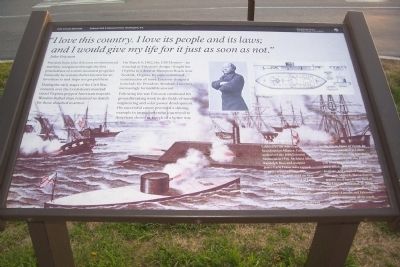
Photographed by Richard E. Miller, April 16, 2009
1. John Ericsson Memorial Marker
“I love this country. I love its people and its laws, and I would give my life for it just as soon as not.”
John Ericsson.
Swedish-born John Ericsson revolutionized maritime navigation through the first practical use of a stern-mounted propeller. Ironically, he remains better known for an invention to sink ships not propel them.
During the early stages of the Civil War, concern over the Confederate iron-clad vessel Virginia gripped American seaports. Wooden-hulled ships remained no match for those sheathed in armor.
On March 9, 1862, the USS Monitor–an ironclad of Ericsson’s design–fought the Virginia to a draw at Hampton Roads near Norfolk, Virginia. Its success initiated construction of more Ericsson-designed ironclads President Abraham Lincoln’s increasingly formidable arsenal.
Following the war, Ericsson continued his ground-breaking work in the fields of naval engineering and solar power development. His successful provided a shining example of immigrants who journeyed to American shores in search of a better way of life.
The Memorial
Lobbied by the American Scandinavian Alliance, Congress authorized the John Ericsson Memorial in 1916. Architect Albert Randolph Ross and sculptor James Earle Fraser were tapped to be its creative forces. The memorial was dedicated on May 29, 1926, before a crowd of 5,000, which included President Calvin Coolidge and Swedish Crown Prince Gustav Adolf. Frasier’s sculpture embodies Ericsson seated in deep thought, shadowed by the female figure of Vision, an American ironworker as Labor, and a Viking warrior as Adventure. At their back stands the tree of life from Norse mythology. All are symbols of Ericsson’s genius, heritage, and adopted homeland. The pink Milford, Massachusetts used here is also used in the Lincoln Memorial. In fitting tribute, these two guardians of the Union – Lincoln and Ericsson – together maintain silent watch along the Potomac River.
Erected by National
this page online
Topics and series. This historical marker and memorial is listed in these topic lists: Industry & Commerce • War, US Civil • Waterways & Vessels. In addition, it is included in the Former U.S. Presidents: #30 Calvin Coolidge series list. A significant historical month for this entry is March 1876.
Location. Marker is missing. It was located near 38° 53.207′ N, 77° 2.995′ W. Marker was in Southwest Washington in Washington, District of Columbia. It was in West Potomac Park. It was on Ohio Drive Southwest south of Independence Avenue Southwest, on the right when traveling north. The memorial on an island in the middle of Ohio Drive in West Potomac Park, one blocks south of the Lincoln Memorial. The marker is accessible to pedestrians on the east side of Ohio Drive, just south of Independence Avenue. Touch for map. Marker was at or near this postal address: 2912 Independence Ave SW, Washington DC 20037, United States of America. Touch for directions.

Regionally, this marker and memorial was in the Washington Metropolitan Area. It was also in the American Northeast, in the Upper South,
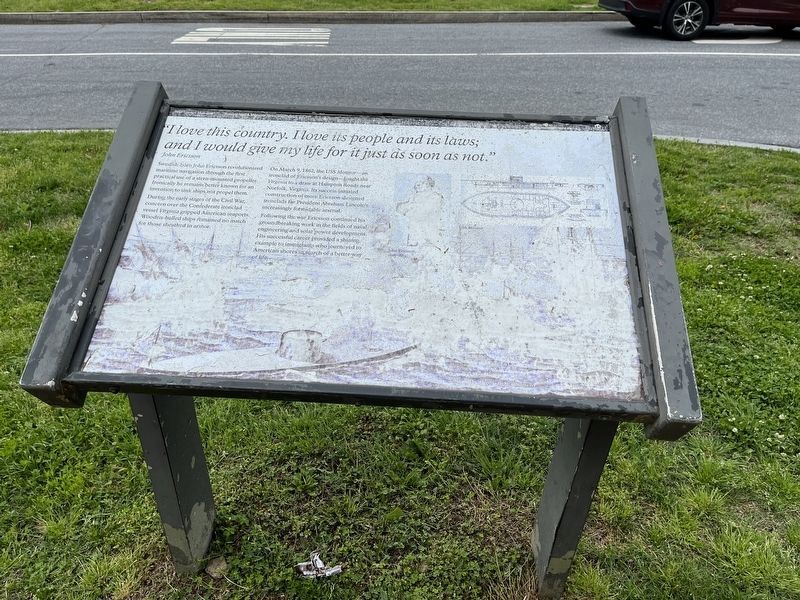
Photographed by Devry Becker Jones (CC0), May 8, 2022
2. John Ericsson Memorial
Unfortunately the marker has weathered significantly.
Other nearby markers. At least 8 other markers are within walking distance of this location: John Ericsson (a few steps from this marker); Half a World Away (about 600 feet away, measured in a direct line); The Cost of Freedom (about 700 feet away); Temple of Democracy (about 800 feet away); Korean War Veterans Memorial (approx. 0.2 miles away); Lincoln Memorial (approx. 0.2 miles away); Not Forgotten (approx. 0.2 miles away); Alaska and Hawaii (approx. 0.2 miles away). Touch for a list and map of all markers in Southwest Washington.
More about this marker. The marker displays a portrait of John Ericsson 1803-1889, a blueprint of the USS Monitor and a background painting of the Battle of Hampton Roads.
Also see . . . John Ericsson. The American Society of Mechanical Engineers website entry (Submitted on July 16, 2021, by Larry Gertner of New York, New York.)
Additional commentary.
1. Marker is no longer there
I noticed when visiting
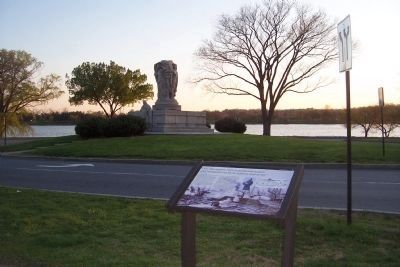
Photographed by Richard E. Miller, April 16, 2009
3. John Ericsson Memorial Marker
with the memorial in the background, on its island in Ohio Drive.
— Submitted April 28, 2025, by Jason Voigt of Glen Carbon, Illinois.
Additional keywords. U.S. Navy; Swedish Americans.
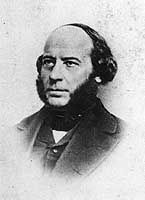
Photographed by Matthew Brady, 1863
4. John Ericsson
Naval Historical Center, online library.

Photographed by Jason Voigt, April 2, 2025
5. John Ericsson Memorial
marker looks to have been damaged
Credits. This page was last revised on April 28, 2025. It was originally submitted on April 16, 2009, by Richard E. Miller of Oxon Hill, Maryland. This page has been viewed 3,074 times since then and 56 times this year. Photos: 1. submitted on April 16, 2009, by Richard E. Miller of Oxon Hill, Maryland. 2. submitted on May 8, 2022, by Devry Becker Jones of Washington, District of Columbia. 3, 4. submitted on April 16, 2009, by Richard E. Miller of Oxon Hill, Maryland. 5. submitted on April 28, 2025, by Jason Voigt of Glen Carbon, Illinois. • Craig Swain was the editor who published this page.
