Tinbridge Hill in Lynchburg, Virginia — The American South (Mid-Atlantic)
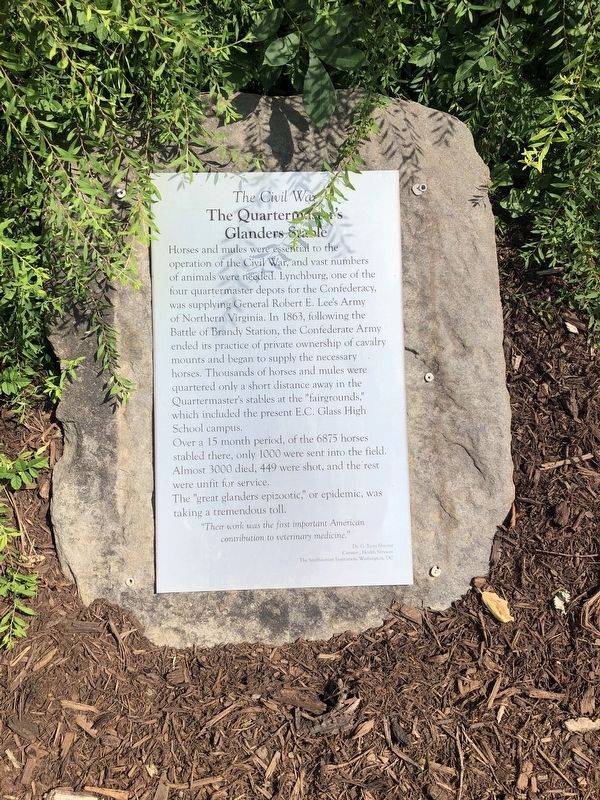
The Quartermaster's Glanders Stable
The Civil War
Photographed by Devry Becker Jones (CC0), August 14, 2021
1. The Quartermaster's Glanders Stable Marker
Horses and mules were essential to the operation of the Civil War, and vast numbers of animals were needed. Lynchburg, one of the four quartermaster depots for the Confederacy, was supplying General Robert E. Lee's Army of Northern Virginia. In 1863, following the Battle of Brandy Station, the Confederate Army ended its practice of private ownership of cavalry mounts and began to supply the necessary horses. Thousands of horses and mules were quartered only a short distance away in the Quartermaster's stables at the "fairgrounds," which included the present E.C. Glass High School campus.
Over a 15 month period, of the 6875 horses stabled there, only 1000 were sent into the field. Almost 3000 died, 449 were shot, and the rest were unfit for service.
The "great glanders epizootic," or epidemic, was taking a tremendous toll.
"Their work was the first important American contribution to veterinary medicine."
Dr. G. Terry Sharrer
Curator, Health Services
The Smithsonian Institution, Washington, DC
The Research
Dr. John Jay Terrell and Dr. James G. Page, two of the physicians attending the wounded and sick
this page online
In what was considered a landmark study of early pathological experimentation, Drs. Terrell and Page studied 19 horses stricken with glanders, conducting postmortem examinations at various stages of the disease's progression. They also were able to transmit the disease intentionally from a diseased horse to a sound one, sacrificing the animal 33 days later to study his advanced and terminal symptoms. The researchers' results and recommendations were published in 1864 in a pamphlet, Glanders and Farcy in Horses, which was distributed by the Confederate authorities to all of its facilities for quartering horses or mules.
The Results
It was concluded that this glanders disease, which caused major respiratory distress
![The Quartermaster's Glanders Stable Marker [The Research panel] image. Click for full size.](Photos6/604/Photo604715.jpg?8192021110400AM "The Quartermaster's Glanders Stable Marker [The Research panel]. Click for full size.")
Photographed by Devry Becker Jones (CC0), August 14, 2021
2. The Quartermaster's Glanders Stable Marker [The Research panel]
Horses use the nose and the sense of smell to identify and to communicate with one another. Thus the nose played host to a sense vital in their daily lives and can likewise serve as host to such a deadly virus. Therefore, the doctors strongly recommended that the animals not use communal watering troughs.
When the Civil War ended, so did the need to quarter such large numbers of horses and mules together. Glanders was no longer an epidemic. The historic first steps in veterinary medicine, so similar to Dr. Terrell's innovations in the treatment of smallpox in the Pest House, attest to a local medical legacy of great importance.
Topics. This historical marker
![The Quartermaster's Glanders Stable Marker [The Results panel] image. Click for full size.](Photos6/604/Photo604716.jpg?8192021110500AM "The Quartermaster's Glanders Stable Marker [The Results panel]. Click for full size.")
Photographed by Devry Becker Jones (CC0), August 14, 2021
3. The Quartermaster's Glanders Stable Marker [The Results panel]
Location. 37° 24.835′ N, 79° 9.435′ W. Marker is in Lynchburg, Virginia. It is in Tinbridge Hill. It can be reached from Wise Street 0.1 miles north of 4th Street, on the right when traveling south. Touch for map. Marker is at or near this postal address: 401 Taylor St, Lynchburg VA 24501, United States of America. Touch for directions.

Regionally, this marker is in Central Virginia. It is also in the American South and specifically in the Upper South. Globally, it is in North America, the Western Hemisphere, the Western World, and the Anglosphere. Historically, it finds itself in what was once the territory of the Mississippian Culture, one of the original Thirteen Colonies, one of the Confederate States of America, and the Antebellum South.
Other nearby markers. At least 8 other markers are within walking distance of this marker: Stone Watering Trough (here, next to this marker); Glanders (here, next to this marker); Site of Glanders Stable (a few steps from this marker); Ivy Chapel Union Church
Photographed by Devry Becker Jones (CC0), August 14, 2021
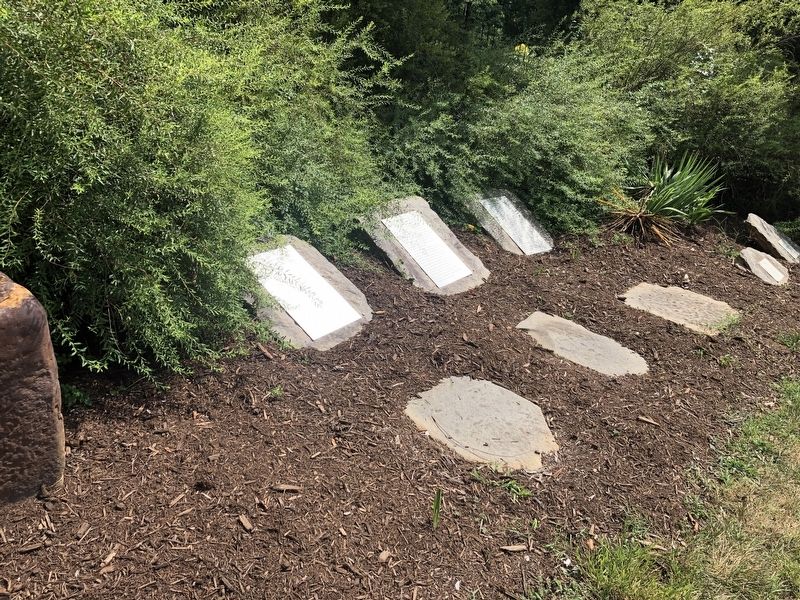
4. The Quartermaster's Glanders Stable Marker panels
Another marker is no longer nearby. The Quartermaster’s Glanders Stable (was a few steps from this marker but has been replaced with another marker now near it).
Related marker. Click here for another marker that is related to this marker. This marker has replaced the linked marker. This new marker has a subtitle and an additional quotation that were not present on the original marker.
Credits. This page was last revised on February 1, 2023. It was originally submitted on August 19, 2021, by Devry Becker Jones of Washington, District of Columbia. This page has been viewed 279 times since then and 26 times this year. Photos: 1, 2, 3, 4. submitted on August 19, 2021, by Devry Becker Jones of Washington, District of Columbia.
