Roanoke Rapids in Halifax County, North Carolina — The American South (South Atlantic)
Roanoke Canal
"The importance … is evident"
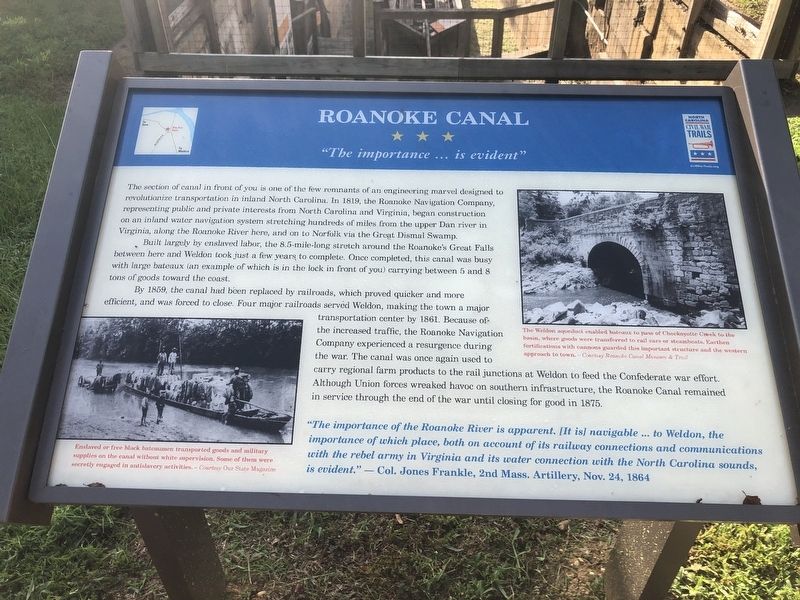
The section of canal in front of you is one of the few remnants of an engineering marvel designed to revolutionize transportation in inland North Carolina. In 1819, the Roanoke Navigation Company, representing public and private interests from North Carolina and Virginia, began construction on an inland water navigation system stretching hundreds of miles from the upper Dan river in Virginia, along the Roanoke River here, and on to Norfolk via the Great Dismal Swamp.
Built largely by enslaved labor, the 8.5-mile-long stretch around the Roanoke's Great Falls between here and Weldon took just a few years to complete. Once completed, this canal was busy with large bateaux (an example of which is in the lock in front of you) carrying between 5 and 8 tons of goods toward the coast.
By 1859, the canal had been replaced by railroads, which proved quicker and more efficient, was forced to close. Four major railroads served Weldon, making the town a major transportation center by 1861. Because of the increased traffic, the Roanoke Navigation Company experienced a resurgence during the war. The canal was once again used to
this page online
"The importance of the Roanoke River is apparent. [It is] navigable … to Weldon, the importance of which place, both on account of its railway connections and communications with the rebel army in Virginia and its water connection with the North Carolina sounds, is evident." — Col. Jones Frankle, 2nd Mass. Artillery, Nov. 24, 1864
[Captions:]
The Weldon aqueduct enabled bateaux to pass of Chockoyette Creed to the basin, where goods were transferred to rail cars or steamboats. Earthen fortifications with cannons guarded this important structure and the western approach to town.
Enslaved or free black bateaumen transported goods and military supplies on the canal without white supervision. Some of them were secretly engaged in antislavery activities.
Erected by North Carolina Civil War Trails.
Topics and series. This historical marker is listed in these
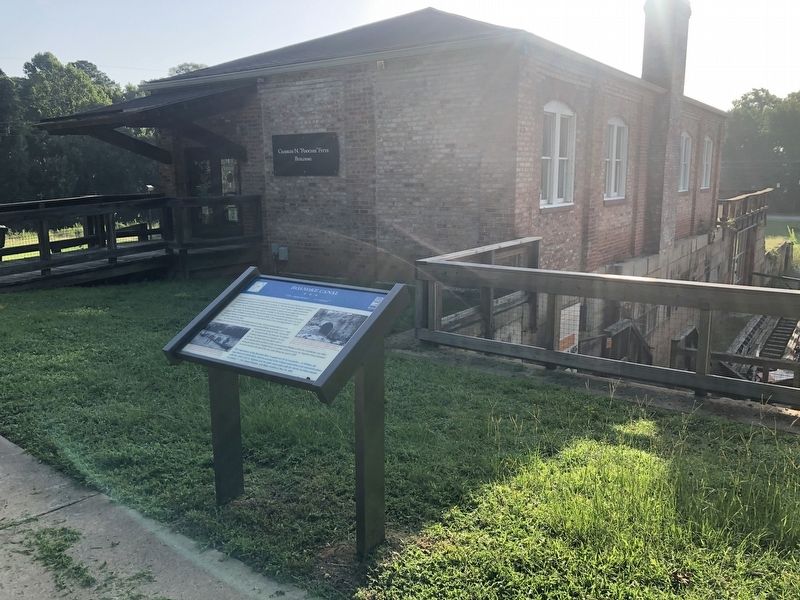
Location. 36° 28.482′ N, 77° 38.907′ W. Marker is in Roanoke Rapids, North Carolina, in Halifax County. It is on Jackson Street Extended (County Road 1464) 0.1 miles west of Roanoke Avenue (State Highway 48), on the right when traveling west. Touch for map. Marker is at or near this postal address: 15 Jackson St, Roanoke Rapids NC 27870, United States of America. Touch for directions.

Regionally, this marker is in the Coastal Plain. It is also in the American South and specifically in the Upper South. Globally, it is in North America, the Western Hemisphere, the Western World, and the Anglosphere. Historically, it finds itself in what was once the territory of the Mississippian Culture, one of the original Thirteen Colonies, one of the Confederate States of America, and the Antebellum South.
Other nearby markers. At least 8 other markers are within walking distance of this marker: The Batteauxmen
Photographed by Devry Becker Jones (CC0), August 27, 2021
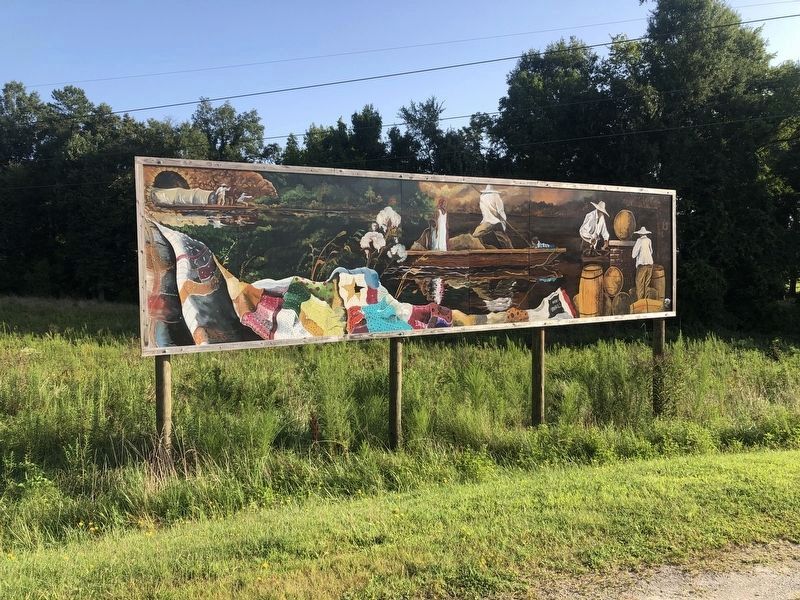
3. Nearby mural showing bateaumen on the canal
Another marker is no longer nearby. Roanoke Canal (was within shouting distance of this marker but has been confirmed missing).
Credits. This page was last revised on November 26, 2021. It was originally submitted on August 28, 2021, by Devry Becker Jones of Washington, District of Columbia. This page has been viewed 383 times since then and 18 times this year. Photos: 1, 2, 3. submitted on August 28, 2021, by Devry Becker Jones of Washington, District of Columbia.
