Near Richmond in Henrico County, Virginia — The American South (Mid-Atlantic)
Battle of New Market Heights
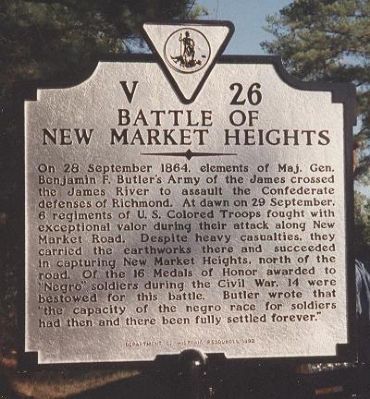
Photographed by Richard E. Miller, circa 1997
1. Battle of New Market Heights Marker
Erected 1993 by Va. Dept. of Historic Resources. (Marker Number V-26.)
Topics and series. This historical marker is listed in these topic lists: African Americans • Civil Rights • War, US Civil. In addition, it is included in the Virginia Department of Historic Resources (DHR) series list. A significant historical date for this entry is September 28, 1864.
Location. 37° 25.872′ N, 77° 19.067′ W. Marker is near Richmond, Virginia, in Henrico County. It is at the intersection of New Market Road (Scenic
this page online

Regionally, this marker is in the Piedmont and in Central Virginia. It is also in the American South, specifically in the Upper South, and on the Eastern Seaboard. Globally, it is in the North Atlantic Region, North America, the Western Hemisphere, the Western World, and the Anglosphere. Historically, it finds itself in what was once the territory of the Mississippian Culture, one of the original Thirteen Colonies, one of the Confederate States of America, and the Antebellum South.
Other nearby markers. At least 8 other markers are within walking distance of this marker: The War of 1812 / Richmond's War of 1812 Defensive Camps (within shouting distance of
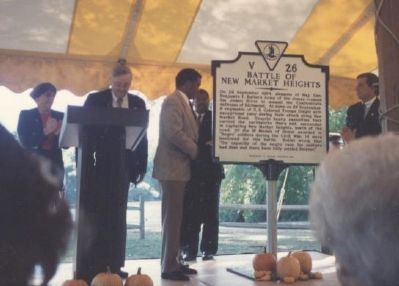
Photographed by Richard E. Miller
2. Unveiling Ceremony, Deep Bottom Park, Varina, 1993.
Col. William DeShields (U.S. Army, Ret.), president of the Black Military History Institute of America - the organization responsible for the marker's creation - assists with the unveiling prior to its actual installation on New Market Road.
Another marker is no longer nearby. New Market Heights (was approx. 0.7 miles away but has been replaced with another marker now near it).
More about this marker. The battle of New Market Heights is described in signage with greater detail about three miles to the south in the Deep Bottom County Park where the Army of the James launched its attack on 28 September 1864.
The marker was placed at the initiative of the Black Military History Institute.
Regarding Battle of New Market Heights. In addition to the 16 soldiers mentioned on the marker, eight Black U.S. sailors also received the Medal of Honor during the Civil War. And in 2001, Corporal
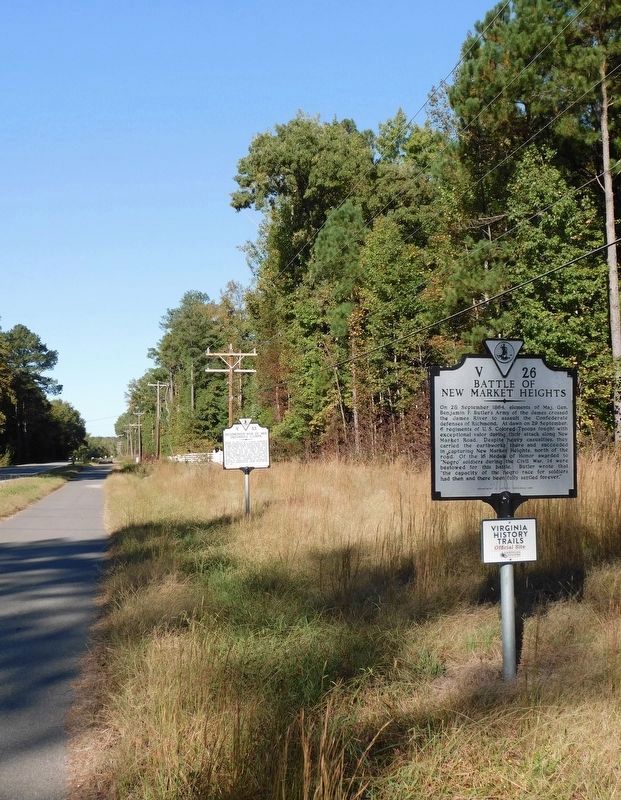
Photographed by Bradley Owen, October 18, 2021
3. Battle of New Market Heights Marker
View is looking to the west.
Related markers. Click here for a list of markers that are related to this marker. To better understand the relationship, study each marker in the order shown.
Also see . . . Wikipedia entry for The Battle of Chaffin's Farm. Describes the overall battle of which the assault on New Market Heights was part. (Submitted on January 26, 2008, by Richard E. Miller of Oxon Hill, Maryland.)
Additional keywords. USCT, Chaffin's Farm, United States Colored Troops, Fort Gilmer, Fort Harrison.
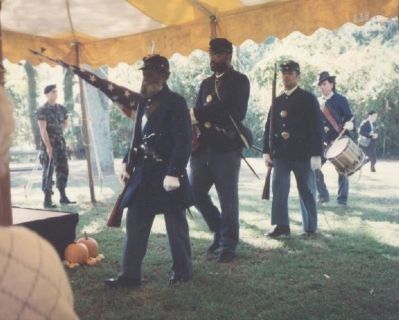
Photographed by Richard E. Miller, 1993
4. Unveiling Ceremony, Deep Bottom Park, Varina, 1993.
Color guard includes USCT re-enactors Alvin Baptiste, Kenneth Brown and Richard Miller.
Credits. This page was last revised on November 15, 2021. It was originally submitted on December 4, 2007, by Richard E. Miller of Oxon Hill, Maryland. This page has been viewed 6,127 times since then and 90 times this year. Last updated on September 9, 2021, by Bradley Owen of Morgantown, West Virginia. Photos: 1. submitted on December 4, 2007, by Richard E. Miller of Oxon Hill, Maryland. 2. submitted on January 26, 2008, by Richard E. Miller of Oxon Hill, Maryland. 3. submitted on November 10, 2021, by Bradley Owen of Morgantown, West Virginia. 4. submitted on January 26, 2008, by Richard E. Miller of Oxon Hill, Maryland. • Bernard Fisher was the editor who published this page.
