
Downtown Juneau in Juneau Borough, Alaska — Northwest (North America)
William Henry Seward

Photographed by Duane and Tracy Marsteller, September 3, 2021
1. William Henry Seward Marker
Family and Early Political Life
William Henry Seward was born in Florida, New York, on May 16, 1801. His father, a wealthy landowner, was a slaveholder prior to New York abolishing slavery in 1827. Seward would later become instrumental in abolishing slavery throughout the United States.
Seward studied law at Union College in Schenectady and in 1822 he passed the New York bar examination. While practicing law with retired judge Elijah Miller in Auburn, he met Miller's daughter, Frances. They married in 1824 and moved into the large Miller House, where they raised five children and lived for the rest of their lives. The house is now the Seward House Museum.
Soon after moving to Auburn, Seward jumped into politics. He won election to the New York state senate and was Governor of New York, before being twice elected to the U.S. Senate.
While serving as U.S. Senator, Seward and his wife Frances, in violation of federal law, established an Underground Railroad safe house in their home, providing shelter for slaves traveling north to freedom. Seward forged a friendship with Harriet Tubman, a former slave and leading operative
this page online
In the National Spotlight
In 1860, Seward was the new Republican Party's presumed nominee for president, but, at the tumultuous party convention in Chicago, he lost to Abraham Lincoln on the third ballot. Seward went on to campaign vigorously for Lincoln, who was elected 16th President of the United States. Lincoln appointed him Secretary of State and Seward soon became Lincoln's closest cabinet adviser. Seward played an important role in the Lincoln cabinet. Seward hoped to preserve the Union and prevent the Civil War, but, following the secession of southern states, both he and Lincoln came to understand that abolition of slavery would be essential to restoring the Union.
Throughout the Civil War, Seward prevented any European country from recognizing the Confederate States as an independent country, possibly preventing a world war. He contributed to the wording and the timing of the Emancipation Proclamation, and later lobbied Congress for passage of the 13th Amendment abolishing slavery.
On the evening

Photographed by Duane and Tracy Marsteller, September 3, 2021
2. William Henry Seward Marker detail
Frances Adeline Miller Seward (left) and William Henry Seward in 1884, by Henry Inman.
Captions
(Left) Portrait of William H. Seward, Secretary of State 1861-69. Image courtesy of Library of Congress cph. Ja23003
Center (top to bottom)
• Seward in 1859
• (left) Frances Adeline Miller Seward in 1844. by Henry Inman; (right) William H. Seward in 1844 by Henry Inman
• Official portrait of New York Governor William H. Seward by Chester Harding
• Seward House in Auburn, New York
• U.S. Pres. Abraham Lincoln and his cabinet, including William Seward (seated second to left), in the council chamber at the White House. Painted by F.B. Carpenter; engraved by A.H. Ritchie, 1866. Library of Congress, Washington, D.C.
(Right, left to right)
•

Chester Harding (via New York State Education Department) / Public domain, 1844
3. William Henry Seward Marker detail (original)
Official portrait of New York's 12th governor, William H. Seward, who was in office 1839-1842.
• Assassination of President Lincoln at Ford's Theatre 1865, H.H. Lloyd & Co. Currer and Ives, New York
This project was funded in part by the Alaska Historical Commission and a Juneau History Grant from the Juneau Douglas City Museum, City and Borough of Juneau and developed by Alaska State Parks.
Topics. This historical marker is listed in these topic lists: Abolition & Underground RR • Government & Politics • War, US Civil. A significant historical date for this entry is May 16, 1801.
Location. 58° 18.099′ N, 134° 24.62′ W. Marker is in Juneau, Alaska, in Juneau Borough. It is in Downtown Juneau. It can be reached from the intersection of Main Street and 4th Street. Marker is in a plaza in front of the Alaska State Capitol. Touch for map. Marker is at or near this postal address: 359 Main St, Juneau AK 99801, United States of America. Touch for directions.

Regionally, this marker is in Southeast Alaska, in Tlingit and Haida & Tsimshian Region. It is also on the American Pacific Coast. Globally, it is in North America, the Inside Passage, the Pacific

Francis B. Carpenter (via Library of Congress) / Public domain, 1864
4. William Henry Seward Marker detail (original)
Print of F.B. Carpenter's The First Reading of the Emancipation Proclamation Before the Cabinet.
Other nearby markers. At least 8 other markers are within walking distance of this marker: Seward & Alaska (here, next to this marker); a different marker also named William Henry Seward (here, next to this marker); Windfall Fisherman (a few steps from this marker); Dimond Courthouse (within shouting distance of this marker); 4-Story Totem (within shouting distance of this marker); Liberty Bell Reproduction (within shouting distance of this marker); Harvesting of the Atom (within shouting distance of this marker); Bishop Michael H. Kenny (within shouting distance of this marker). Touch for a list and map of all markers in Juneau.
Also see . . . “Like the Scenes of Some Hideous Dream”: Lewis Powell’s Assassination Attempt on Secretary of State. Details on the assassination attempt, by Frank Jastrzembski in Emerging Civil War. Posted April 14, 2020. (Submitted on September 13, 2021, by Duane and Tracy Marsteller of Murfreesboro, Tennessee.)
Harper's Weekly (via Seward House Museum) / Public domain
5. William Henry Seward Marker detail (original)
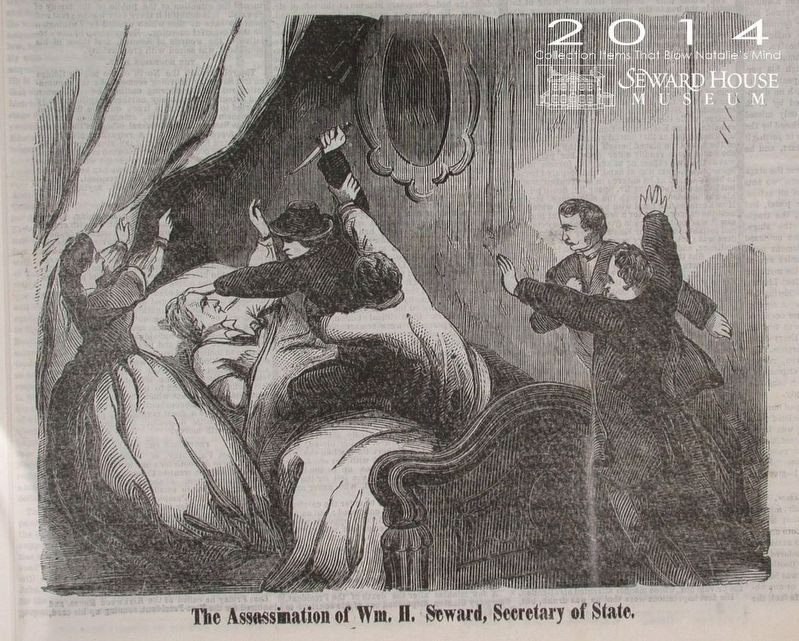
This engraving depicts Lewis Thornton Powell's attempted assassination of Secretary of State William H. Seward on April 4, 1865. Seward was unable to defend himself because he was in bed recuperating from fractures sustained in a carriage accident a week earlier. The attack was thwarted by George Foster Robinson, a U.S. Army sergeant assigned to watch over Seward.
Photographed by Duane and Tracy Marsteller, September 3, 2021
6. William Henry Seward Marker
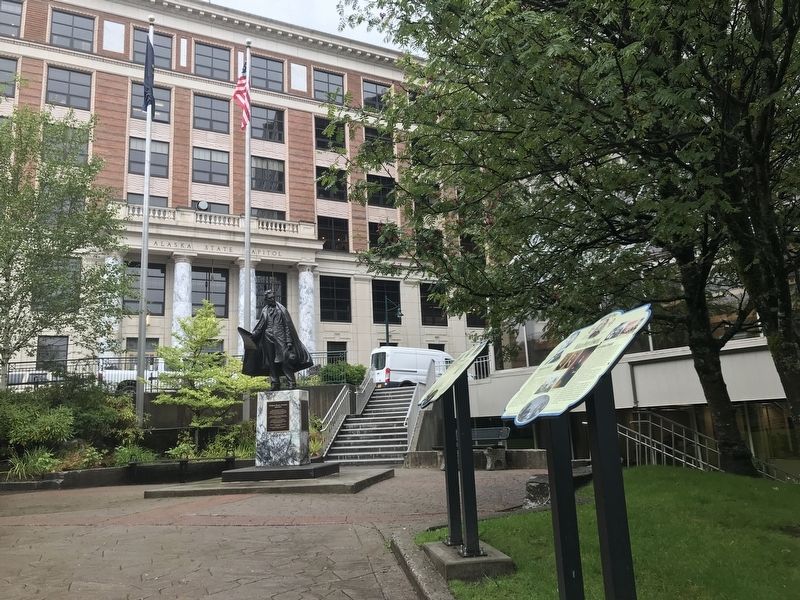
This marker is on the right. A statue of Seward and the Alaska State Capitol are in the background.
Credits. This page was last revised on December 2, 2023. It was originally submitted on September 13, 2021, by Duane and Tracy Marsteller of Murfreesboro, Tennessee. This page has been viewed 829 times since then and 61 times this year. Photos: 1, 2, 3, 4, 5, 6. submitted on September 13, 2021, by Duane and Tracy Marsteller of Murfreesboro, Tennessee.
