Lake View East in Chicago in Cook County, Illinois — The American Midwest (Great Lakes)
Frida Kahlo
| — | The Legacy Walk | — |
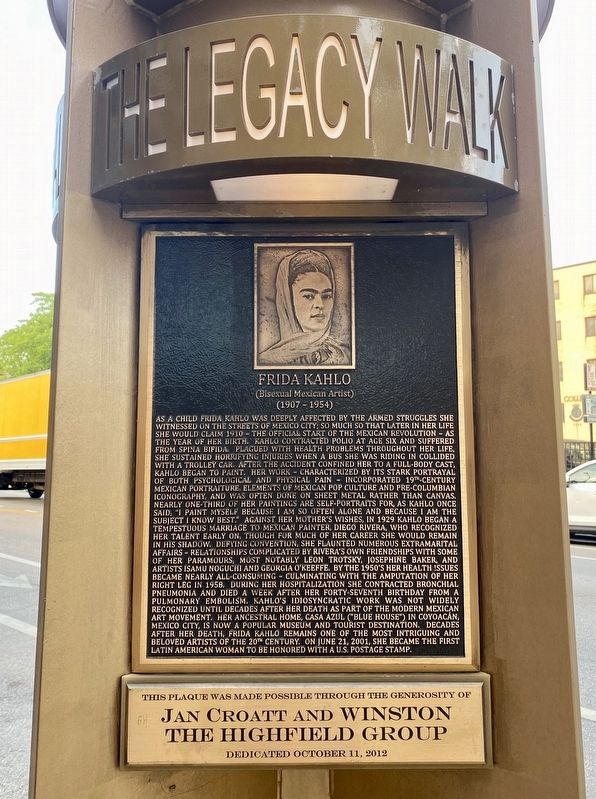
Photographed by Andrew Ruppenstein, August 26, 2021
1. Frida Kahlo Marker
(Bisexual Mexican Artist)
1907 - 1954
this page online
Erected 2012 by The Legacy Project.
Topics and series. This historical marker is listed in these topic lists: Arts, Letters, Music • Hispanic Americans • Women. In addition, it is included in the The Legacy Walk series list. A significant historical date for this entry is July 6, 1907.
Location. 41° 56.802′ N, 87° 38.973′ W. Marker is in Chicago, Illinois, in Cook County. It is in Lake View East. It is on North Halsted Street, on the left when traveling north. Touch for map. Marker is at or near this postal address: 3540 North Halsted, Chicago IL 60657,
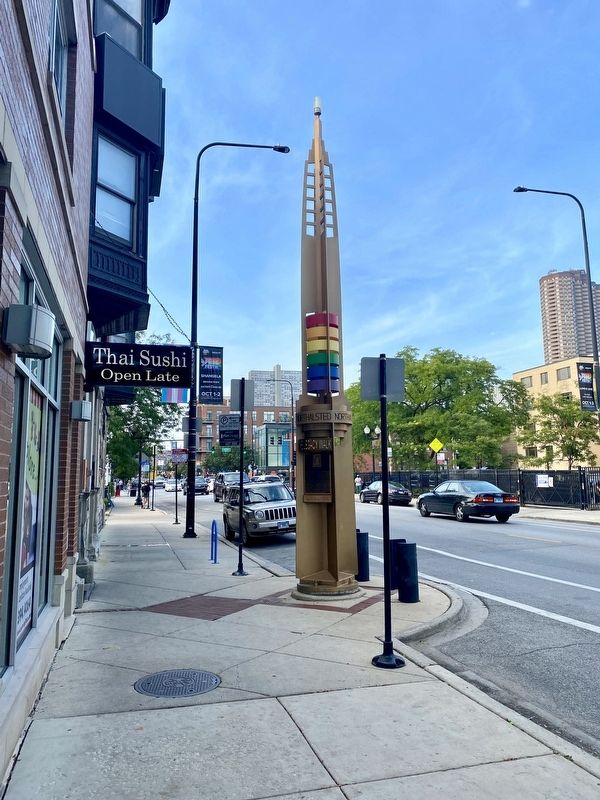
Photographed by Andrew Ruppenstein, August 26, 2021
2. Frida Kahlo Marker - wide view

Regionally, this marker is on Chicago’s North Side. It is also in the American Midwest. Globally, it is in North America, on the Great Lakes, in the Western Hemisphere, in the Western World, and in the Anglosphere. Historically, it finds itself in what was once the Viceroyalty of New France, the territory of the Mississippian Culture, and the Northwest Territory.
Other nearby markers. At least 8 other markers are within walking distance of this marker: Fr. Mychal Judge (here, next to this marker); Alvin Ailey (a few steps from this marker); Ruth Ellis (a few steps from this marker); American Veterans for Equal Rights Military Memorial (about 300 feet away, measured in a direct line); 42nd Precinct/Town Hall Police Station (about 300 feet away); Dr. Tom Waddell (about 300 feet away); Barbara Jordan (about 300 feet away); Two Spirit (about 400 feet away). Touch for a list and map of all markers in Chicago.
Also see . . .
1. Frida Kahlo (Wikipedia).
"Magdalena Carmen Frida Kahlo y Calderón (6 July 1907 – 13 July 1954) was a Mexican painter known for her many portraits, self-portraits, and works inspired by the nature and artifacts of Mexico. Inspired by the country's popular culture, she employed a naïve folk art style to explore questions of identity, postcolonialism, gender, class,(Submitted on September 17, 2021.)and race in Mexican society. Her paintings often had strong autobiographical elements and mixed realism with fantasy. In addition to belonging to the post-revolutionary Mexicayotl movement, which sought to define a Mexican identity, Kahlo has been described as a surrealist or magical realist. She is known for painting about her experience of chronic pain."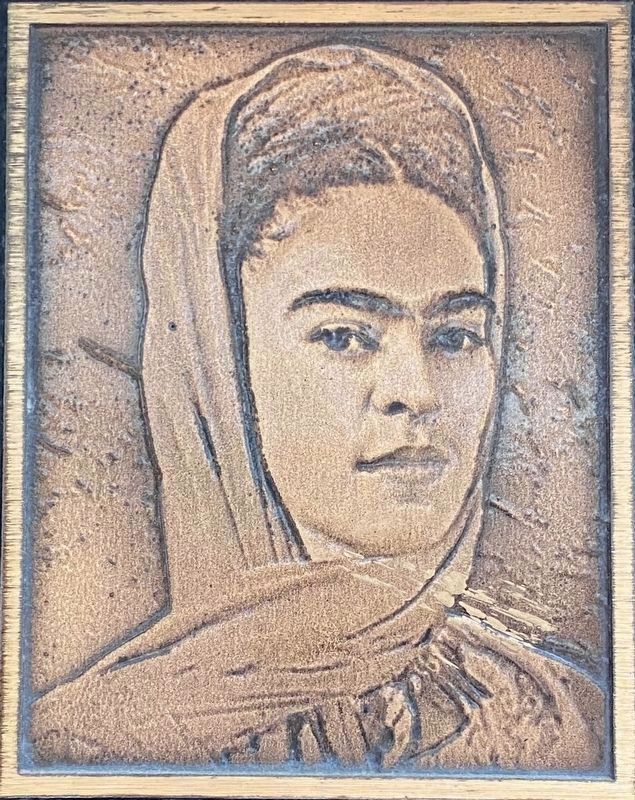 3. Marker inset: Frida Kahlo(See next photo for image source)
2. Frida Kahlo and her paintings (FridaKahlo.org). The artist's foundation provides a biography, along with many paintings, photos, video. (Submitted on September 17, 2021.)
Additional keywords. lgbt lgbtq
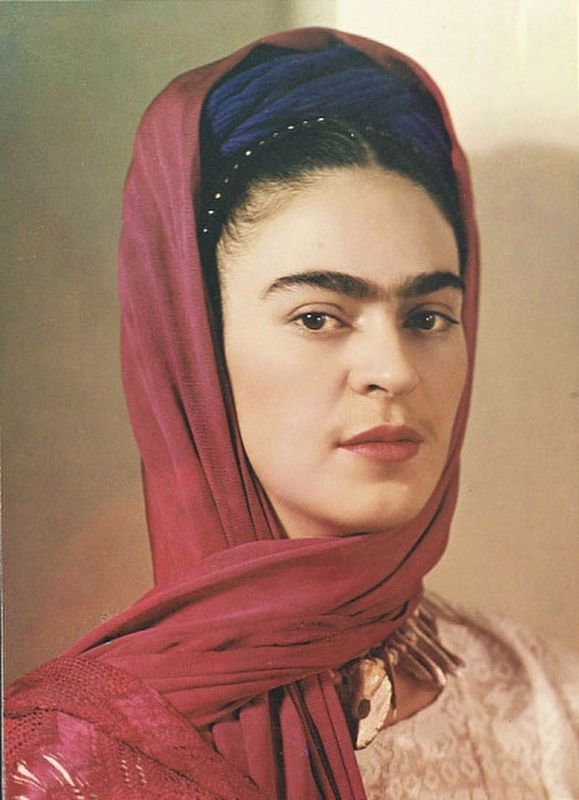
Nickolas Muray (courtesy of the National Museum of American History / Smithsonian Institution), circa 1946
4. Frida Kahlo de Rivera - 3-color Carbro portrait
Credits. This page was last revised on January 30, 2023. It was originally submitted on September 17, 2021, by Andrew Ruppenstein of Lamorinda, California. This page has been viewed 353 times since then and 25 times this year. Photos: 1, 2, 3, 4. submitted on September 17, 2021, by Andrew Ruppenstein of Lamorinda, California.
