Gambles Hill in Richmond, Virginia — The American South (Mid-Atlantic)
Water Power
| — | Captain John Smith Chesapeake National Historic Trail | — |
Photographed by Bernard Fisher, September 27, 2021
1. Water Power Marker
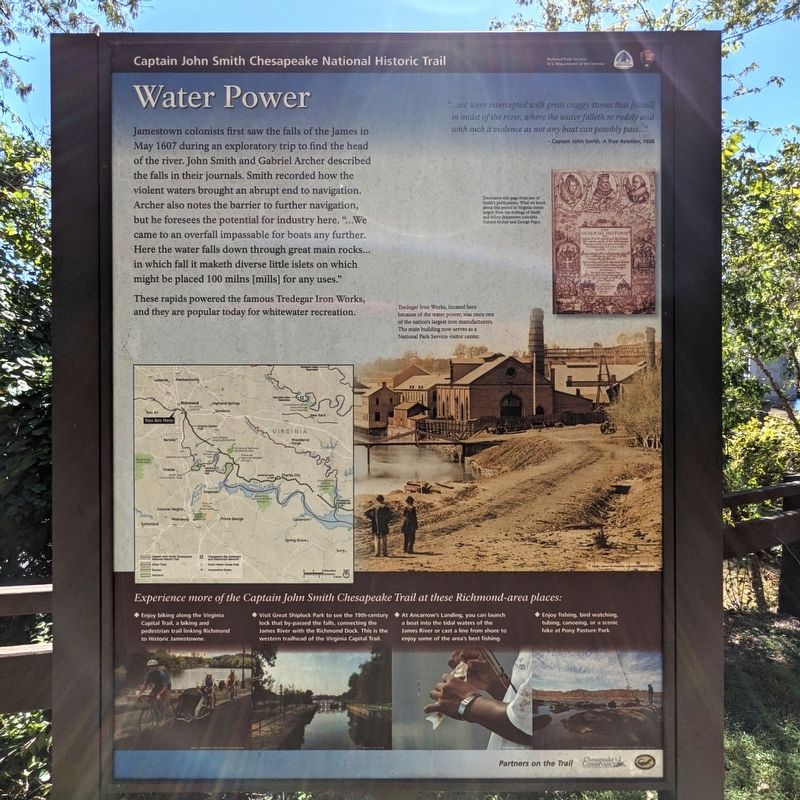
These rapids powered the famous Tredegar Iron Works, and they are popular today for whitewater recreation.
"...we were intercepted with great craggy stones that [stand] in midst of the river, where the water falleth so rudely and with such a violence as not any boat can possibly pass..."
— Captain John Smith, A True Relation, 1608
(sidebar)
Experience more of the Captain John Smith Chesapeake Trail at these Richmond-area places:
• Enjoy biking along the Virginia Capital Trail, a biking and pedestrian trail linking Richmond to Historic
this page online
• Visit Great Shiplock Park to see the 19th-century lock that by-passed the falls, connecting the James River with the Richmond Dock. This is the western trailhead of the Virginia Capital Trail.
• At Ancarrow's Landing, you can launch a boat into the tidal waters of the James River or cast a line from shore to enjoy some of the area's best fishing.
• Enjoy fishing, bird watching. tubing. canoeing. or a scenic hike at Pony Pasture Park.
(captons)
Decorative tide page from one of Smith's publications. What we know about this period in Virginia comes largely from the writings of Smith and fellow Jamestown colonists Gabriel Archer and George Percy.
Tredegar Iron Works, located here because of the water power, was once one of the nation's largest iron manufacturers. The main building now serves as a National Park Service visitor center. Image Library of Congreess, Alexander Gardner, 1865
Erected by National Park Service, U.S. Department of the Interior.
Topics and series. This historical marker is listed in these topic lists: Exploration • Industry & Commerce • Parks & Recreational Areas
Photographed by Bernard Fisher, September 27, 2021
2. Water Power Marker
Location. 37° 32.06′ N, 77° 26.923′ W. Marker is in Richmond, Virginia. It is in Gambles Hill. It is on Tredegar Street 0.1 miles west of Brown's Island Way, on the left when traveling west. Touch for map. Marker is in this post office area: Richmond VA 23219, United States of America. Touch for directions.

Regionally, this marker is in Central Virginia. It is also in the American South and specifically in the Upper South. Globally, it is in North America, the Western Hemisphere, the Western World, and the Anglosphere. Historically, it finds itself in what was once the territory of the Mississippian Culture, one of the original Thirteen Colonies, one of the Confederate States of America, and the Antebellum South.
Other nearby markers. At least 7 other markers are within walking distance of this marker: Welcome to Richmond’s Historic Riverfront (a few steps from this marker); Belle Isle (within shouting distance of this marker); Robert E. Lee Bridge
Photographed by Bernard Fisher, September 27, 2021
3. Water Power Marker
Other markers no longer nearby. Making Machines at Tredegar (was about 600 feet away but has been permanently removed); Industrial Recycling (was about 600 feet away but has been permanently removed); Tredegar Rolling Mills (was about 600 feet away but has been permanently removed); Neighborhoods at Tredegar (was about 700 feet away but has been permanently removed); Belle Isle Prison (was about 700 feet away but has been permanently removed); Belle Isle and Old Dominion Iron and Nail Works (was about 800 feet away but has been permanently removed); Tredegar in 1951 (was approx. 0.2 miles away but has been permanently removed); The Bulldozer Press (was approx. 0.2 miles away but has been permanently removed); Gateway to the Civil War (was approx. 0.2 miles away but has been permanently removed).
Credits. This page was last revised on February 1, 2023. It was originally submitted on September 28, 2021, by Bernard Fisher of Richmond, Virginia. This page has been viewed 294 times since then and 19 times this year. Photos: 1, 2, 3. submitted on September 28, 2021, by Bernard Fisher of Richmond, Virginia.
