Corpus Christi in Nueces County, Texas — The American South (West South Central)
George Owens

Photographed by James Hulse, September 1, 2021
1. George Owens Marker
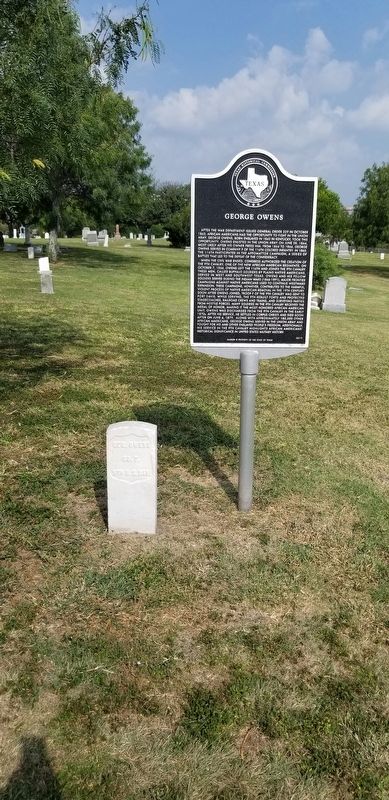
When the Civil War ended, Congress authorized the creation of the 9th Cavalry, one of the new African American Regiments. On October 7, 1866, Owens left the 116th and joined the 9th Cavalry. These men, called Buffalo Soldiers by Plains Native Americans, served in west and southwest Texas. Owens and his fellow soldiers served during the Indians wars (1866-1891), major frontier campaigns against Native Americans used to continue westward expansion. These campaigns, however, contributed to the harmful, violent process of Native American removal in the 19th century. Soon after Owens joined, Troop F of the 9th Cavalry was sent to Fort Davis. While serving, the 9th rebuilt forts and protected stagecoaches, railroad crews and trains, and surveying parties from hostile forces. Many soldiers in the 9th Cavalry received the Medal of Honor, making it the most honored African American unit. Owens was discharged from the 9th Cavalry in the early 1870s. After his service, he settled in Corpus Christi and died soon after on June 4, 1879. Along with approximately 180,000 other African Americans, George Owens served in the Union Army and fought for his and other enslaved people's freedom. Additionally, his service in the 9th Cavalry highlights African American's historical significance in United States military history.
Erected 2017
this page online
Topics. This historical marker is listed in these topic lists: African Americans • Forts and Castles • War, US Civil • Wars, US Indian. A significant historical date for this entry is June 28, 1864.
Location. 27° 48.058′ N, 97° 23.933′ W. Marker is in Corpus Christi, Texas, in Nueces County. It can be reached from the intersection of Ramirez Street and Padre Street. The marker is located in the east section of the Old Bayview Cemetery. Touch for map. Marker is at or near this postal address: 1150 Ramirez Street, Corpus Christi TX 78401, United States of America. Touch for directions.

Regionally, this marker is in the American South and on the Gulf Coast. Globally, it is in North America, a Gulf of Mexico state, the Western Hemisphere, the Western World, and the Anglosphere. Historically, it finds itself in what was once New Spain, the Republic of Texas, and one of the Confederate States of America.
Other nearby markers. At least 8 other markers are within walking distance of this marker: Thomas S. Parker (a few steps from this marker); Old Bayview Mesquite (within
Photographed by James Hulse, September 1, 2021
2. George Owens Marker and gravestone
Also see . . . Buffalo Soldiers.
Buffalo soldiers was the name given by the Plains Indians to the four regiments of African Americans, and more particularly to the two cavalry regiments, that served on the frontier in the post-Civil War army. More than 180,000 black soldiers had seen service in segregated regiments in the Union Army during the Civil War, and many units had achieved outstanding combat records. Source: The Handbook of Texas(Submitted on October 2, 2021, by James Hulse of Medina, Texas.)
Photographed by James Hulse, September 1, 2021
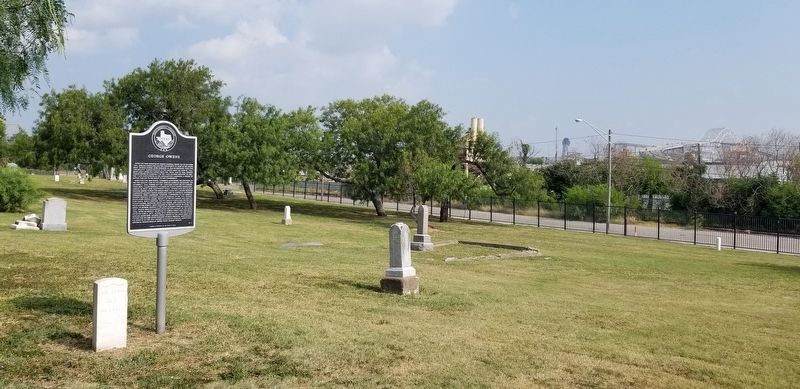
3. The view of the George Owens Marker in the cemetery
Credits. This page was last revised on October 2, 2021. It was originally submitted on October 2, 2021, by James Hulse of Medina, Texas. This page has been viewed 763 times since then and 33 times this year. Photos: 1, 2, 3. submitted on October 2, 2021, by James Hulse of Medina, Texas.
