Near Powhatan in Powhatan County, Virginia — The American South (Mid-Atlantic)
Huguenot Springs
Confederate Hospital & Cemetery
April 26, 2009
1. Huguenot Springs CWT Marker
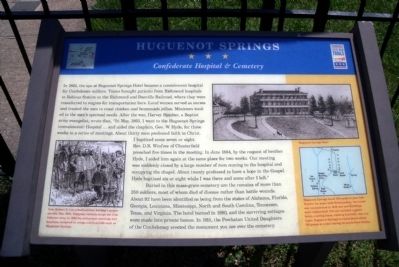
In 1862, the spa at Huguenot Springs Hotel became a convalescent hospital for Confederate soldiers. Trains brought patients from Richmond hospitals to Robious Station on the Richmond and Danville Railroad, where they were transferred to wagons for transportation here. Local women served as nurses and treated the men to roast chicken and homemade jellies. Ministers tended to the men’s spiritual needs. After the war, Harvey Hatcher, a Baptist army evangelist, wrote that, “In May, 1863, 1 went to the Huguenot Springs (convalescent) Hospital … and aided the chaplain, Geo. W Hyde, for three weeks in a series of meetings. About thirty men professed faith in Christ. I baptized some seven or eight. Rev. D.B. Winfree of Chesterfield preached five times in the meeting. In June 1864, by the request of brother Hyde, I aided him again at the same place for two weeks. Our meeting was suddenly closed by a large number of men coming to the hospital and occupying the chapel. About twenty professed to have a hope in the Gospel. Hyde baptized six or eight while I was there and some after I left.”
Buried in this mass-grave cemetery are
this page online
[Sidebar:]
Huguenot Springs stood 500 yards to your left. Popular for years with Richmonders, the resort was incorporated in 1846 and new buildings were constructed. The spa included a grand hotel, a spring house, bathing facilities, and cottages. Huguenot Springs accommodated about 150 guests at a time during its antebellum heyday.
[Captions:]
Gen. Robert E. Lee joined soldiers holding a prayer service, Nov 1863. Religious revivals swept the Confederate army in 1863-64, and prayer meetings and baptisms occurred in camps and hospitals such as Huguenot Springs.
Huguenot Springs Hotel
Erected by Virginia Civil War Trails.
Topics and series. This historical marker is listed
April 26, 2009
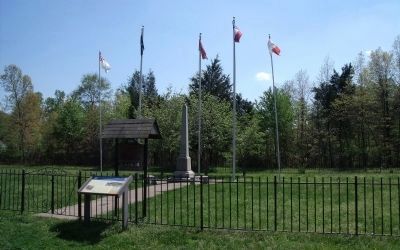
2. Huguenot Springs CWT Marker & UDC Monument
Location. This marker has been replaced by another marker nearby. It was located near 37° 33.563′ N, 77° 42.241′ W. Marker was near Powhatan, Virginia, in Powhatan County. It was on Old Confederate Cemetery Road 0.1 miles west of Huguenot Springs Road (Virginia Route 607), on the left when traveling west. Located in Huguenot Springs Cemetery. Touch for map. Marker was in this post office area: Midlothian VA 23113, United States of America. Touch for directions.

Regionally, this marker was in the Piedmont, in Central Virginia, and in the Richmond Metropolitan Area. It was also in the American South and specifically in the Upper South. Globally, it was in North America, the Western Hemisphere, the Western World, and the Anglosphere. Historically, it found itself in what was once the territory of the Mississippian Culture, one of the original Thirteen Colonies, one of the Confederate States
April 26, 2009
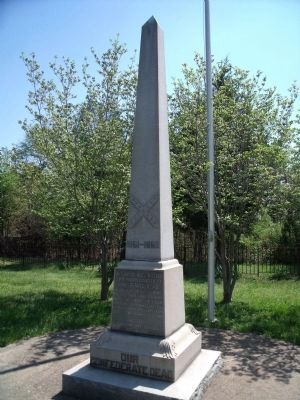
3. Huguenot Springs UDC Monument.
Other nearby markers. At least 8 other markers are within 3 miles of this location, measured as the crow flies: A different marker also named Huguenot Springs (here, next to this marker); Our Confederate Dead (a few steps from this marker); Huguenot Springs Confederate Cemetery (approx. 0.3 miles away); Terre Haute Farm African American Cemetery (approx. half a mile away); Huguenot Settlement (approx. half a mile away); The Huguenot Monument (approx. half a mile away); Mowhemcho-Manakin Town (approx. half a mile away); a different marker also named Huguenot Settlement (approx. 2.9 miles away). Touch for a list and map of all markers in Powhatan.
Related marker. Click here for another marker that is related to this marker. It replaced this marker in the same location.
Also see . . . The Huguenot Society of the Founders of Manakin In the Colony of Virginia. (Submitted on April 28, 2009.)
April 26, 2009
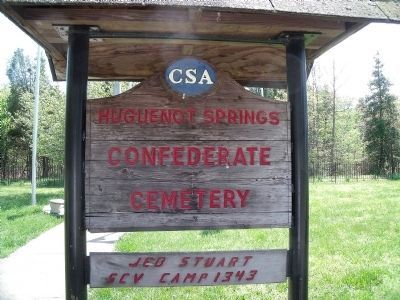
4. Huguenot Springs SCV sign.

2025
5. Huguenot Springs Surviving Cottage
Some of Huguenot Springs' buildings still survive on the old resort parcel. Four (or five) of the original cottages were retained, with two (or three) joined together in front of the hotel's foundation to form a residence. Two stand separately as they were built, one on each side of the current residence. This is the West Cottage. The foundation of the hotel is also visible behind the residence, which currently functions as a Private Event Venue. The circulation pattern is also still intact, with the same long loop driveway shown in the marker's plan view.

2025
6. Huguenot Springs
Aerial view of the resort area. At lower left is the ca. 1840 Huguenot Springs Ordinary, renovated in 1952. The house at lower right is modern construction. The long circular drive is the original circulation pattern for the resort. The I-plan house at its distant head is two (or three) of the original resort cottages moved, conjoined, and enlarged. The foundation for the original hotel is behind that building. There are two original cottages in their original locations to the west (right) and east (left) of the conjoined set, facing the dirt road. Compare this view to the marker's plan view.
Credits. This page was last revised on March 17, 2026. It was originally submitted on April 27, 2009, by Bernard Fisher of Richmond, Virginia. This page has been viewed 4,710 times since then and 132 times this year. Last updated on March 17, 2026, by Evan Dwyer of Richmond, Virginia. Photos: 1, 2, 3, 4. submitted on April 27, 2009. 5, 6. submitted on March 17, 2026. • Devry Becker Jones was the editor who published this page.
