Central Arlington in Tarrant County, Texas — The American South (West South Central)
City of Arlington
Photographed by J Frye
1. City of Arlington Marker
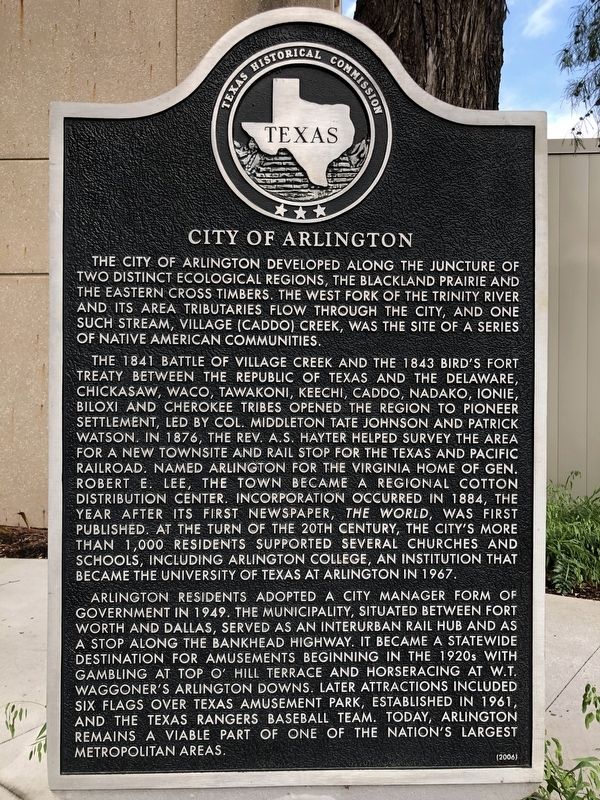
The City of Arlington developed along the juncture of two distinct ecological regions, the Blackland Prairie and the Eastern Cross Timbers. The West Fork of the Trinity River and its area tributaries flow through the city, and one such stream, Village (Caddo) Creek was the site of a series of Native American Communities.
The 1841 Battle of Village Creek and the 1843 Bird's Fort Treaty between the Republic of Texas and the Delaware, Chickasaw, Waco, Tawakoni, Keechi, Caddo, Nadako, Ionie, Biloxi and Cherokee tribes opened the region to pioneer settlement, led by Col. Middleton Tate Johnson and Patrick Watson. In 1876, the Rev. A.S. Hayter helped survey the area for a new townsite and rail stop for the Texas and Pacific Railroad. Named Arlington for the Virginia home of Gen. Robert E. Lee, the town became a regional cotton distribution center. Incorporation occurred in 1884, the year after its first newspaper, The World, was first published. At the turn of the 20th Century, the city's more than 1,000 residents supported several churches and schools, including Arlington College, an institution that became the University
this page online
Arlington residents adopted a City Manager for of government in 1949. The municipality, situated between Fort Worth and Dallas, served as an interurban rail hub and as a stop along the Bankhead Highway. It became a statewide destination for amusements beginning in the 1920s with gambling at Top O' Hill Terrace and horseracing at W.T. Waggoner's Arlington Downs. Later attractions included Six Flags Over Texas amusement park, established in 1961, and the Texas Rangers baseball team. Today, Arlington remains a viable part of one of the Nation's largest metropolitan areas.
Erected 2006 by Texas Historical Commission. (Marker Number 13792.)
Topics. This historical marker is listed in these topic lists: Agriculture • Indigenous Peoples and Communities • Railroads & Streetcars • Settlements & Settlers. A significant historical year for this entry is 1841.
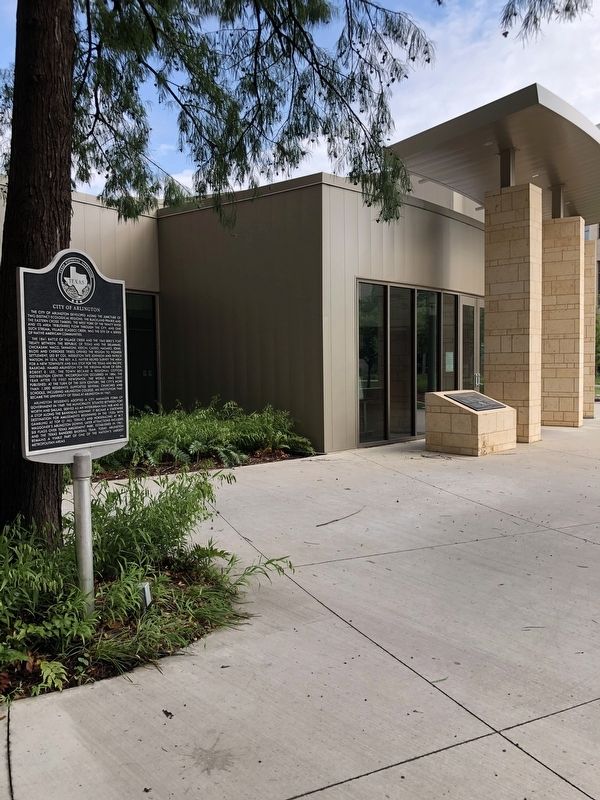
Location. 32° 44.153′ N, 97° 6.46′ W. Marker is in Arlington, Texas, in Tarrant County. It is in Central Arlington. It is on West Abram Street just west of South Center Street, on the right when traveling west. Touch for map. Marker is
Photographed by J Frye
2. City of Arlington Marker

Regionally, this marker is in the Prairies & Lakes Region and in the Dallas-Fort Worth Metropolitan Area. It is also in the American South. Globally, it is in North America, a Gulf of Mexico state, the Western Hemisphere, the Western World, and the Anglosphere. Historically, it finds itself in what was once New Spain, the Republic of Texas, and one of the Confederate States of America.
Other nearby markers. At least 8 other markers are within walking distance of this marker: Colonel Neel E. Kearby (within shouting distance of this marker); Andrew Hayter (within shouting distance of this marker); The Interurban (about 300 feet away, measured in a direct line); Arlington Post Office (about 400 feet away); Arlington Texas & Pacific Depot and Platform (about 600 feet away); Arlington Texas & Pacific Railroad Train Depot (about 600 feet away); a different marker also named Arlington Texas & Pacific Railroad Train Depot (about 600 feet away); First Baptist Church of Arlington (about 700 feet away). Touch for a list and map of all markers in Arlington.
Credits. This page was last revised on June 3, 2023. It was originally submitted on June 13, 2021, by J Frye of Fort Worth, Texas. This page has been viewed 904 times since then and 95 times this year. Last updated on October 8, 2021, by J Frye of Fort Worth, Texas. Photos: 1, 2. submitted on June 13, 2021, by J Frye of Fort Worth, Texas. • J. Makali Bruton was the editor who published this page.
