Greenville in Wayne County, Missouri — The American Midwest (Upper Plains)
Old Greenville - Hiram N. Hollady's Company Town
Photographed by Thomas Smith, October 4, 2021
1. Old Greenville - Hiram N. Hollady's Company Town Marker
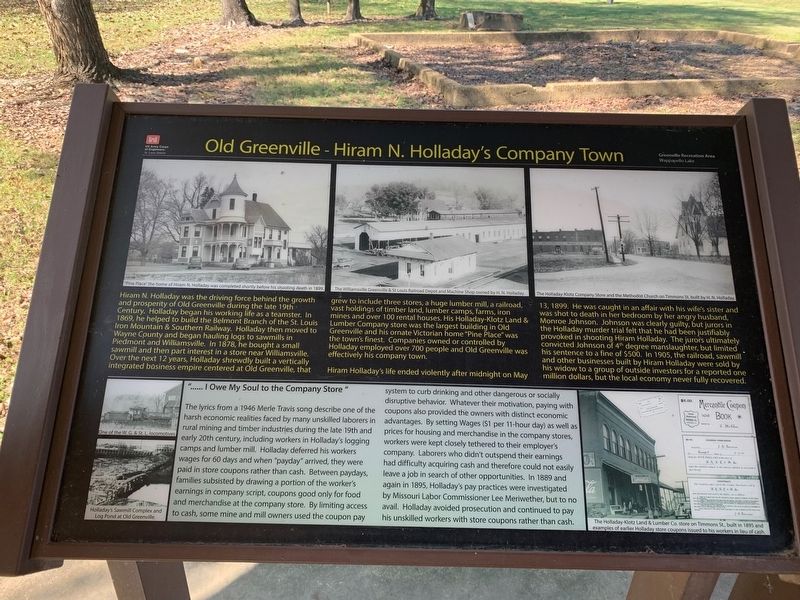
Hiram N. Holladay was the driving force behind the growth and prosperity of Old Greenville during the late 19th Century. Holladay began his working life as a teamster. In 1869, he helped to build the Belmont Branch of the St. Louis Iron Mountain & Southern Railway. Holladay then moved to Wayne County and began hauling logs to sawmills in Piedmont and Williamsville. In 1878, he bought a small sawmill and then part interest in a store near Williamsville. Over the next 12 years, Holladay shrewdly built a vertically integrated business empire centered at Old Greenville, that grew to include three stores, a huge lumber mill, a railroad, vast holdings of timber land, lumber camps, farms, iron mines and over 100 rental houses, His Holladay-Klotz Land & Lumber Company store was the largest building in Old Greenville and his ornate Victorian home "Pine Place" was the town finest. Companies owned or controlled by Holladay employed over 700 people and Old Greenville was effectively his company town.
Hiram Holladay's life ended violently after midnight on may 13, 1899. He was caught in an affair with his wife's sister and was
this page online
"...... I Owe My Soul to the Company Store"
The lyrics from a 1946 Merle Travis song describe one of the harsh economic realities faced by many unskilled labors in rural mining and timber industries during the late 19th and early 20th century, including workers in Holladay 's logging camps and lumber mill. Holladay deferred his workers wages for 60 days and when "payday" arrived they were paid in store coupons rather than cash. Between paydays, families subsisted by drawing a portion of the worker's earnings in company script, coupons good only for food and merchandise at the company store, By limiting access to
Photographed by Thomas Smith, October 4, 2021
2. Gazebo at the Memory Lane Trailhead
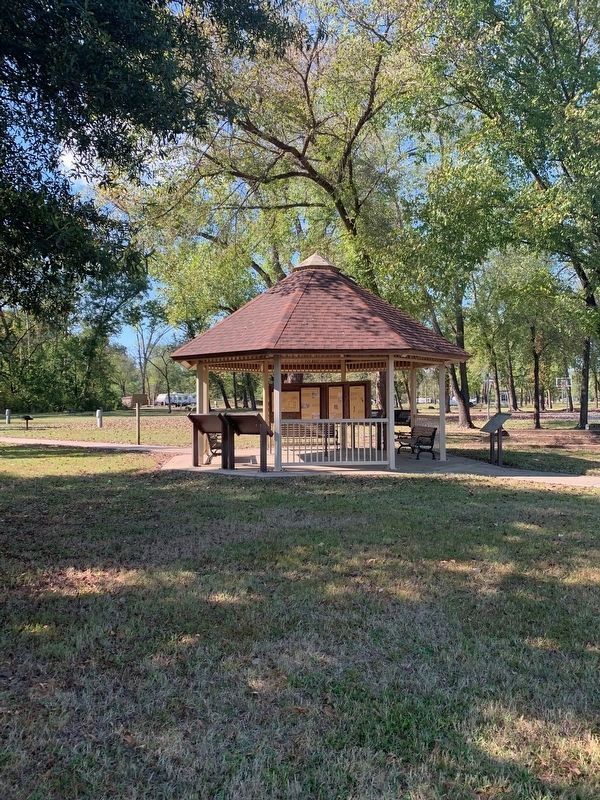
This marker is one of the two closest to the camera.
Topics. This historical marker is listed in these topic lists: Civil Rights • Industry & Commerce • Labor Unions • Settlements & Settlers. A significant historical date for this entry is May 13, 1899.
Location. 37° 5.971′ N, 90° 27.322′ W. Marker is in Greenville, Missouri, in Wayne County. It is on U.S. 67 0.2 miles south of County Road 221, on
Photographed by Brian Waala, June 27, 2026
3. Old Greenville - Hiram N. Hollady's Company Town Marker
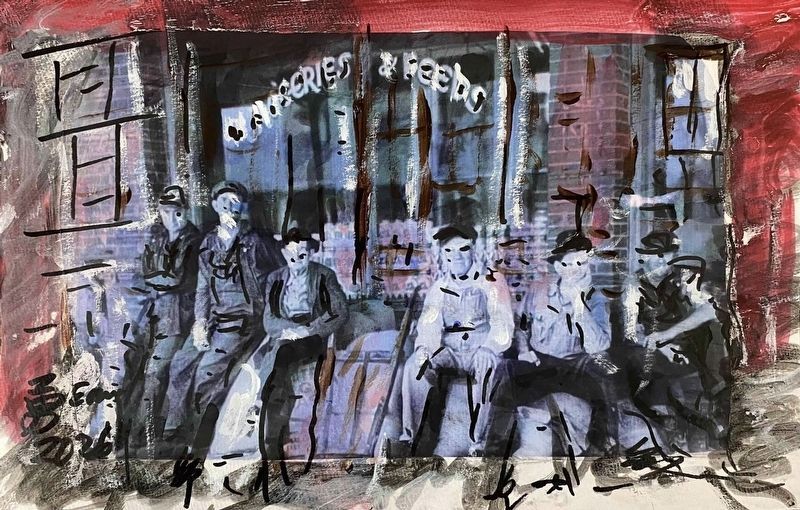
These are paintings I did of the photos at Old Greenville Park.

Regionally, this marker is in Southeast Missouri. It is also in the American Ozarks, in the Lewis & Clark Corridor, and in the Corn Belt. Globally, it is in North America, the Western Hemisphere, the Western World, and the Anglosphere. Historically, it finds itself in what was once the territory of the Mississippian Culture, the Louisiana Purchase, and the Antebellum South.
Other nearby markers. At least 8 other markers are within walking distance of this marker: Memory Lane (here, next to this marker); Old Greenville's Timmons Street Business District (here, next to this marker); Alice J. Curtice Moyer-Wing , The Ozark Suffragist (here, next to this marker); Old Greenville - April 22, 1939 (here, next to this marker); Old Greenville in 1940 - Before the Wappapello Dam (a few steps from this marker); Memory Lane Trail (a few steps from this marker); Bedwell Tavern (within shouting distance of this marker); Wilcox Service Station (about 300 feet away, measured in a direct line). Touch for a list and map of all markers in Greenville.
Credits. This page was last revised on July 11, 2026. It was originally submitted on October 14, 2021, by Thomas Smith of Waterloo, Ill. This page has been viewed 1,630 times since then and 186 times this year. Photos: 1, 2. submitted on October 14, 2021, by Thomas Smith of Waterloo, Ill. 3. submitted on June 28, 2026, by Brian Waala of Silva, Missouri. • Devry Becker Jones was the editor who published this page.
