Lisbon in Linn County, Iowa — The American Midwest (Upper Plains)
The Lincoln Highway
A Highway to Honor Lincoln
Photographed by Cosmos Mariner, June 27, 2021
1. Lincoln Highway Marker
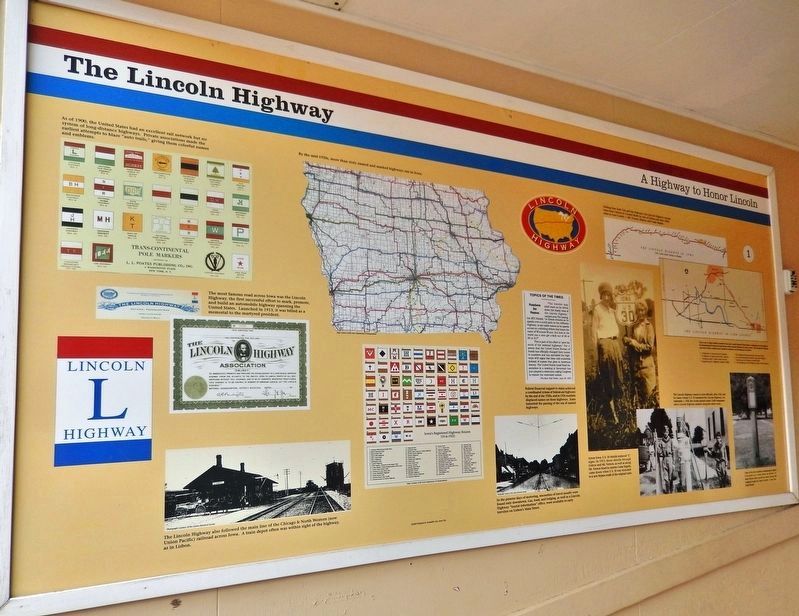
The most famous road across Iowa was the Lincoln Highway, the first successful effort to mark, promote, and build an automobile highway spanning the United States. Launched in 1913, it was billed as a memorial to the martyred president.
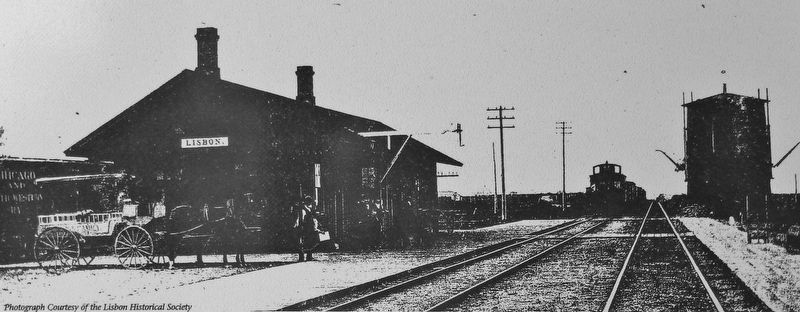
The Lincoln Highway also followed the main line of the Chicago & North Western (now Union Pacific) railroad across Iowa. A train depot often was within sight of the highway, as in Lisbon.
By the mid-1920s, more than sixty named and marked highways ran in Iowa.
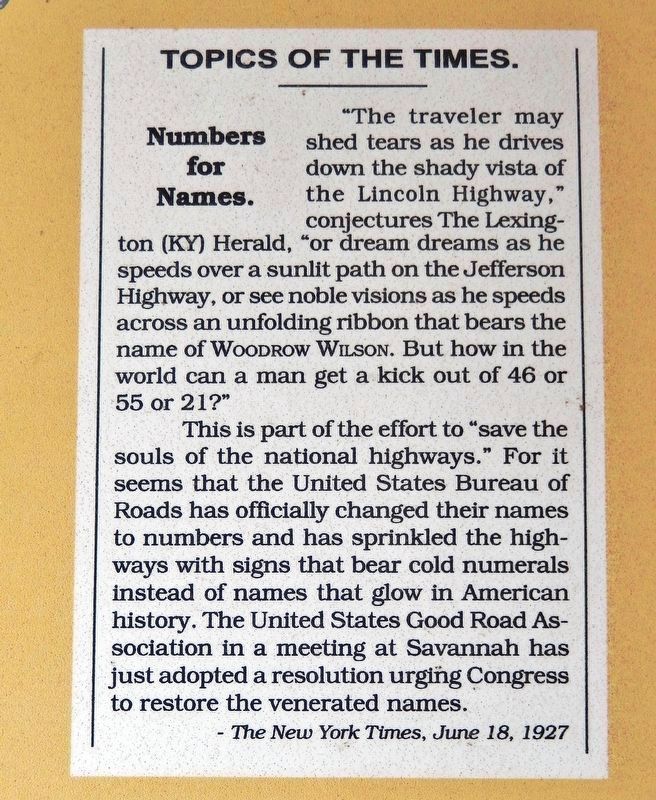
Federal financial support to states achieved a coordinated system of federal-aid highways by the end of the 1920s, and in 1926 numbers displaced names on those highways. Some lamented the passing of the era of named highways.
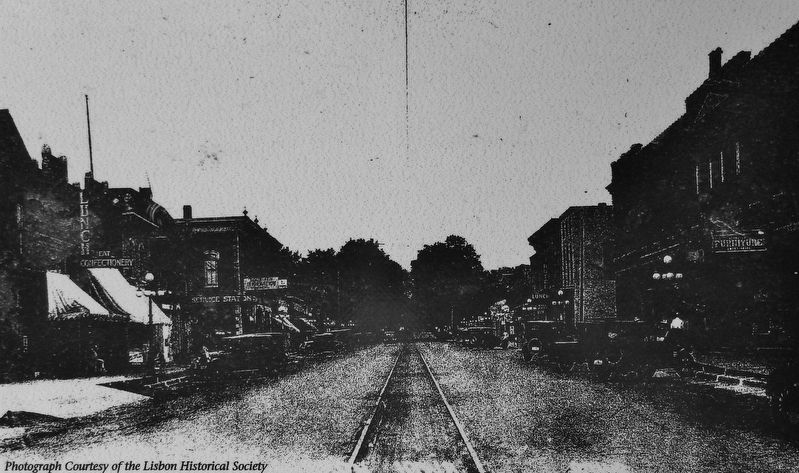
In the pioneer days of motoring, necessities of travel usually were found only downtown. Gas, food, and lodging, as well as a Lincoln Highway "tourist information" office, were available to early travelers
this page online
Across Iowa, U.S. 30 shields replaced "L" signs. In 1953, those shields through Lisbon and Mt. Vernon, as well as along Mt. Vernon Road in eastern Cedar Rapids, came down when U.S. 30 was relocated to a new bypass south of the original route.
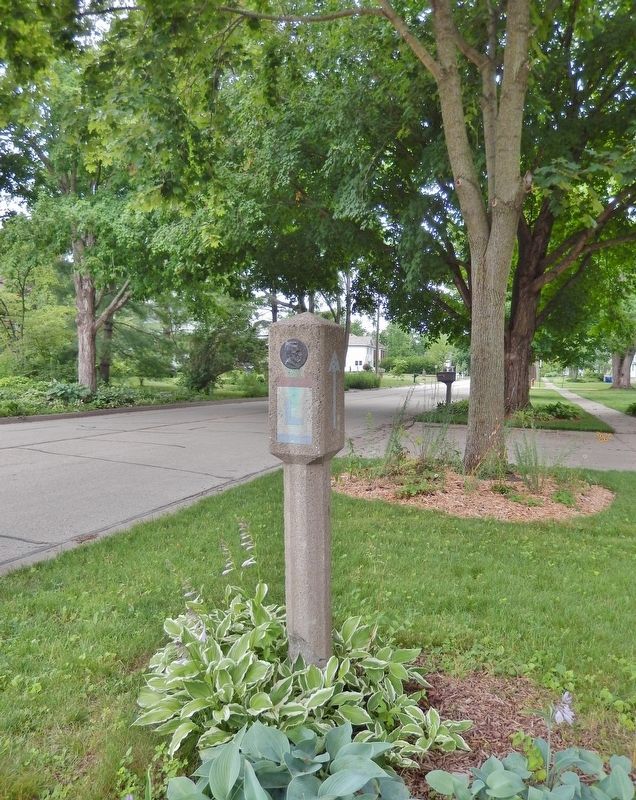
The Lincoln Highway ceased to exist officially after 1926, but for many Iowans U.S. 30 remained the Lincoln Highway. On September 1, 1928, Boy Scouts planted nearly 3,000 commemorative Lincoln Highway markers along the entire route.
Linking New York City and San Francisco, the Lincoln Highway crossed Iowa from Clinton to Council Bluffs by way of Lisbon and three other cities in Linn County — Mt. Vernon, Marion, and Cedar Rapids.
This is one of eight exhibits created by the Linn County Historic Preservation Commission for the purpose of interpreting the historical importance of the Lincoln Highway in Linn County. The interpretive themes and sites of these exhibits (also located by numbers on this map) are as follows:
1. A Highway to Honor Lincoln (Lisbon)
2. A Highway of Main Streets (Mt. Vernon)
3. "Seedling Miles" (Abbe Creek School)
4. Engineering the Highway (Squaw Creek)
5.The Highway through Marion (Thomas Park)Courtesy Lisbon Historical Society2. Marker detail: Lisbon Railroad Depot
6. Accommodating the Motorist (Lincoln Heights)
7. Promoting the Highway (Haskell Park)
8. The Enduring Lincoln Highway (State Patrol Station)
One of the few markers remaining in place is located on East Main Street in Lisbon. At least three other markers stand along the original route in Linn County. Can you find them?
[marker illustrations]
• Trans-Continental Pole Markers
• Iowa’s Registered Highway Routes, 1914-1925
• The Lincoln Highway in Iowa — 358.3 miles from Clinton to Omaha
• The Lincoln Highway in Linn County
Erected by Linn County Historic Preservation Commission. (Marker Number 1.)
Topics and series. This historical marker is listed in these topic lists: Railroads & Streetcars • Roads & Vehicles. In addition, it is included in the Lincoln Highway series list. A significant historical year for this entry is 1913.
Location. 41° 55.283′ N, 91° 23.123′ W. Marker is in Lisbon, Iowa, in Linn County. It can be reached from the intersection of East Main Street (County Highway E48) and North Washington Street (County Highway X20), on the right when traveling east. Marker is mounted at eye-level
Courtesy Lisbon Historical Society
3. Marker detail: Lisbon Main Street

Regionally, this marker is in Eastern Iowa. It is also in the American Midwest and in the Corn Belt. Globally, it is in North America, the Western Hemisphere, the Western World, and the Anglosphere. Historically, it finds itself in what was once the territory of the Mississippian Culture and also the Louisiana Purchase.
Other nearby markers. At least 8 other markers are within 4 miles of this marker, measured as the crow flies: History of Our Town Lisbon, Iowa (here, next to this marker); Mount Vernon Mainstreet Fire (approx. 1.7 miles away); The Old Military Road (approx. 1.8 miles away); South Hall (approx. 1.9 miles away); a different marker also named The Lincoln Highway (approx. 2.3 miles away); a different marker also named The Lincoln Highway (approx. 3.6 miles away); Uranus (approx. 3.7 miles away); William Abbe (approx. 3.7 miles away).
4. Marker detail: Topics of the Times
Numbers for Names
Numbers for Names
"The traveler may shed tears as he drives down the shady vista of the Lincoln Highway," conjectures The Lexington (KY) Herald, "or dream dreams as he speeds over a sunlit path on the Jefferson Highway, or see noble visions as he speeds across an unfolding ribbon that bears the name of WOODROW WILSON. But how in the world can a man get a kick out of 46 or 55 or 21?"
This is part of the effort to "save the souls of the national highways." For it seems that the United States Bureau of Roads has officially changed their names to numbers and has sprinkled the highways with signs that bear cold numerals instead of names that glow in American history. The United States Good Road Association in a meeting at Savannah has just adopted a resolution urging Congress to restore the venerated names.
—The New York Times, June 18, 1927
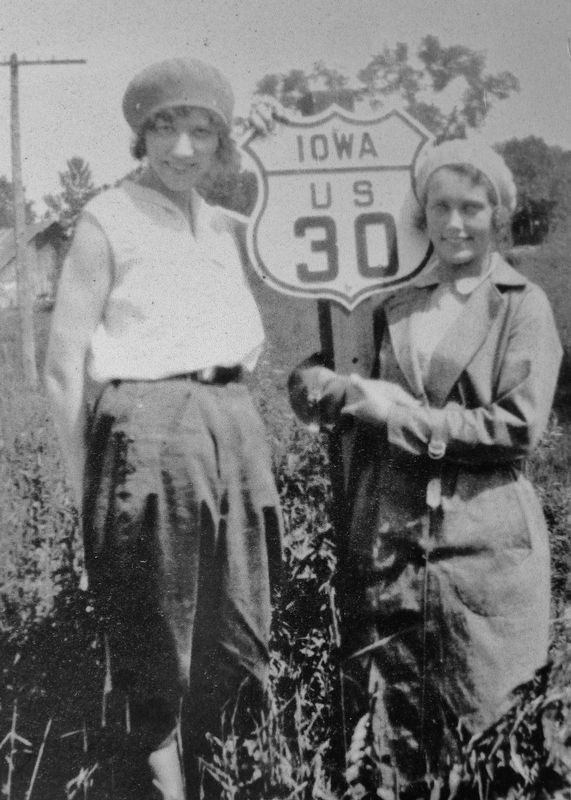
5. Marker detail: U.S. 30 shields replaced "L" signs
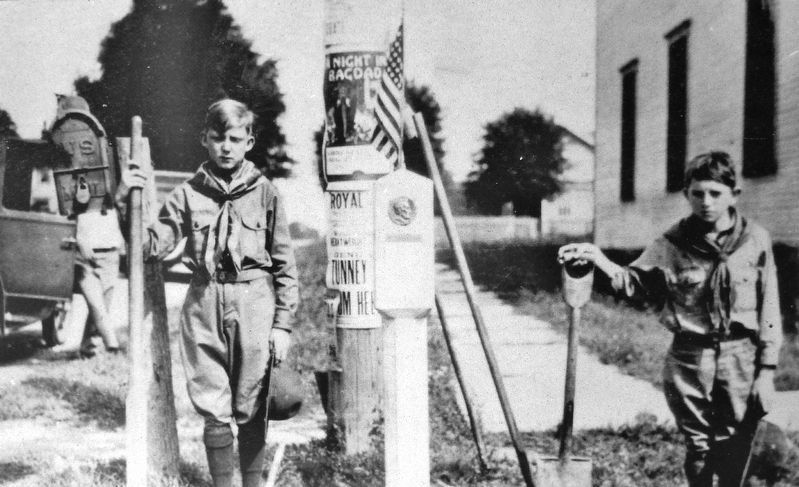
6. Marker detail: Boy Scouts Install Lincoln Highway Marker
Photographed by Cosmos Mariner, June 27, 2021
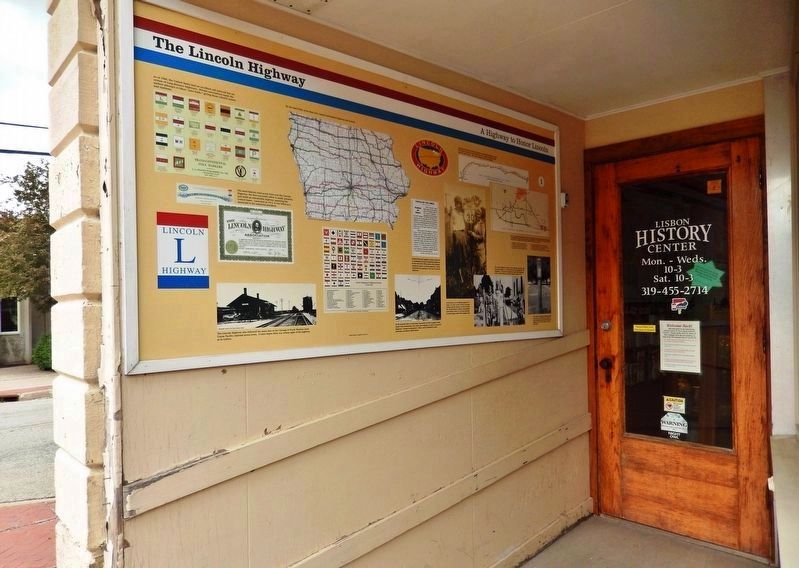
7. The Lincoln Highway Marker
Photographed by Cosmos Mariner, June 27, 2021
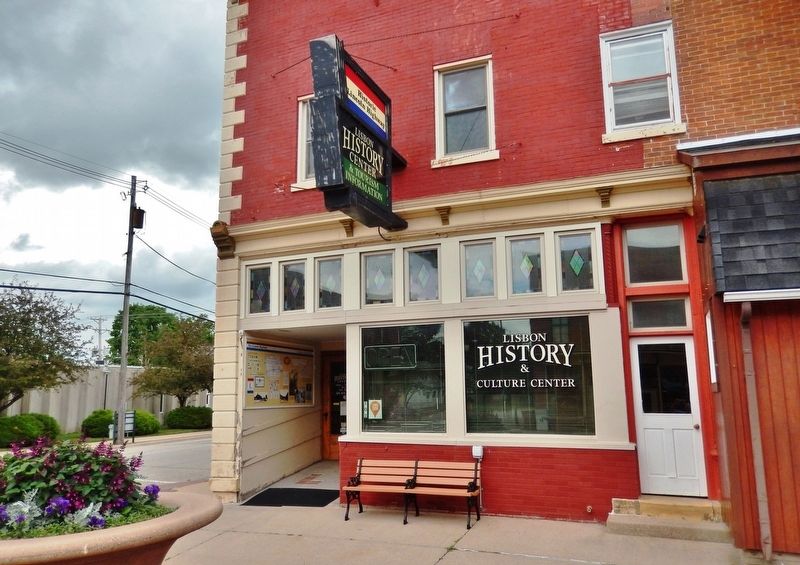
8. Lisbon History Center
Photographed by Cosmos Mariner, June 27, 2021
9. Lisbon's Remaining Lincoln Highway Marker
(on East Main Street)
(on East Main Street)
Credits. This page was last revised on October 28, 2021. It was originally submitted on October 28, 2021, by Cosmos Mariner of Cape Canaveral, Florida. This page has been viewed 942 times since then and 61 times this year. Photos: 1, 2, 3, 4, 5, 6, 7, 8, 9. submitted on October 28, 2021, by Cosmos Mariner of Cape Canaveral, Florida.
