Karamea in Buller District, West Coast Region, New Zealand — Southwestern Pacific Ocean
The History of the Karamea Estuary
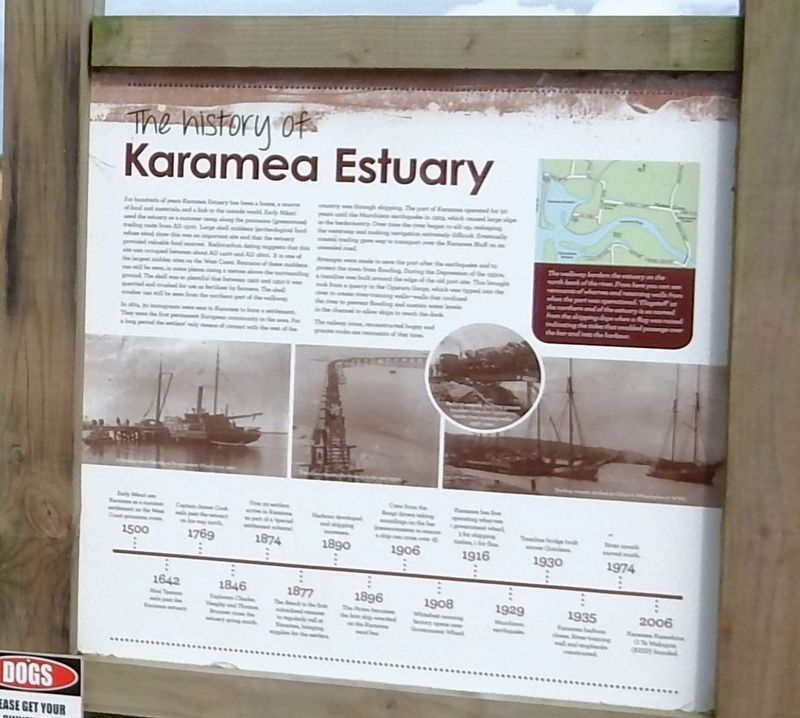
Courtesy of Thomas P. Martin, February 15, 2015
1. The History of the Karamea Estuary Marker
In 1874, 30 immigrants were sent to Karamea to form a settlement. They were the first permanent European community in the area. For a long period the settlers' only means of contact with the rest of the country was through shipping. The port of Karamea operated for 50 years until the Murchison earthquake in 1929, which
this page online
Attempts were made to save the port after the earthquake and to protect the town from flooding. During the Depression of the 1930s, a tramline was built around the edge of the old port site. This brought rock from a quarry in the Oparara Gorge, which was tipped into the river to create river-training walls — walls that confined the river to prevent flooding and sustain water levels in the channel to allow ships to reach the dock.
The railway irons, reconstructed bogey and granite rocks are remnants of that time.
{Timeline]
1500 Early Māori use Karamea as a summer settlement on the West Coast pounamu route.
1642 Abel Tasman sails past the Karamea estuary.
1769 Captain James Cook sails past the estuary on his way north.
1846 Explorers Charles Heaphy and Thomas Brunner cross the estuary going south.
1874 First 30 settlers arrive in Karamea as part of a 'special settlement scheme.'
1877 The
Courtesy of Thomas P. Martin, February 15, 2015
2. The History of the Karamea Estuary Marker
1890 Harbour developed and shipping increases.
1896 The Picton becomes the first ship wrecked on the Karamea sandbar.
1906 Crew from the Rangi drown taking soundings on the bar (measurements to ensure a ship can cross over it).
1908 Whitebait canning factory opens near Government Wharf.
1916 Karamea has five operating wharves: 1 government wharf, 3 for shipping timber, 1 for flax.
1929 Murchison earthquake.
1930 Tramline bridge built across Quinlans.
1935 Karamea harbour closes. River-training wall and stopbanks constructed.
1974 River mouth moved south.
2006 Karamea Kaiawhina O Te Wahapuu (KEEP) founded.
Captions (left to right)
• A trading vessel loading at Government Wharf circa 1920.
• Tramline crossing the estuary in the mid-1930s.
• Railway wagons carrying granite boulders from the Oparara to create river-training walls, 1930-1940.
• Trading vessels docked at Gilbert's Wharf prior to WWI.
• (Map) The walkway borders the estuary on the north bank of the river. From here you can see remnants of wharves and retaining walls from when the port was operational. ‘Flagstaff’ at the northern end of the estuary is so named from the shipping days when a flag was raised indicating the tides that enabled passage over the bar and into the harbour.
Topics. This historical marker is listed in these topic lists: Environment • Industry & Commerce • Settlements & Settlers • Waterways & Vessels. A significant historical year for this entry is 1500.
Location. 41° 14.985′ S, 172° 6.245′ E. Marker is in Karamea, West Coast Region, in Buller District. It is on Ray Street half a kilometer west of Wharf Road. Marker is at the western end of Ray Street. Touch for map. Marker is in this post office area: Karamea, West Coast Region 7893, New Zealand. Touch for directions.

Regionally, it is in Oceania, in Australasia, in Polynesia, in the Pacific Ocean, on the Ring of Fire, on the Pacific Rim, in the Western World, and in the Anglosphere. Historically, it finds itself in what was once a British colony.
Credits. This page was last revised on February 13, 2022. It was originally submitted on October 28, 2021, by Duane and Tracy Marsteller of Murfreesboro, Tennessee. This page has been viewed 711 times since then and 46 times this year. Photos: 1, 2. submitted on October 28, 2021, by Duane and Tracy Marsteller of Murfreesboro, Tennessee.
