Near Prince George in Prince George County, Virginia — The American South (Mid-Atlantic)
Opportunity Lost
Photographed by Bill Coughlin, April 23, 2007
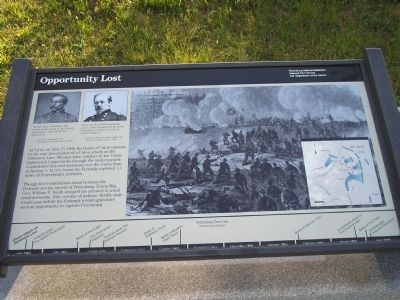
1. Opportunity Lost Marker
- Gen. P.G.T. Beauregard, CSA Confederate Commander, June 15, 1864
“Deeming that I held important points of the enemy’s line of works, I thought it prudent to make no farther advance.”
- Maj. Gen. William F. “Baldy” Smith, USA Union Commander, June 15, 1864
At 7 p.m. on June 15, 1864, the boom of Union cannons to the east foreshadowed a Union attack on the Dimmock Line. Minutes later, soldiers of the Union Eighteenth Corps broke through the undermanned Confederate line and swarmed over the works here at Battery 5. In two hours the Federals captured 1.5 miles of Petersburg’s defenses.
Though few Confederates stood between the Federals and the streets of Petersburg, Union Maj. Gen. William F. Smith stopped his advance to await reinforcements. Nine months of tedious, deadly siege would pass before the Federals would again have such an opportunity to capture Petersburg.
Erected by Petersburg National Battlefield, National Park Service, Department of the Interior.
Topics. This historical marker is listed in this
this page online
Location. This marker has been replaced by another marker nearby. It was located near 37° 14.741′ N, 77° 21.42′ W. Marker was near Prince George, Virginia, in Prince George County. It could be reached from Petersburg Tour Road, on the left when traveling north. The marker is in the Petersburg National Battlefield on the Battery 5 Trail. The trailhead is located at the Visitor Center. Touch for map. Marker was at or near this postal address: 5001 Siege Rd, Prince George VA 23875, United States of America. Touch for directions.

Regionally, this marker was in Coastal Virginia. It was also in the American South, specifically in the Upper South, in the Tidewater, and on the Eastern Seaboard. Globally, it was in the North Atlantic Region, North America, the Western Hemisphere, the Western World, and the Anglosphere. Historically, it found itself in what was once the territory of the Mississippian Culture, one of the original Thirteen Colonies, one of the Confederate States of America, and the Antebellum South.
Other nearby markers. At least 8 other markers
Photographed by Bill Coughlin, April 23, 2007
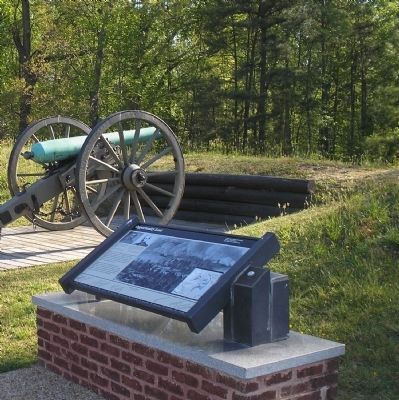
2. Marker and a cannon
The "Opportunity Lost" Marker is located inside Battery 5. It is one of the "talking" waysides on the Battlefield. In the background is a rare 6-pdr Field Gun produced by Brierfield Arsenal, in Alabama. The gun is the sole surviving example of that manufacturer.
Other markers no longer nearby. Battery 5 of the Dimmock Line (was within shouting distance of this marker but has been replaced with another marker now near it); Uprooted by War (was about 400 feet away but has been replaced with another marker now near it).
More about this marker. The upper left side of the marker features photographs of Confederate Gen. Beauregard and Union Gen. Smith, above the quotes from each. The right side of the marker contains a picture of “Union troops storm[ing] the Dimmock Line.” The bottom right of the marker features
Photographed by Bill Coughlin, April 23, 2007
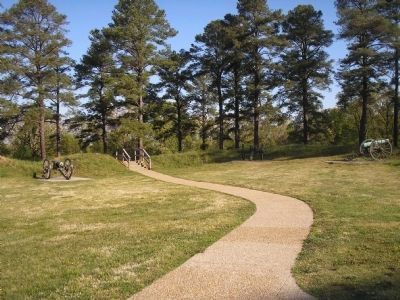
3. Inside Battery 5
The trail through Battery 5 leads to the location of the "Dictator," a large motar that was used to shell the city of Petersburg during the siege.
Related marker. Click here for another marker that is related to this marker. New Marker At This Location also titled "Opportunity Lost".
Also see . . .
1. Petersburg National Battlefield. National Park Service. (Submitted on April 5, 2008, by Bill Coughlin of Woodland Park, New Jersey.)
2. The Civil War Siege of Petersburg. (Submitted on April 5, 2008, by Bill Coughlin of Woodland Park, New Jersey.)
Photographed by Bill Coughlin, April 23, 2007
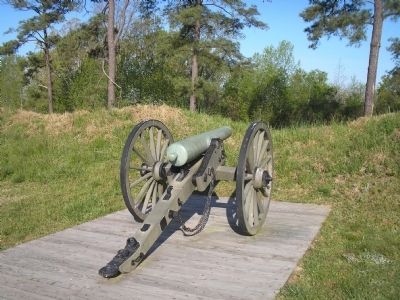
4. Battery 5 Cannon
Several cannons are located in Battery 5 on the Dimmock Line in Petersburg National Battlefield. This gun is a 12-pounder Confederate Napoleon produced by Augusta Foundry, Georgia.
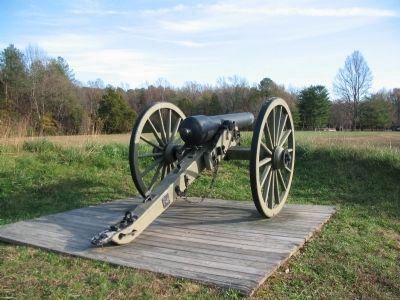
Photographed by Craig Swain, November 22, 2008
5. Confederate 12-pounder Iron Napoleon
A Confederate gun looks out of Battery 5 toward Battery 6. This 12-pounder light field gun was produced by Tredegar Foundry, Richmond, Virginia. It was issued and used like the more familiar bronze Napoleons, but required a breech band, giving it a similar appearance to Parrott Rifles. Roughly 125 of these were produced in the later half of the war. Less than ten survive today.
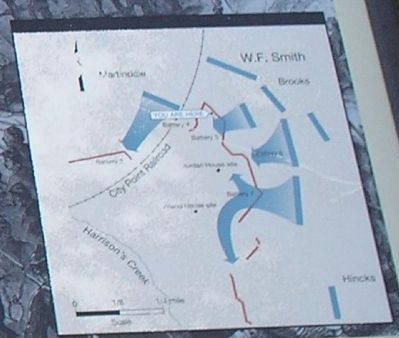
Photographed by Bill Coughlin, April 23, 2007
6. Battery 5 Map
Map from the marker showing the fortifications of Battery 5.
Credits. This page was last revised on November 15, 2021. It was originally submitted on April 5, 2008. This page has been viewed 1,698 times since then and 23 times this year. Last updated on November 11, 2021. Photos: 1, 2, 3, 4. submitted on April 5, 2008, by Bill Coughlin of Woodland Park, New Jersey. 5. submitted on December 22, 2008, by Craig Swain of Leesburg, Virginia. 6. submitted on April 5, 2008, by Bill Coughlin of Woodland Park, New Jersey. • Bernard Fisher was the editor who published this page.
