Urbanna in Middlesex County, Virginia — The American South (Mid-Atlantic)
Watling Street and Urbanna's Master Builder
Urbanna, Virginia
The Museum in the Streetsฎ
Photographed by Devry Becker Jones (CC0), November 25, 2021
1. Watling Street and Urbanna's Master Builder Marker
Inscription.
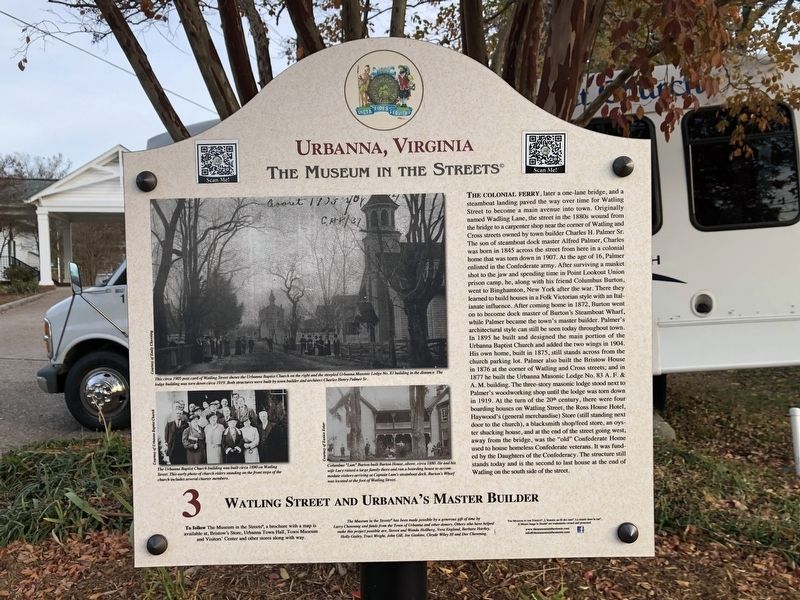
Watling Street and Urbanna's Master Builder. Urbanna, Virginia. The colonial ferry, later a one-lane bridge, and a steamboat landing paved the way over time for Watling Street to become a main avenue into town. Originally named Wadling Lane, the street in the 1880s wound from the bridge to a carpenter shop near the corner of Watling and Cross streets owned by town builder Charles H. Palmer Sr. The son of steamboat dock master Alfred Palmer, Cahrles was born in 1845 across the street from here in a colonial home that was torn down in 1907. At the age of 16, Palmer enlisted in the Confederate army. After surviving a musket shot to the jaw and spending time in Point Lookout Union prison camp, he, along with his friend Columbus Burton, went to Binghamton, New York after the war. There they learned to build houses in a Folk Victorian style with an italianate influence. After coming home in 1872, Burton went on to become dock master of Burton's Steamboat Wharf, while Palmer became the town's master builder. Palmer's architectural style can still be seen today throughout town. In 1895 he built and designed the main portion of the Urbanna Baptist Church and added the two wings in 1904. His own home, built in 1875, still stands across from the church parking lot. Palmer also built the Bristow House in 1876 at the corner of Watling and Cross streets; and in 1877 he built the Urbanna Masonic Lodge No. 83 A.F.&A.M. building. The three-story masonic lodge stood next to Palmer's woodworking shop until the lodge was torn down in 1919. At the turn of the 20th century, there were four boarding houses on Watling Street, the Ross Hotel, Haywood's (general merchandise) Store (still standing next door to the church), a blacksmith shop/feed store, an oyster shucking house, and at the end of the street going west, away from the bridge, was the "old" Confederate Home used to house homeless Confederate veterans. It was funded by the Daughters of the Confederacy. The structure still stands today and is the second to last house at the end of Watling on the south side of the street.
The colonial ferry, later a one-lane bridge, and a steamboat landing paved the way over time for Watling Street to become a main avenue into town. Originally named Wadling Lane, the street in the 1880s wound from the bridge to a carpenter shop near the corner of Watling and Cross streets owned by town builder Charles H. Palmer Sr. The son of steamboat dock master Alfred Palmer, Cahrles was born in 1845 across the street from here in a colonial home that was torn down in 1907. At the age of 16, Palmer enlisted in the Confederate army. After surviving a musket shot to the jaw and spending time in Point Lookout Union prison camp, he, along with his friend Columbus Burton, went to Binghamton, New York after the war. There they learned to build houses in a Folk Victorian style with an italianate influence. After coming home in 1872, Burton went on to become dock master of Burton's Steamboat Wharf, while Palmer became the town's master builder. Palmer's architectural style can still be seen today throughout town. In 1895 he built and designed the main portion of the Urbanna Baptist Church and added the two wings in 1904. His
Click or scan to see this page online
own home, built in 1875, still stands across from the church parking lot. Palmer also built the Bristow House in 1876 at the corner of Watling and Cross streets; and in 1877 he built the Urbanna Masonic Lodge No. 83 A.F.&A.M. building. The three-story masonic lodge stood next to Palmer's woodworking shop until the lodge was torn down in 1919. At the turn of the 20th century, there were four boarding houses on Watling Street, the Ross Hotel, Haywood's (general merchandise) Store (still standing next door to the church), a blacksmith shop/feed store, an oyster shucking house, and at the end of the street going west, away from the bridge, was the "old" Confederate Home used to house homeless Confederate veterans. It was funded by the Daughters of the Confederacy. The structure still stands today and is the second to last house at the end of Watling on the south side of the street.
Erected by The Museum in the Streetsฎ. (Marker Number 3.)
Location. 37° 38.07′ N, 76° 34.399′ W. Marker is in Urbanna, Virginia, in Middlesex County. It is at the intersection of Watling Street (Virginia Route 1004) and Urbanna Road ( Route 227), on the right when traveling west on Watling Street. Touch for map. Marker is at or near this postal address: 101 Watling St, Urbanna VA 23175, United States of America. Touch for directions.

Regionally, this marker is on Virginia’s Middle Peninsula. It is also in the American South, specifically in the Upper South, in the Tidewater, and in the Chesapeake Bay Region. Globally, it is in the North Atlantic Region, North America, the Western Hemisphere, the Western World, and the Anglosphere. Historically, it finds itself in what was once the territory of the Mississippian Culture, one of the original Thirteen Colonies, one of the Confederate States of America, and the Antebellum South.
Credits. This page was last revised on November 25, 2021. It was originally submitted on November 25, 2021, by Devry Becker Jones of Washington, District of Columbia. This page has been viewed 504 times since then and 28 times this year. Photos:1, 2. submitted on November 25, 2021, by Devry Becker Jones of Washington, District of Columbia.