Croom in Prince George's County, Maryland — The American Northeast (Mid-Atlantic)
First Americans at Mount Calvert
Photographed by F. Robby, August 19, 2013
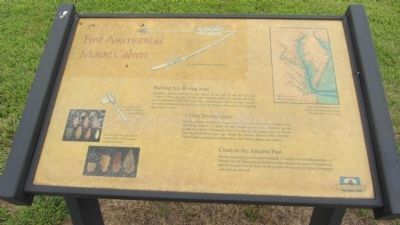
1. First Americans at Mount Calvert Marker
American Indians arrived in this region at the end of the last Ice Age (12000-15000 years ago). As the earth warmed and the ice melted, sea levels rose dramatically. By 5,000 years ago, ancient lands and rivers once used by the earliest Indians were buried beneath the rising waters of the Chesapeake Bay and its rivers.
A New Environment
As the climate stabilized, evergreen trees were replaced by hardwoods providing habitat for deer, elk and smaller game. Fish migrated up the tributaries of the Chesapeake Bay. The first Indian people came to Mount Calvert about 8,000 years ago during the Archaic Period (7500-1000 BC). These hunters and gatherers thrived on the region's plants and animals.
Clues to the Ancient Past
Archaeologists have recovered thousands of Archaic Period Indian artifacts at Mount Calvert. Spear points, knives and the remains of stone cooking hearths provide insight into the lives of the people who lived here before Europeans and Africans arrived.
Topics. This historical marker is listed in these topic lists: Environment • Indigenous Peoples and Communities.
Location. 38° 47.011′ N,
this page online

Regionally, this marker is in the Washington Metropolitan Area. It is also in the American South, specifically in the Upper South, in the Mid-Atlantic, and on the Eastern Seaboard. Globally, it is in the North Atlantic Region, North America, the Western Hemisphere, the Western World, and the Anglosphere. Historically, it finds itself in what was once one of the original Thirteen Colonies and also the Antebellum South.
Other nearby markers. At least 8 other markers are within walking distance of this marker: Mount Calvert Historical and Archaeological Park (here, next to this marker); Woodland Indians (about 400 feet away, measured in a direct line); Mount Calvert, Early Town (about 400 feet away); Chesapeake Beach Railway (about 500 feet away); The War of 1812 and the Chesapeake Flotilla
Photographed by F. Robby, August 19, 2013
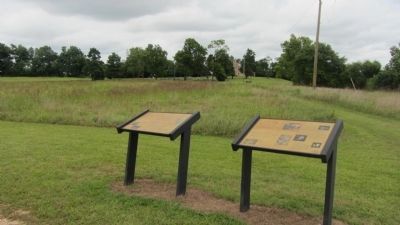
2. First Americans at Mount Calvert Marker
Looking north toward the Mount Calvert plantation house.
Photographed by F. Robby, August 19, 2013
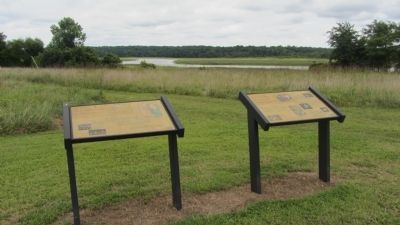
3. First Americans at Mount Calvert Marker
Overlooking the Patuxent River.
Photographed by Allen C. Browne, December 26, 2014
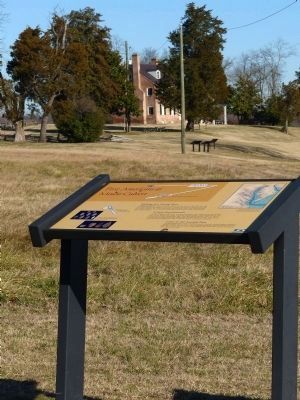
4. First Americans at Mount Calvert Marker
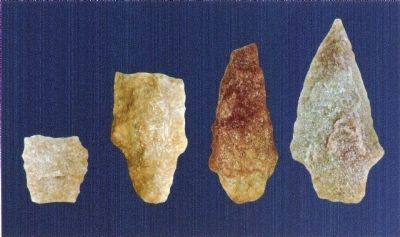
Photographed by Allen C. Browne, December 26, 2014
5. Archaic Spear Points
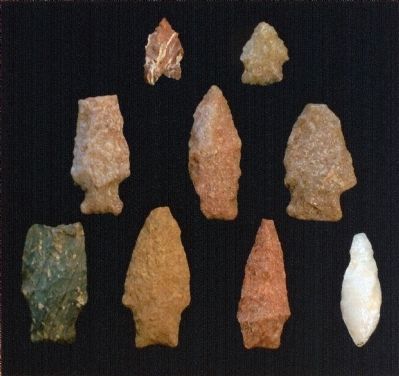
Photographed by Allen C. Browne, December 26, 2014
6. Archaic Spear Points

Photographed by Allen C. Browne, December 26, 2014
7. Replica of spear and spear thrower
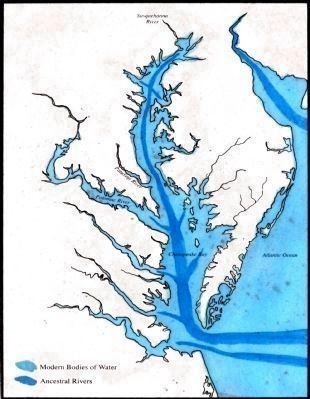
Photographed by Allen C. Browne, December 26, 2014
8. Ancient River Beds
Credits. This page was last revised on December 5, 2021. It was originally submitted on September 1, 2013, by F. Robby of Baltimore, Maryland. This page has been viewed 619 times since then and 22 times this year. Last updated on December 4, 2021, by Carl Gordon Moore Jr. of North East, Maryland. Photos: 1, 2, 3. submitted on September 1, 2013, by F. Robby of Baltimore, Maryland. 4, 5, 6, 7, 8. submitted on February 7, 2015, by Allen C. Browne of Silver Spring, Maryland. • J. Makali Bruton was the editor who published this page.
