Foxhall in Northwest Washington in Washington, District of Columbia — The American Northeast (Mid-Atlantic)
Foxhall Village Now and Then
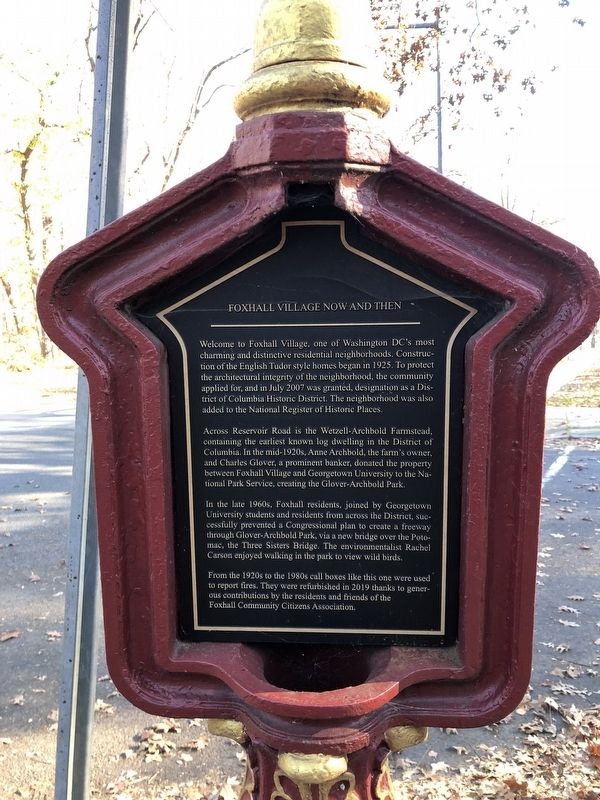
Welcome to Foxhall Village, one of Washington DC's most charming and distinctive residential neighborhoods. Construction of the English Tudor style homes began in 1925. To protect the architectural integrity of the neighborhood, the community applied for, and in July 2007 was granted, designation as a District of Columbia Historic District. The neighborhood was also added to the National Register of Historic Places.
Across Reservoir Road is the Wetzell-Archbold Farmstead, containing the earliest known log dwelling in the District of Columbia. In the mid-1920s, Anne Archbold, the farm's owner, and Charles Glover, a prominent banker, donated the property between Foxhall Village and Georgetown University to the National Park Service, creating the Glover-Archbold Park.
In the late 1960s, Foxhall residents, joined by Georgetown University students and residents from across the District, successfully prevented a Congressional plan to create a freeway through Glover-Archbold Park, via a new bridge over the Potomac, the Three Sisters Bridge. Then environmentalist Rachel Carson enjoyed walking in the park to view wild birds.
From
this page online
Erected 2019 by Foxhall Community Citizens Association. (Marker Number 4.)
Topics. This historical marker is listed in these topic lists: Architecture • Charity & Public Work • Communications • Parks & Recreational Areas • Settlements & Settlers • Women. A significant historical month for this entry is July 2007.
Location. 38° 54.752′ N, 77° 4.895′ W. Marker is in Northwest Washington in Washington, District of Columbia. It is in Foxhall. It is on 44th Street Northwest just south of Reservoir Road Northwest, on the left when traveling north. Touch for map. Marker is at or near this postal address: 4402 Reservoir Rd NW, Washington DC 20007, United States of America. Touch for directions.

Regionally, this marker is in the Washington Metropolitan Area. It is also in the American Northeast, in the Upper South, in the Mid-Atlantic, in the Tidewater, and in the Chesapeake Bay Region. Globally, it

Other nearby markers. At least 8 other markers are within walking distance of this marker: Through the Eyes of a Scientist (within shouting distance of this marker); History of Police and Fire Call Boxes (about 600 feet away, measured in a direct line); The Development of Foxhall Village (about 700 feet away); Development Along Foxhall Road (approx. 0.2 miles away); The Freddy and Diana Prince Labyrinth (approx. 0.3 miles away); Healing in War and Peace (approx. 0.3 miles away); MacArthur Boulevard and the Washington Aqueduct (approx. 0.4 miles away); Henry Foxall - Industrialist (approx. 0.4 miles away). Touch for a list and map of all markers in Northwest Washington.
Another marker is no longer nearby. History of MedStar Georgetown Hospital (was approx. 0.4 miles away but has been permanently removed).
Additional commentary.
1. The Freeway Revolts and Their Legacy
The Freeway Revolts was a set of political movements in the 1960s that occurred when new roads were in development to run through historic areas of cities.
The Freeway Revolts
For DC, note how there are few to no freeways through much of the Northwestern Quadrant, while Interstates 295, 395 and 695 run through the other three quadrants, which were historically not as affluent. The only "state highway" in the District of Columbia is DC 295, which runs through Northeast DC. This legacy has given these less affluent communities the nickname of "sacrifice communities."
The historic preservation movement has too often ignored many contributions from communities of color, especially African American communities. The District of Columbia has worked on preserving its proud African American heritage, although work remains to be done.
— Submitted December 5, 2021, by Devry Becker Jones of Washington, District of Columbia.
Additional keywords. the Freeway Revolts

Credits. This page was last revised on January 30, 2023. It was originally submitted on December 5, 2021, by Devry Becker Jones of Washington, District of Columbia. This page has been viewed 518 times since then and 43 times this year. Photos: 1, 2, 3, 4. submitted on December 5, 2021, by Devry Becker Jones of Washington, District of Columbia.
