Central City in Birmingham in Jefferson County, Alabama — The American South (East South Central)
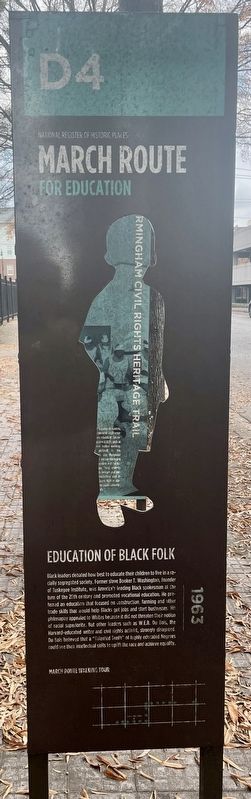
Education of Black Folk
March Route for Education
| — | Birmingham Civil Rights Heritage Trail | — |
Photographed by Mark Hilton, December 5, 2021
1. Education of Black Folk Marker
(Marker is under trees that have darkened the marker surface.)
Paired marker
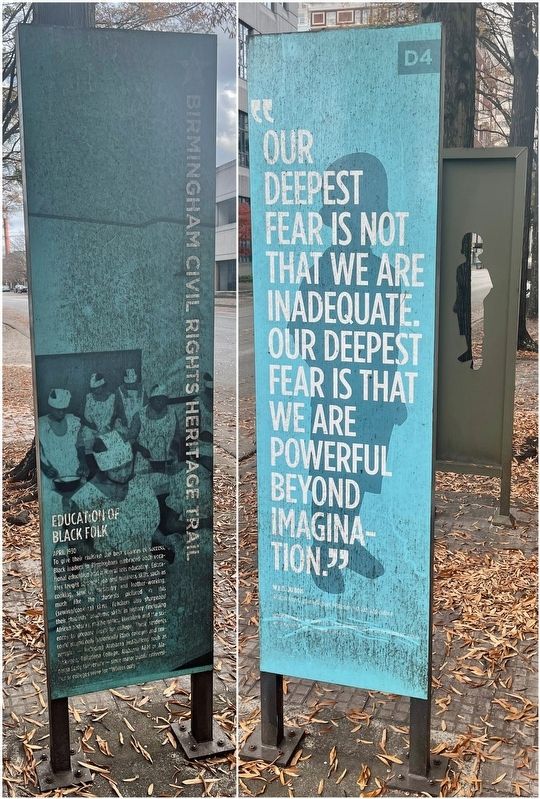
April 1930
To give their children the best chances of success, Black leaders in Birmingham embraced both vocational education and a liberal arts education. Educators taught student's job and business skills such as cooking, sewing, carpentry and leather-working, much like the students pictured in this (sewing/cooking) class. Teachers also
this page online
"Our deepest fear is not that we are inadequate. Our deepest fear is we are powerful beyond imagination."
W.E.B. Du Bois
African American Intellectual, historian, activist and author
Lesson D4: What are the benefits of an industrial education that focuses on job skills and a liberal arts education to focuses on college preparation?
Erected by the Birmingham Civil Rights Heritage Trail. (Marker Number D4.)
Topics and series. This historical marker is listed in these topic lists: African Americans • Civil Rights • Education. In addition, it is included in the Birmingham Civil Rights Heritage Trail series list. A significant historical month for this entry is April 1930.
Location. 33° 31.251′ N, 86° 48.444′ W. Marker
Photographed by Mark Hilton
2. Education of Black Folk paired marker

Regionally, this marker is in the American South and specifically in the Deep South. Globally, it is in North America, a Gulf of Mexico state, the Western Hemisphere, the Western World, and the Anglosphere. Historically, it finds itself in what was once the territory of the Mississippian Culture, one of the Confederate States of America, and the Antebellum South.
Other nearby markers. At least 8 other markers are within walking distance of this marker: Little Lady Can Read (within shouting distance of this marker); Hope Arrives (within shouting distance of this marker); Alabama's Rebel Yell (within shouting distance of this marker); Separate But Unequal Education (about 300 feet away, measured in a direct line); The Tutwiler Hotel / The Tutwiler-Ridgely Rebirth (about 300 feet away); The Schoolhouse Stand at Alabama (about 300 feet away); School Integration Now (about 400 feet away); Children's Crusade for Education (about 400 feet away). Touch for a list and map of all markers in Birmingham.
Regarding Education of Black Folk. The Civil Rights Activist Committee “Home of the Foot Soldiers“ is the Information Center for the Birmingham Civil Rights Heritage Trail.
Photographed by Mark Hilton, December 5, 2021
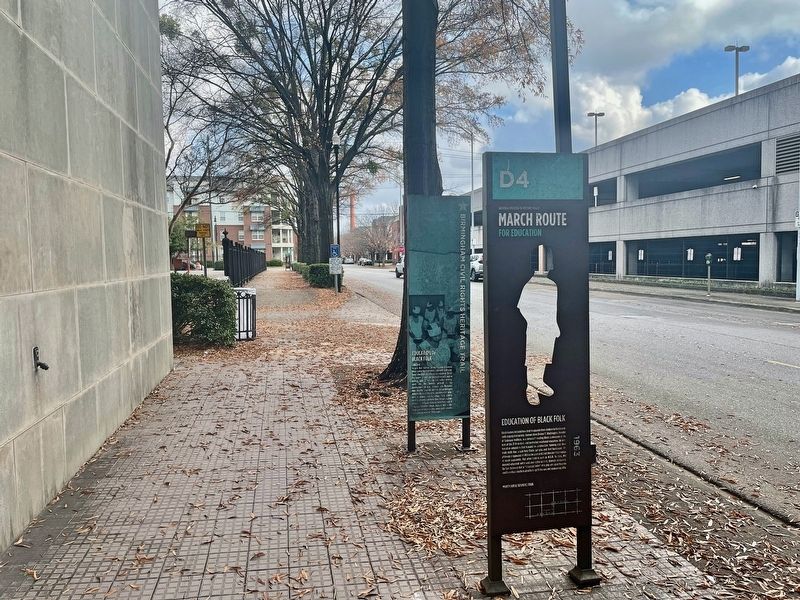
3. Education of Black Folk Marker
Credits. This page was last revised on January 8, 2022. It was originally submitted on December 6, 2021, by Mark Hilton of Montgomery, Alabama. This page has been viewed 393 times since then and 34 times this year. Photos: 1, 2, 3. submitted on December 6, 2021, by Mark Hilton of Montgomery, Alabama.
