Near Franklin in Macon County, North Carolina — The American South (South Atlantic)
Pottery Clay
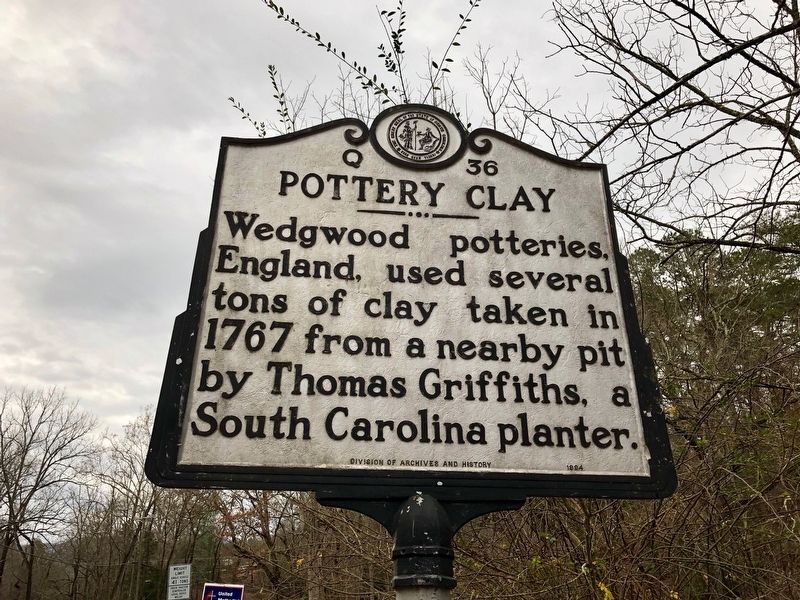
Warren LeMay via Flickr/Public domain, January 2, 2019
1. Pottery Clay Marker
Erected 1950 by North Carolina Division of Archives and History. (Marker Number Q-36.)
Topics and series. This historical marker is listed in these topic lists: Colonial Era • Environment • Industry & Commerce. In addition, it is included in the North Carolina Division of Archives and History series list. A significant historical year for this entry is 1767.
Location. 35° 15.714′ N, 83° 24.62′ W. Marker is near Franklin, North Carolina, in Macon County. It is at the intersection of Bryson City Road (State Highway 28) and West's Mill Road (County Road 1350), on the right on Bryson City Road. Touch for map. Marker is at or near this postal address: 20 West's Mill Rd, Franklin NC 28734, United States of America. Touch for directions.

Regionally, this marker is in andspecifically he Mountains in the Golden Corner. It is also in the American South, specifically in the Upper South, in Appalachia, and specifically in Southern Appalachia. Globally, it is in North America, the
this page online
Other nearby markers. At least 8 other markers are within 6 miles of this marker, measured as the crow flies: Cowee (within shouting distance of this marker); Nokwisiyi (Star Place) (approx. 5.7 miles away); Na'ha or Rebecca Morris (approx. 5.7 miles away); Nikwasi (approx. 5.7 miles away); Nikwasi Mound (approx. 5.7 miles away); The Bartram Trail (approx. 5.8 miles away); William Bartram Naturalist (approx. 5.8 miles away); Dixie Hall (approx. 5.8 miles away). Touch for a list and map of all markers in Franklin.
Another marker is no longer nearby. Cherokee Defeat (was approx. 3½ miles away but has been permanently removed).
Regarding Pottery Clay. Essay on North Carolina marker page:
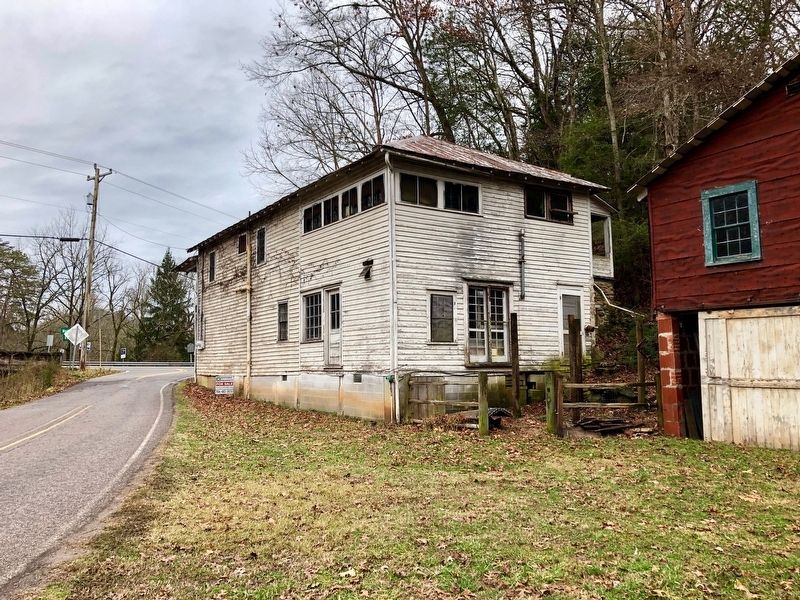
By the 1740s people in England and in the American colonies knew of the valuable white clay deposits in the Cherokee region of the North Carolinamountains. Andrew Duche, a potter from Savannah, Georgia, learned that the basic ingredients for making porcelain, kaolin and petunze, could be derived from the white clay. A British patent was filed about 1744 “for the production of porcelain from an earthy mixture, produced by the Cherokee Nation in America, that probably consisted of kaolin, feldspar and quartz.” One British explorer described Cherokee houses that were “plaistered with a clay white as lime which is found in this Country.”Warren LeMay via Flickr/Public domain, January 2, 20192. Pottery Clay MarkerLooking south from West's Mill Road. Marker can be seen across the road.
At the time there was increasing interest in creating porcelain in England and the colonies. To this end, in 1765 Josiah Wedgwood launched efforts to secure what was called Cherokee Clay. Although transporting the clay from the backcountry to the coast and then to England would be almost prohibitively expensive, Wedgwood was unwilling to invest and in 1766 he secured an agent to travel to America and conduct business on his behalf. The agent, Thomas Griffiths, was the younger brother of an old friend of Wedgwood’s and was familiar with the Carolinas, owning property in South Carolina.
Griffiths left England in July 1767, bound for Charleston and ultimately the settlement of Ayoree in the Cherokee Middle Towns (Iotla in present Macon County). There he was to negotiate an arrangement whereby he could purchase five to six tons of Cherokee Clay for Wedgwood. Upon his arrival at Keowee, Girffiths was told by the Indians that “they had been Trubled with some young Men long before, who made great holes in their Land, took away their fine White Clay, and gave them only Promises for it.”
In early November, with the assistance of an interpreter, Griffiths met with the Cherokee for a “strong Talk which lasted near four hours” and settled on a reasonable trade, though unspecified in Griffiths’ journal, for the clay. Griffiths managed to extract and dry “a Ton of fine clay” in about four days. Heavy rains delayed the rest of the extraction, which was completed on December 18, 1767. Five days later he headed down the mountains with about five tons of clay carried by pack horses. Griffiths delivered the Cherokee Clay to Josiah Wedgwood in April 1768.
Because of the expenses incurred, and because other kaolin deposits were discovered in England, Wedgwood never pursued additional shipments of clay from North Carolina. His supply lasted at least until 1783, however, at which time he wrote that Cherokee Clay was the basis of a new biscuit porcelain that we was manufacturing. In 1985 the Wedgwood firm used North Carolina clay to produce limited edition bowls and plates for the commemoration of the 400th anniversary of the Roanoke colony.
Credits. This page was last revised on December 9, 2021. It was originally submitted on December 9, 2021, by Duane and Tracy Marsteller of Murfreesboro, Tennessee. This page has been viewed 850 times since then and 45 times this year. Photos: 1, 2. submitted on December 9, 2021, by Duane and Tracy Marsteller of Murfreesboro, Tennessee.
