Historic District in St. Augustine in St. Johns County, Florida — The American South (South Atlantic)
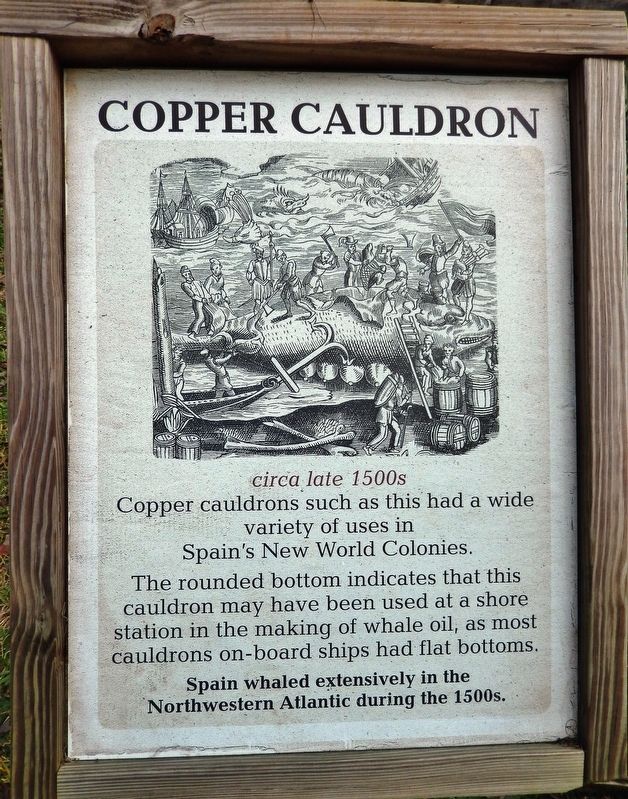
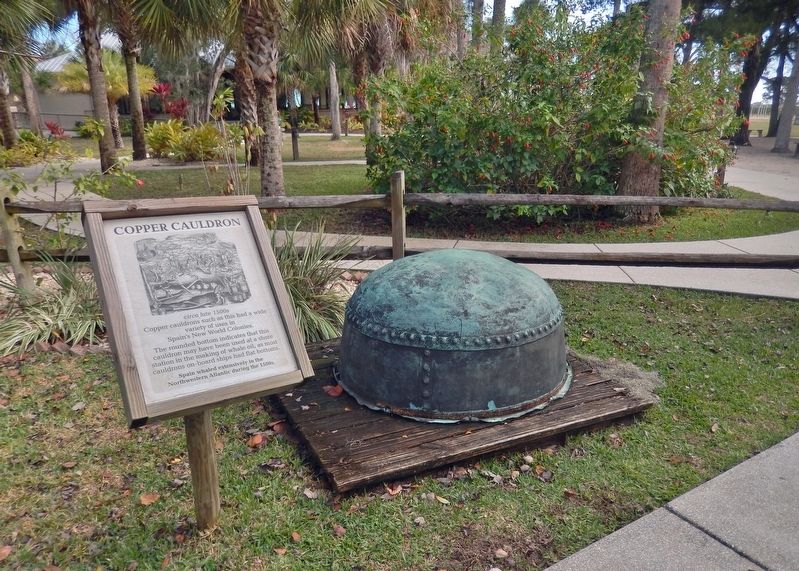
Copper Cauldron
circa late 1500s
Photographed by Cosmos Mariner, December 16, 2021
1. Copper Cauldron Marker
variety of uses in
Spain's New World Colonies.
The rounded bottom indicates that this cauldron may have been used at a shore station in the making of whale oil, as most cauldrons on-board ships had flat bottoms.
Northwestern Atlantic during the 1500s.
Topics. This historical marker is listed in these topic lists: Colonial Era • Industry & Commerce • Waterways & Vessels.
Location. 29° 54.426′ N, 81° 18.92′ W. Marker is in St. Augustine, Florida, in St. Johns County. It is in the Historic District. It can be reached from Williams Street east of Magnolia Avenue. Marker is located along the interpretive trail in Ponce de León's Fountain of Youth Archaeological Park. Touch for map. Marker is at or near this postal address: 11 Magnolia Avenue, Saint Augustine FL 32084, United States of America. Touch for directions.

Regionally, this marker is in First Coast and in Greater Jacksonville. It is also in the American South and on the Eastern Seaboard. Globally, it is in the North Atlantic Region,
this page online
Other nearby markers. At least 8 other markers are within walking distance of this marker: Common Anchor (a few steps from this marker); 1770s British Anchor (a few steps from this marker); U.S.S. Constitution Cannons (a few steps from this marker); The Original Mission Church (a few steps from this marker); Mission Life in Nombre de Dios (within shouting distance of this marker); Timucuan Style Dugout Canoe (within shouting distance of this marker); Life in the Timucuan Village (within shouting distance of this marker); a different marker also named The Original Mission Church (within shouting distance of this marker). Touch for a list and map of all markers in St. Augustine.
Related markers. Click here for a list of markers that are related to this marker. Ponce de León's Fountain of Youth Archaeological Park
Also see . . . History of Basque whaling.
Photographed by Cosmos Mariner, December 16, 2021
2. Copper Cauldron Marker
The first undisputed presence of Basque whaling expeditions in the New World was in the second quarter of the 16th century. By the 1540s, when the Spanish Basques began sending whaling expeditions to Newfoundland, the ventures were no longer experimental, but a "resounding financial success from their inception." By the end of the decade they were delivering large cargoes of whale oil to Bristol, London, and Flanders. A large market existed for "lumera", as whale oil used for lighting was called.(Submitted on December 26, 2021, by Cosmos Mariner of Cape Canaveral, Florida.)

Photographed by Cosmos Mariner, December 16, 2021
3. Copper Cauldron
Credits. This page was last revised on September 5, 2024. It was originally submitted on December 26, 2021, by Cosmos Mariner of Cape Canaveral, Florida. This page has been viewed 759 times since then and 44 times this year. Photos: 1, 2, 3. submitted on December 26, 2021, by Cosmos Mariner of Cape Canaveral, Florida.
