Main/Military Plaza in San Antonio in Bexar County, Texas — The American South (West South Central)
Plaza Principal
La Ley, The Law of the Indes, 1571
| — | Main Plaza | — |
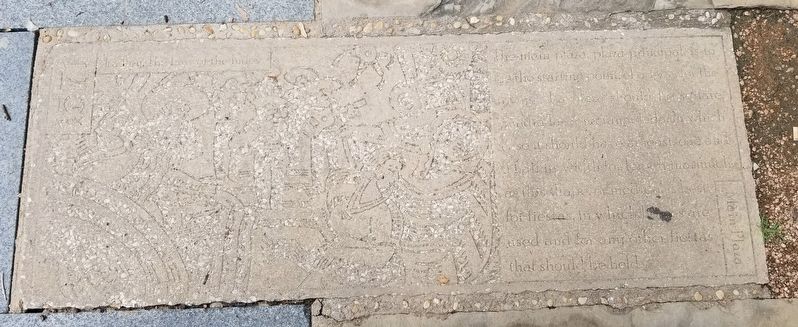
Photographed by James Hulse, August 9, 2021
1. Plaza Principal Marker
Erected 2008 by Bexar County and the city of San Antonio.
Topics. This historical marker is listed in these topic lists: Charity & Public Work • Colonial Era • Hispanic Americans.
Location. 29° 25.481′ N, 98° 29.607′ W. Marker is in San Antonio, Texas, in Bexar County. It is in Main/Military Plaza. It can be reached from the intersection of Dolorosa and Main Plaza. The marker lays flat on the ground in the Main Plaza grounds. Touch for map. Marker is at or near this postal address: 100 Dolorosa, San Antonio TX 78205, United States of America. Touch for directions.

Regionally, this marker is in South Texas. It is also in the American South. Globally, it is in North America, a Gulf of Mexico state, the Western Hemisphere,
this page online
Other nearby markers. At least 8 other markers are within walking distance of this marker: Games of Chance (a few steps from this marker); Cock Fighting (a few steps from this marker); White Elephant (a few steps from this marker); The Old Cathedral (a few steps from this marker); Draws a Revolver and Fires Away (a few steps from this marker); American Dancers (a few steps from this marker); Sinister Enticements (within shouting distance of this marker); Main Plaza - Plaza de las Islas (within shouting distance of this marker). Touch for a list and map of all markers in San Antonio.
Regarding Plaza Principal. When visiting Main Plaza, be sure to look for and locate all 30 significant, historical pavers embedded into the floor of the plaza.
Also see . . . Laws of the Indies.
The Laws of the Indies (Spanish: Leyes de las Indias) are the entire body of laws issued by the Spanish Crown for the American and the Asian possessions of its empire. They(Submitted on December 26, 2021, by James Hulse of Medina, Texas.)regulated social, political, religious, and economic life in these areas. The laws are composed of myriad decrees issued over the centuries and the important laws of the 16th century, which attempted to regulate the interactions between the settlers and natives, such as the Laws of Burgos (1512) and the New Laws (1542). Throughout the 400 years of Spanish presence in these parts of the world, the laws were compiled several times, most notably in 1680 under Charles II in the Recopilación de las Leyes de los Reynos de las Indias. (Compilation of the Laws of the Kingdoms of the Indies). This became considered the classic collection of the laws, although later laws superseded parts of it, and other compilations were issued. Source: WikipediaPhotographed by James Hulse, August 9, 20212. Closeup of the Plaza Principal Marker


Photographed by James Hulse, August 9, 2021
3. The view of the Plaza Principal Marker in the Main Plaza
Credits. This page was last revised on February 2, 2023. It was originally submitted on December 26, 2021, by James Hulse of Medina, Texas. This page has been viewed 385 times since then and 32 times this year. Photos: 1, 2, 3. submitted on December 27, 2021, by James Hulse of Medina, Texas.
