Druid Hill Park in Baltimore, Maryland — The American Northeast (Mid-Atlantic)
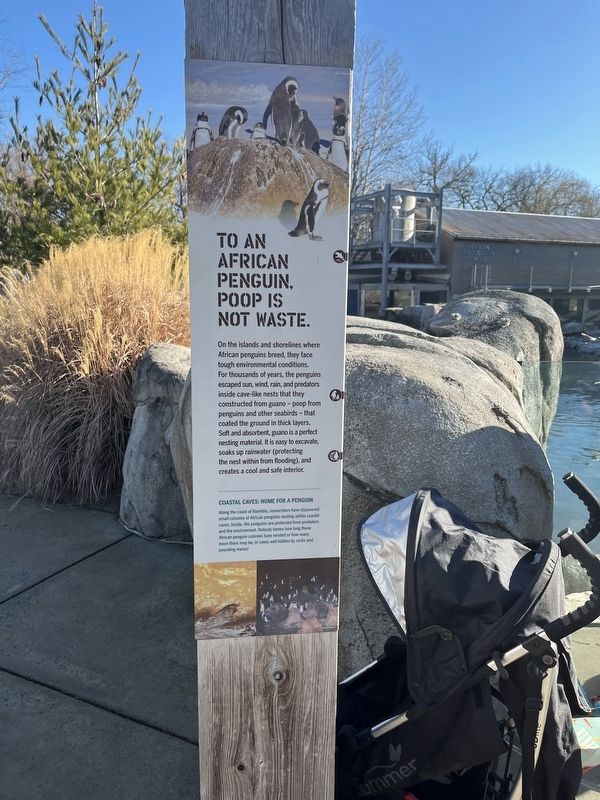
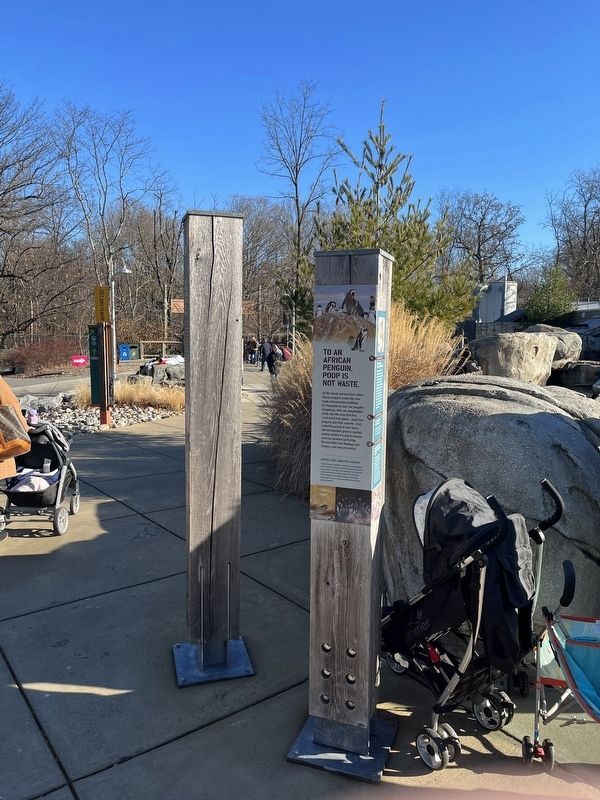
To an African penguin, poop is not waste.
🐧
Photographed by Devry Becker Jones (CC0), December 26, 2021
1. To an African Penguin, Poop Is Not Waste. Marker
On the islands and shorelines where African penguins breed, they face tough environmental conditions. For thousands of years, the penguins escaped sun, wind, rain, and predators inside cave-like nests that they constructed from guano — poop from penguins and other seabirds — that coated the ground in thick layers. Soft and absorbent, guano is a perfect nestling material. It is easy to excavate, soaks up rainwater (protecting the nest within from flooding), and creates a cool and safe interior.
Coastal Caves: Home for a Penguin
Along the coast of Namibia, researchers have discovered small colonies of African penguins nestling within coastal caves. Inside, the penguins are protected from predators and the environment. Nobody knows how long these African penguin colonies have existed or how many more there may be, in caves well hidden by rocks and pounding waves!
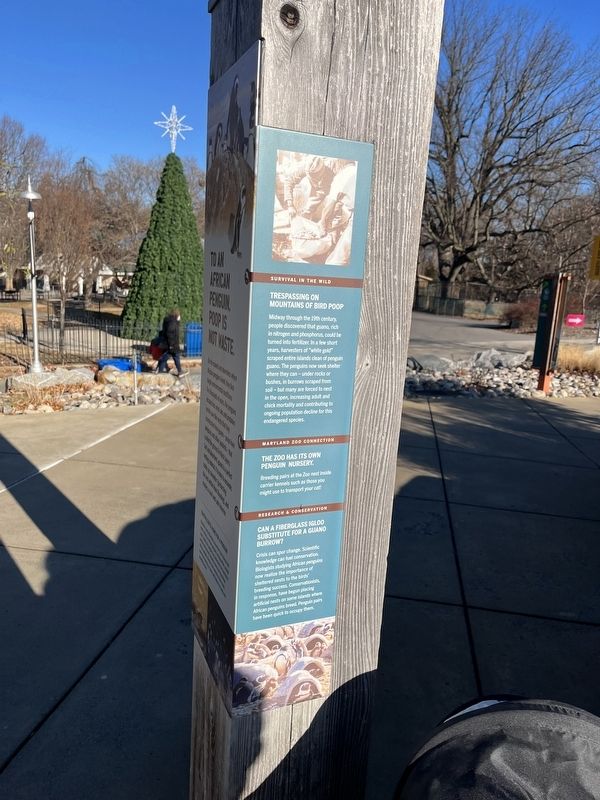
Survival in the Wild
Trespassing on Mountains of Bird Poop
Midway through the 19th century, people discovered that guano, rich in nitrogen and phosphorus, could be turned into fertilizer. In a few short years, harvesters of "white gold" scraped entire islands
this page online
Maryland Zoo Connection
The Zoo Has Its Own Penguin Nursery.
Breeding pairs at the Zoo nest inside carrier kennels such as those you might use to transport your cat!
Research & Conservation
Can A Fiberglass Igloo Substitute for a Guano Burrow?
Crisis can spur change. Scientific knowledge can fuel conservation. Biologists studying AFrican penguins now realize the importance of sheltered nests to the birds' breeding success. Conservationists, in response, have begun placing artificial nests on some islands where African penguins breed. Penguin pairs have been quick to occupy them.
Topics. This historical marker is listed in these topic lists: Animals • Environment • Industry & Commerce • Natural Resources • Science & Medicine.
Location. 39° 19.523′ N, 76° 38.71′ W. Marker is in Baltimore,
Photographed by Devry Becker Jones (CC0), December 26, 2021
2. To an African Penguin, Poop Is Not Waste. Marker

Regionally, this marker is in Central Maryland. It is also in the American Mid-Atlantic, in the Chesapeake Bay Region, and on the Eastern Seaboard. Globally, it is in the North Atlantic Region, North America, the Western Hemisphere, the Western World, and the Anglosphere. Historically, it finds itself in what was once one of the original Thirteen Colonies and also the Antebellum South.
Other nearby markers. At least 8 other markers are within walking distance of this marker: Because penguins are birds, they must breed on land. (here, next to this marker); Avian Malaria: A Problem with a Pioneering Solution (a few steps from this marker); Survival in the Wild / Research & Conservation (a few steps from this marker); Welcome to Penguin Coast (a few steps from this marker); Disaster at Sea (within shouting distance of this marker); Help from the Zoo (within shouting distance of this
Photographed by Devry Becker Jones (CC0), December 26, 2021
3. To an African Penguin, Poop Is Not Waste. Marker
Credits. This page was last revised on December 28, 2021. It was originally submitted on December 27, 2021, by Devry Becker Jones of Washington, District of Columbia. This page has been viewed 571 times since then and 43 times this year. Photos: 1, 2, 3. submitted on December 27, 2021, by Devry Becker Jones of Washington, District of Columbia.
