Druid Hill Park in Baltimore, Maryland — The American Northeast (Mid-Atlantic)
Saving Okapi
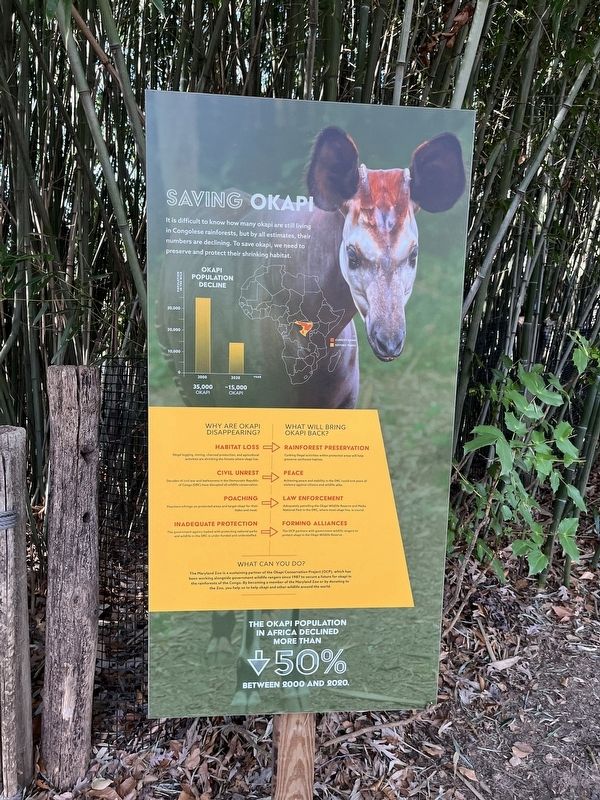
It is difficult to know how many okapi are still living in Congolese rainforests, but by all estimates, their numbers are declining. To save okapi, we need to preserve and protect their shrinking habitat.
Okapi population decline
2000: 35,000 okapi
2020: ~15,000 okapi
➩
What will bring okapi back?
Habitat loss. Illegal logging, mining, charcoal production, and agricultural activities are shrinking the forests where okapi live.
➩
Rainforest preservation. Curbing illegal activities within protected areas will help preserve rainforest habitat.
Civil unrest. Decades of civil war and lawlessness in the Democratic Republic of Congo (DRC) have disrupted all wildlife conservation.
➩
Peace. Achieving peace and stability in the DRC could end years of violence against citizens and wildlife alike.
Poaching. Poachers infringe on protected areas and target okapi for their hides and meat.
➩
Law enforcement. Adequately patrolling the Okapi Wildlife Reserve and Maiko National Park in the DRC, where most okapi live, is crucial.
Inadequate protection. The
this page online
➩
Forming alliances. The OCP partners with government wildlife rangers to protect okapi in the Okapi Wildlife Reserve.
What can you do?
The Maryland Zoo is a sustaining partner of the Okapi Conservation Project (OCP), which has been working alongside government wildlife rangers since 1987 to secure a future for okapi in the rainforests of the Congo. By becoming a member of the Maryland Zoo or by donating to the Zoo, you help us to help okapi and other wildlife around the world.
The okapi population in Africa declined more than 🢃50% between 2000 and 2020.
Topics. This historical marker is listed in these topic lists: Animals • Environment • Government & Politics • Industry & Commerce • Parks & Recreational Areas • Wars, Non-US. A significant historical year for this entry is 2000.
Location. 39° 19.489′ N, 76° 38.458′ W. Marker is in Baltimore, Maryland. It is in Druid Hill Park. It can be reached from Silver Spring Drive east of African Journey, on the left when traveling north.
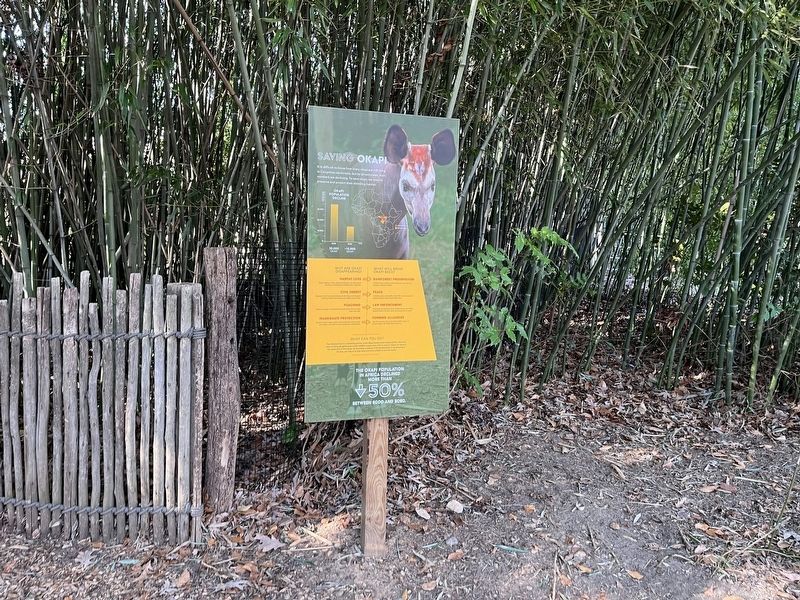

Regionally, this marker is in Central Maryland. It is also in the American Mid-Atlantic, in the Chesapeake Bay Region, and on the Eastern Seaboard. Globally, it is in the North Atlantic Region, North America, the Western Hemisphere, the Western World, and the Anglosphere. Historically, it finds itself in what was once one of the original Thirteen Colonies and also the Antebellum South.
Other nearby markers. At least 8 other markers are within walking distance of this marker: Ghosts of the forest (within shouting distance of this marker); African Savannah Elephant (about 400 feet away, measured in a direct line); Living with Elephants (about 400 feet away); Tipping the Balance (about 400 feet away); An Innovative Partnership (about 400 feet away); Family Matters (about 400 feet away); Living with Cheetahs (about 600 feet away); "…And Oh, We Had Fun" (approx. 0.2 miles away). Touch for a list and map of all markers in Baltimore.
Credits. This page was last revised on December 28, 2021. It was originally submitted on December 28, 2021, by Devry Becker Jones of Washington, District of Columbia. This page has been viewed 310 times since then and 30 times this year. Photos: 1, 2. submitted on December 28, 2021, by Devry Becker Jones of Washington, District of Columbia.
