St. Augustine in St. Johns County, Florida — The American South (South Atlantic)
Tabby
⎯⎯⎯
Coquina
Photographed by Cosmos Mariner, December 16, 2021
1. Tabby / Coquina Marker
TabbyComposition
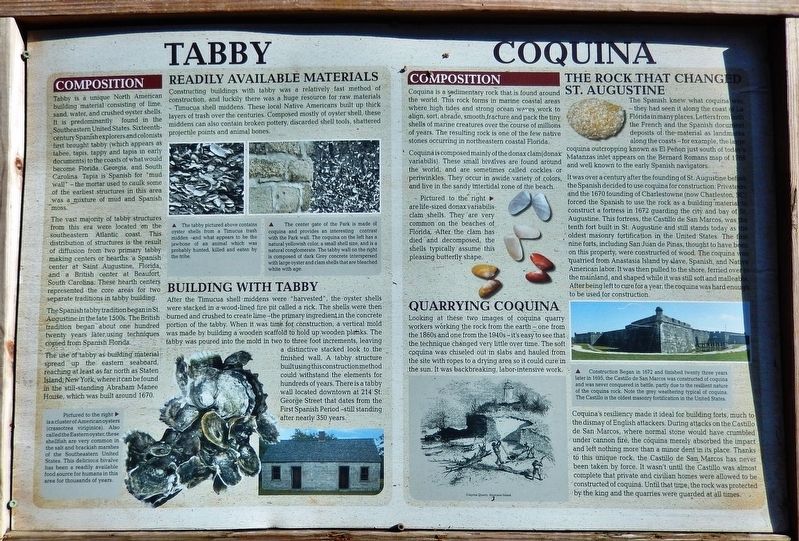
Tabby is a unique North American building material consisting of lime, sand, water, and crushed oyster shells. It is predominantly found in the Southeastern United States. Sixteenth-century Spanish explorers and colonists first brought tabby (which appears as tabee, tapis, tappy and tapia in early documents) to the coasts of what would become Florida, Georgia, and South Carolina. Tapia is Spanish for "mud wall" — the mortar used to caulk some of the earliest structures in this area was a mixture of mud and Spanish moss.
The vast majority of tabby structures from this era were located on the southeastern Atlantic coast. This distribution of structures is the result of diffusion from two primary tabby making centers or hearths: a Spanish center at Saint Augustine, Florida, and a British center at Beaufort, South Carolina. These hearth centers represented the core areas for two separate traditions in tabby building.
The Spanish tabby tradition began in St. Augustine in the late 1500s. The British tradition began about one hundred twenty years later, using techniques copied from Spanish Florida.
The use of tabby
this page online
Readily Available Materials
Constructing buildings with tabby was a relatively fast method of construction, and luckily there was a huge resource for raw materials — Timucua shell middens. These local Native Americans built up thick layers of trash over the centuries. Composed mostly of oyster shell, these middens can also contain broken pottery, discarded shell tools, shattered projectile points and animal bones.
Building with Tabby
After the Timucua shell middens were "harvested", the oyster shells were stacked in a wood-lined fire pit called a rick. The shells were then burned and crushed to create lime — the primary ingredient in the concrete portion of the tabby. When it was time for construction, a vertical mold was made by building a wooden scaffold to hold up wooden planks. The tabby was poured into the mold in two to three foot increments, leaving a distinctive stacked look to the finished wall. A tabby structure built using
2. Marker detail: Tabby & Coquina
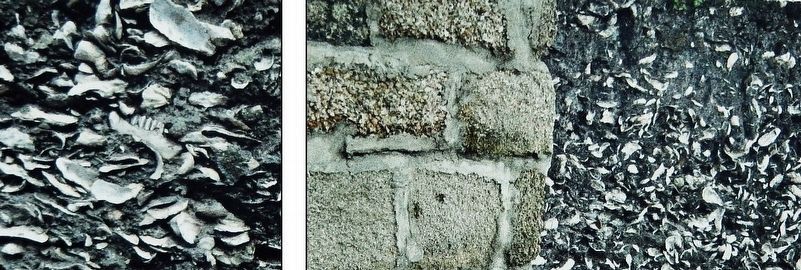
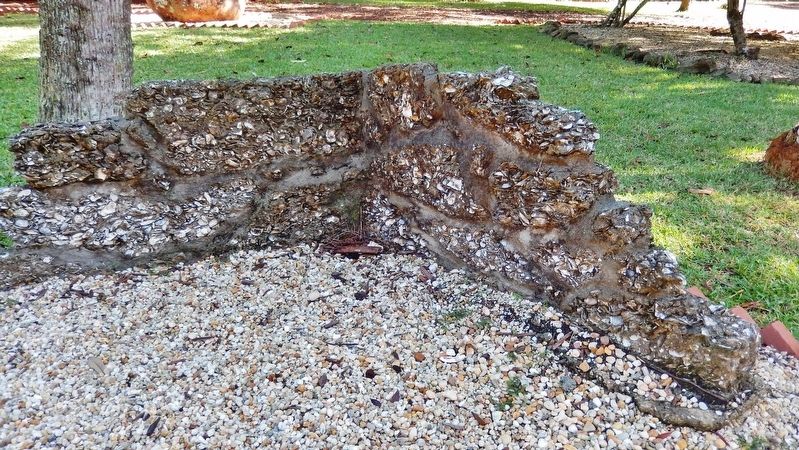
[left] The tabby pictured above contains oyster shells from a Timucua trash midden — and what appears to be the jawbone of an animal which was probably hunted, killed and eaten by the tribe.
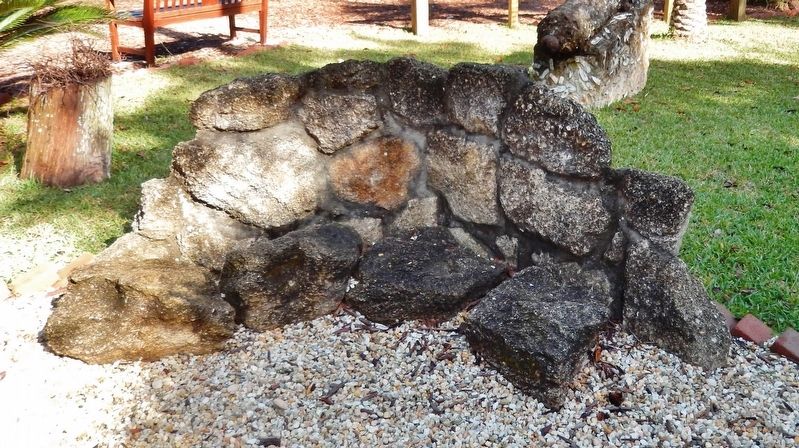
[right] The center gate of the Park is made of coquina and provides an interesting contrast with the Park wall. The coquina on the left has a natural yellowish color, a small shell size, and is a natural conglomerate. The tabby wall on the right is composed of dark Grey concrete interspersed with large oyster and clam shells that are bleached white with age.
Coquina
Composition
Coquina is a sedimentary rock that is found around the world. This rock forms in marine coastal areas where high tides and strong ocean waves work to align, sort, abrade, smooth, fracture and pack the tiny shells of marine creatures over the course of millions of years. The resulting rock is one of the few native stones occurring in northeastern coastal Florida.
Coquina is composed mainly of the donax clam (donax variabilis). These small bivalves are found around the world, and are sometimes called cockles or periwinkles. They Occur in a wide variety of colors, and live in the sandy intertidal zone of the beach.
Pictured to the right are life-sized donax variabilis clam shells. They are very common on the beaches of Florida. After the clam has died and decomposed, the shells typically assume this pleasing butterfly shape.
Quarrying Coquina
Looking at these two images of coquina quarry workers working
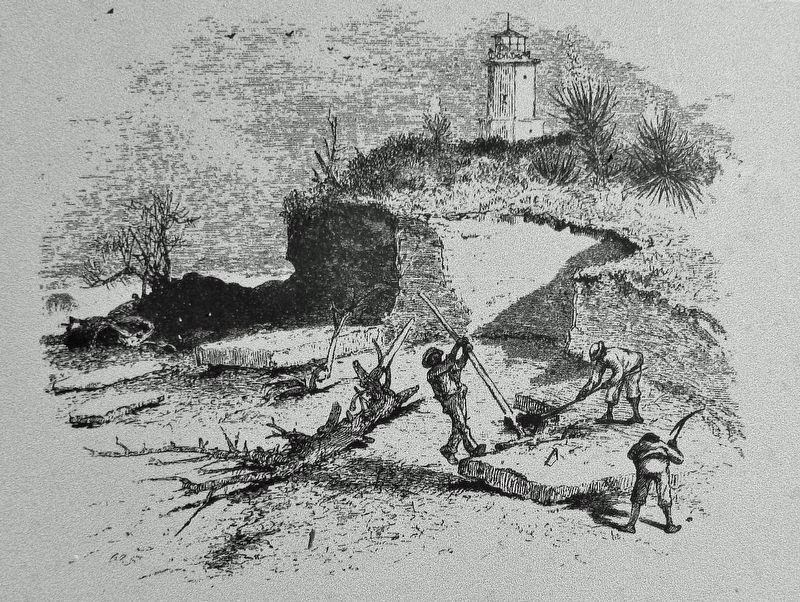
3. Marker detail: Coquina Quarry, Anastasia Island
The Rock that Changed St. Augustine
The Spanish knew what coquina was — they had seen it along the coast of La Flórida in many places. Letters from both the French and the Spanish document deposits of the material as landmarks along the coasts — for example, the large coquina outcropping known as El Peñon just south of today’s Matanzas inlet appears on the Bernard Romans map of 1768 and well known to the early Spanish navigators.
It was over a century after the founding of St. Augustine before the Spanish decided to use coquina for construction. Privateers and the 1670 founding of Charlestowne (now Charleston, SC) forced the Spanish to use the rock as a building material to construct a fortress in 1672 guarding the city and bay of St. Augustine. This fortress, the Castillo de San Marcos, was the tenth fort built in St. Augustine and still
Photographed by Cosmos Mariner, December 16, 2021
4. Tabby / Coquina Marker
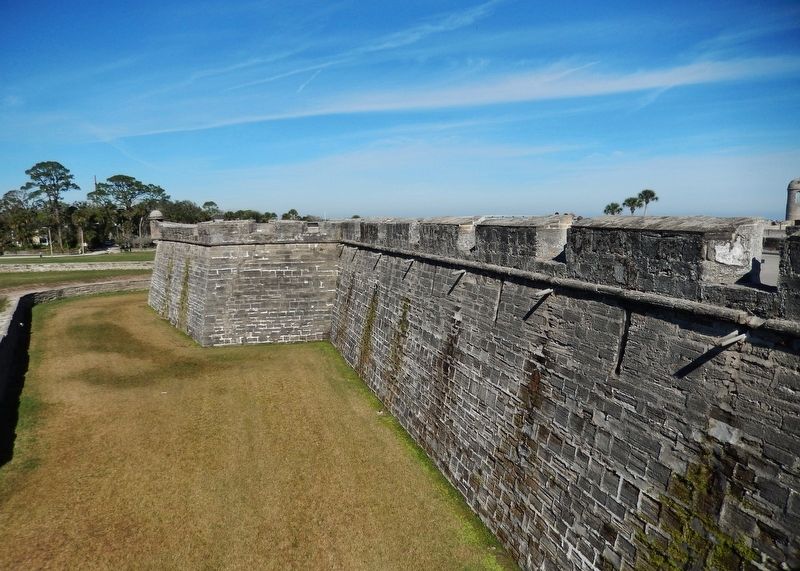
Coquina's resiliency made it ideal for building forts, much to the dismay of English attackers. During attacks on the Castillo de San Marcos, where normal stone would have crumbled under cannon fire, the coquina merely absorbed the impact and left nothing more than a minor dent in its place. Thanks to this unique rock, the Castillo de San Marcos has never been taken by force. It wasn't until the Castillo was almost complete that private and civilian homes were allowed to be constructed of coquina. Until that time, the rock, was protected by the king and the quarries were guarded at all times.
[photo caption]
• Pictured to the right is a cluster of American
Photographed by Cosmos Mariner, December 16, 2021
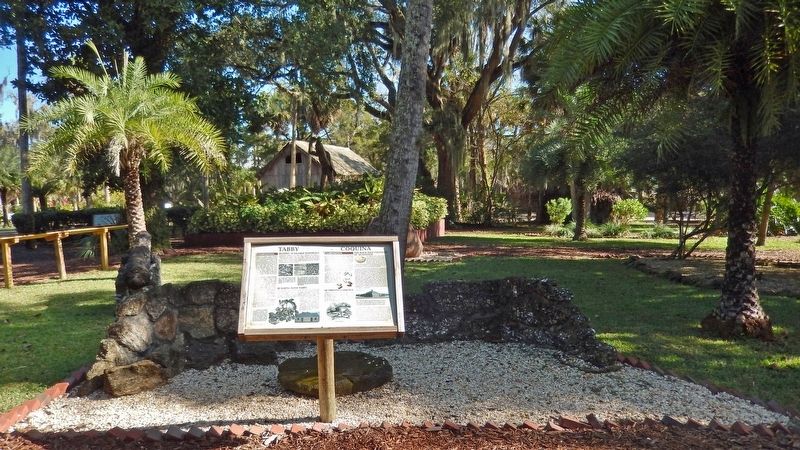
5. Tabby Wall Exhibit (located beside marker)
Topics. This historical marker is listed in these topic lists: Architecture • Colonial Era • Indigenous Peoples and Communities • Settlements & Settlers. A significant historical year for this entry is 1670.
Location. 29° 54.406′ N, 81° 18.934′ W. Marker is in St. Augustine, Florida, in St. Johns County. It can be reached from Williams Street east of Magnolia Avenue. Marker is located along the interpretive trail in Ponce de León's Fountain of Youth Archaeological Park. Touch for map. Marker is at or near this postal address: 11 Magnolia Avenue, Saint Augustine FL 32084, United States of America. Touch for directions.

Regionally, this marker is in First Coast and in Greater Jacksonville. It is also in the American South and on the Eastern Seaboard. Globally, it is in the North Atlantic Region, North America, a Gulf of Mexico state, the Western
Photographed by Cosmos Mariner, December 16, 2021
6. Coquina Wall Exhibit (located beside marker)
Other nearby markers. At least 8 other markers are within walking distance of this marker: 1513 La Florida (here, next to this marker); Juan Ponce (here, next to this marker); 1565 Menendez (here, next to this marker); 4,000 BC (here, next to this marker); Tinajónes (here, next to this marker); Chief Saturiwa (a few steps from this marker); Ancient Civilization Uncovered! (a few steps from this marker); Spanish Cannon (a few steps from this marker). Touch for a list and map of all markers in St. Augustine.
Related markers. Click here for a list of markers that are related to this marker. Ponce de León's Fountain of Youth Archaeological Park
Also see . . .
1. Tabby concrete.
Tabby is a type of concrete made by burning oyster shells to create lime, then mixing it with water, sand, ash and broken oyster shells. Tabby was used by early Spanish settlers in present-day North Carolina and Florida,(Submitted on December 29, 2021, by Cosmos Mariner of Cape Canaveral, Florida.)then by British colonists primarily in coastal South Carolina and Georgia. It is a man-made analogue of coquina, a naturally occurring sedimentary rock derived from shells and also used for building.Photographed by Cosmos Mariner, December 12, 20187. West Wall, San Pablo Bastion, Castillo de San Marcos, St. Augustine, FloridaConstruction Began in 1672 and finished twenty-three years later in 1695, the Castillo de San Marcos was constructed of coquina and was never conquered in battle, partly due to the resilient nature of the coquina rock. Note the grey weathering typical of coquina. The Castillo is the oldest masonry fortification in the United States.
2. Coquina Rock.
Coquina is a sedimentary rock that is composed either wholly or almost entirely of the transported, abraded, and mechanically sorted fragments of the shells of mollusks, trilobites, brachiopods, or other invertebrates. The term coquina comes from the Spanish word for "cockle" and "shellfish". Marine environments associated with coquinas include beaches, shallow submarine raised banks, swift tidal channels, and barrier bars.(Submitted on December 29, 2021, by Cosmos Mariner of Cape Canaveral, Florida.)
Credits. This page was last revised on September 5, 2024. It was originally submitted on December 28, 2021, by Cosmos Mariner of Cape Canaveral, Florida. This page has been viewed 2,762 times since then and 225 times this year. Photos: 1, 2, 3, 4, 5, 6, 7. submitted on December 29, 2021, by Cosmos Mariner of Cape Canaveral, Florida.
