Near Burwell in Garfield County, Nebraska — The American Midwest (Upper Plains)
The Calamus Valley

Photographed by Cosmos Mariner, August 6, 2021
1. The Calamus Valley Marker
The source of the Calamus River is spring-fed Moon Lake, 60 miles northwest of here. The river was named after a common marsh plant eaten by muskrats. Archeological evidence indicates that prehistoric Indians camped in the valley as early as 3,000 years ago. During historic times it was the hunting ground of the Pawnee, Sioux, and Omaha. The first European to visit the region was explorer James Mackay in 1796. Mackay struck the Calamus near its source and followed it downstream to its confluence with the Loup River.
The coming of settlers to the valley in the 1870s sparked occasional conflict with Indians. The last skirmish, the “Battle of the Blowout,” occurred just north of here in 1876. Sergeant William Dougherty of the 23rd Infantry and one Indian were killed in the fight. Lieutenant Charles Heyl and Corporals Patrick Leonard and Jeptha Lytton received Congressional Medals of Honor for bravery. These soldiers were from Fort Hartsuff, located on the Loup River 15 miles to the southeast. The Fort’s active period (1874-1881) marked the beginning of the modern era of settlement and development in the Calamus Valley.
Erected by Bureau
this page online
Topics and series. This historical marker is listed in these topic lists: Forts and Castles • Indigenous Peoples and Communities • Settlements & Settlers • Waterways & Vessels. In addition, it is included in the Medal of Honor Recipients, and the Nebraska State Historical Society series lists. A significant historical year for this entry is 1796.
Location. 41° 50.351′ N, 99° 12.327′ W. Marker is near Burwell, Nebraska, in Garfield County. It can be reached from Dam Road (State Highway 96) 7 miles north of State Highway 91, on the left when traveling north. Marker is located near the parking lot at the southeast end of Calamus Reservoir, overlooking the dam. Touch for map. Marker is at or near this postal address: 46279 Dam Road, Burwell NE 68823, United States of America. Touch for directions.

Regionally, this marker is in Eastern Nebraska. It is also in the American Midwest, in the Corn Belt, and on the prairies. Globally, it is in North America, the Western Hemisphere, the Western World, and the Anglosphere. Historically, it finds itself

Photographed by Cosmos Mariner, August 6, 2021
2. The Calamus Valley Marker
Other nearby markers. At least 8 other markers are within 8 miles of this marker, measured as the crow flies: The North Loup Project (within shouting distance of this marker); Railroad Turntable (approx. 5.2 miles away); First Settlers in Garfield (approx. 5.4 miles away); Garfield County (approx. 5.4 miles away); The Pebble Creek Fight (approx. 5.7 miles away); The Easter Blizzard of 1873 (approx. 5.7 miles away); Valleyview (approx. 6.8 miles away); Kamp Kaleo (approx. 7.2 miles away). Touch for a list and map of all markers in Burwell.
Also see . . .
1. Fort Hartsuff, Nebraska. Legends of America website entry:
When white settlers began to populate the North Loup Valley, Sioux depredations at Sioux Creek in October 1873 and at Pebble Creek in January 1874 prompted the settlers to request military protection. The fort was established on September 5, 1874. On December 9, 1874, the post was renamed in honor of Major General George L. Hartsuff. In addition to protecting the settlers, the fort was also responsible for overseeing the Pawnee Indian Reservation, in present Nance County.
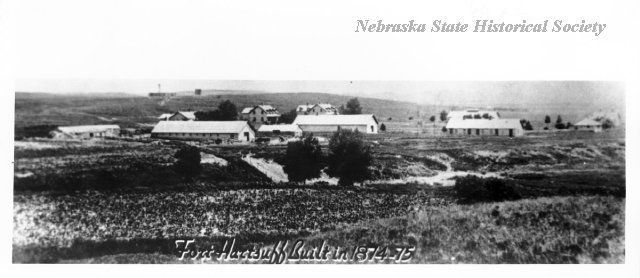
via History Nebraska, 1880
3. A bird's-eye view of Fort Hartstuff, built 1874-75
2. Fort Hartsuff was center of activity for settlers. Farm progress website entry, features the Battle of the Blowout (Submitted on November 1, 2023, by Larry Gertner of New York, New York.)
3. Charles Petit Heath Heyl • Congressional Medal of Honor.
Voluntarily, and with most conspicuous gallantry, charged with three men upon six Indians who were entrenched upon a hillside.(Submitted on January 1, 2022, by Cosmos Mariner of Cape Canaveral, Florida.)
4. Patrick Thomas Leonard • Congressional Medal of Honor.
Gallantry in charge on hostile Sioux.(Submitted on January 1, 2022, by Cosmos Mariner of Cape Canaveral, Florida.)
5. Jeptha L. Lytton • Congressional Medal of Honor.
Gallantry in charge on hostile Sioux.(Submitted on January 1, 2022, by Cosmos Mariner of Cape Canaveral, Florida.)
Credits. This page was last revised on November 1, 2023. It was originally submitted on January 1, 2022, by Cosmos Mariner of Cape Canaveral, Florida. This page has been viewed 958 times since then and 81 times this year. Photos: 1, 2. submitted on January 1, 2022, by Cosmos Mariner of Cape Canaveral, Florida. 3. submitted on November 1, 2023, by Larry Gertner of New York, New York.
