Greenville in Wayne County, Missouri — The American Midwest (Upper Plains)
Greenville Bike Trail - Greenville Trailhead
Photographed by Thomas Smith, December 19, 2021
1. Greenville Bike trail - Greenville Trailhead Marker
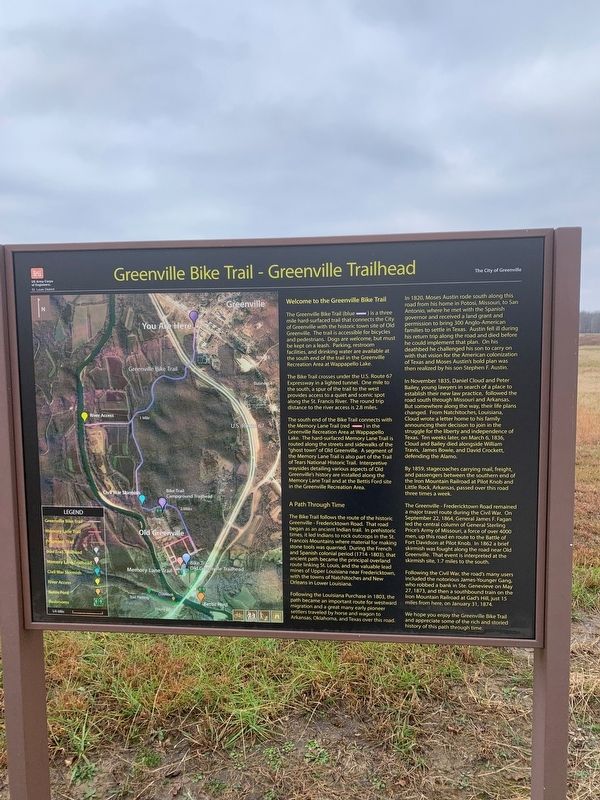
Welcome to the Grenville Bike Trail
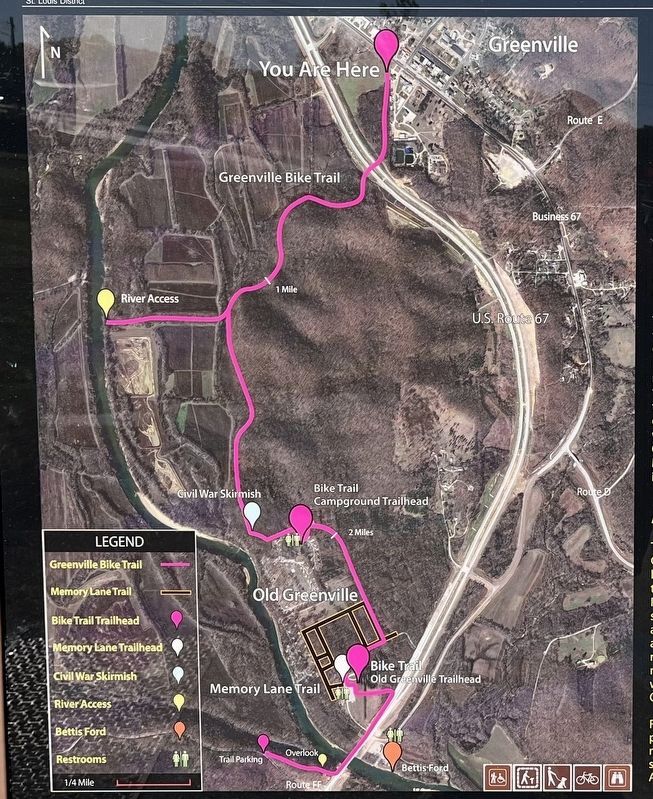
The Grenville Bike Trail (blue) is a three mile hard-surface trail that connects the City of Greenville with the historic town site of Old Greenville. The trail is accessible for bicycles and pedestrians. Dogs are welcome, but must be kept on a leash. Parking, restroom facilities, and drinking water are available ay the south end of the trail in the Greenville Recreation Area at Wappapello Lake.
The Bike Trail crosses under the U.S. Route 67 Expressway in a lighted tunnel. One mile to the south, a spur of the trail to the west provides access to a quiet and scenic spot along the St. Francis River. The round trip distance to the river access is 2.8 miles.
The south end of the Bike Trail connects with the Memory Lane Trail (red) in the Greenville Recreation Area at Wappapello Lake. The hard-surfaced Memory Lane Trail is routed along the streets and sidewalks of the "ghost town" of Old Greenville. A segment of the Memory Lane Trail is also part of the Trail of Tears national Historic Trail. Interpretive waysides detailing various aspects of Old Greenville's history are installed
this page online
A Path Through Time
The Bike Trail follows the route of the historic Greenville-Fredericktown Road. That road began as an ancient Indian trail, In prehistoric times, it led Indians to rock outcrops in the St. Francois Mountains where material for making stone tools was quarried. During the French and Spanish colonial period [1714-1803], that ancient path became the principal overland route linking St. Louis, and the valuable lead mines of Upper Louisiana near Fredericktown, with the towns of Natchitoches and New Orleans in Lower Louisiana.
Following the Louisiana Purchase in 1803, the path became an important route for westward migration and a great many early pioneer settlers traveled by horse and wagon to Arkansas, Oklahoma, and Texas over this road.
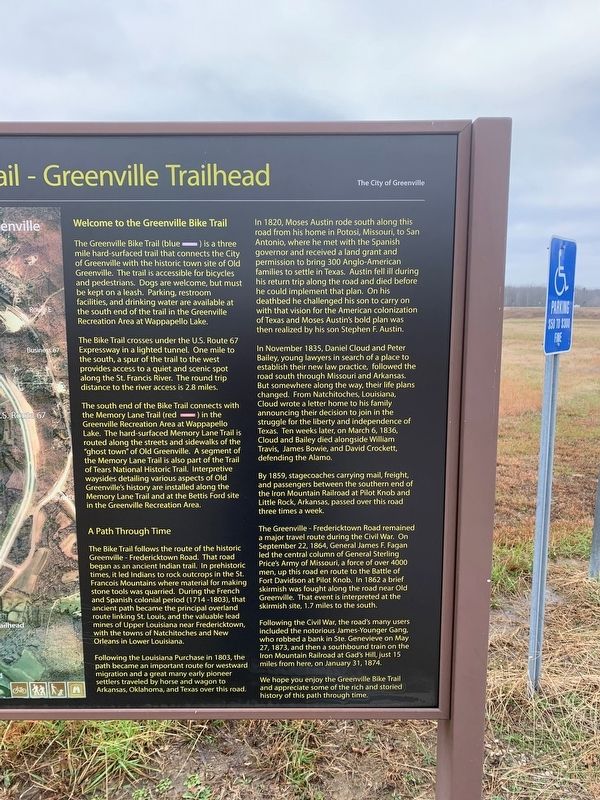
In 1820, Moses Austin rode south along this road from his home in Potosi, Missouri, to San Antonio, where he met with the Spanish governor and received a land grant and permission to bring 300 Anglo-American families to settle Texas. Austin fell ill during his return trip along the road
Photographed by Thomas Smith, December 19, 2021
2. Greenville Bike trail - Greenville Trailhead Marker
In November 1835, Daniel Cloud and Peter Bailey, young lawyers in search of a place to establish their new law practice, followed the road south through Missouri and Arkansas. But somewhere along the way, their life plans changed. From Natchitoches, Louisiana, Cloud wrote a letter home to his family announcing their decision to join in the struggle for the liberty and independence of Texas. Ten weeks later, on march 6, 1836, Cloud and Bailey died alongside William Travis, James Bowie, and David Crockett, defending the Alamo.
By 1859, stagecoaches carrying mail, freight, and passengers between the southern end of the Iron Mountain Railroad at Pilot Knob and Little Rock, Arkansas, passed over this road three times a week.
The Greenville-Fredericktown Road remained a major travel route during the Civil War. On September 22, 1864, General James F. Fagan led the central column of General Sterling Price's
Photographed by Craig Swain, September 27, 2022
3. Map of Bike Trail
The bike trail extends to the Old Greenville Recreation area, passing the site of a Civil War skirmish.
Following the Civil war, the road's many users included the notorious James-Younger Gang, who robbed a bank in Ste. Genevieve on May 27,1873, and then a southbound train on the Iron Mountain Railroad at Gad's Hill, just 15 miles from here, on January 31,1874.
We hope you enjoy the Greenville Bike Trail and appreciated some of the rich and storied history of this path through time.
Topics. This historical marker is listed in these topic lists: Roads & Vehicles • Settlements & Settlers • War, Texas Independence • War, US Civil.
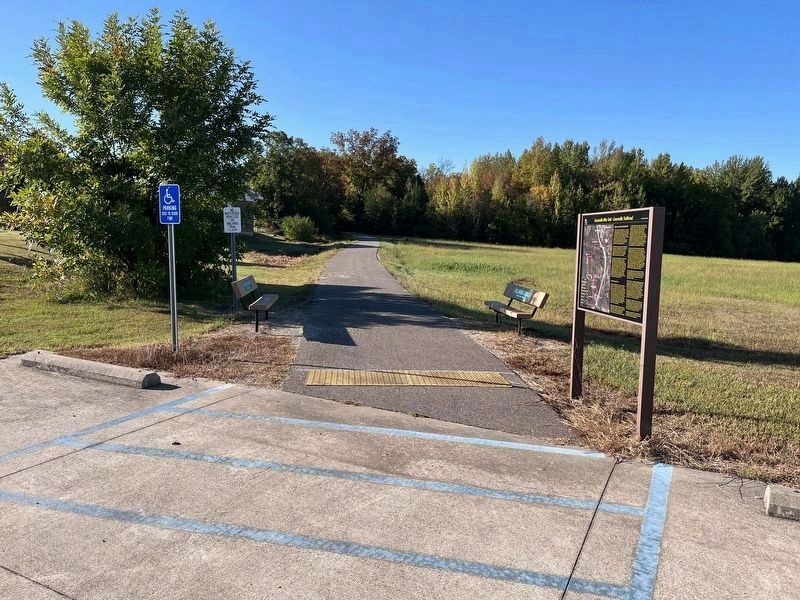
Location. 37° 7.562′ N, 90° 27.141′ W. Marker is in Greenville, Missouri, in Wayne County. It is at the intersection of Front Street (Business U.S. 67) and Sycamore Street, on the right when traveling south on Front Street. Marker is located at the northern end of the Greenville Biking Trail,
Photographed by Craig Swain, September 27, 2022
4. Marker at the Trailhead
The marker is at the northern or town-end of the trail.

Regionally, this marker is in Southeast Missouri. It is also in the American Ozarks, in the Lewis & Clark Corridor, and in the Corn Belt. Globally, it is in North America, the Western Hemisphere, the Western World, and the Anglosphere. Historically, it finds itself in what was once the territory of the Mississippian Culture, the Louisiana Purchase, and the Antebellum South.
Other nearby markers. At least 8 other markers are within 2 miles of this marker, measured as the crow flies: Wayne County Veterans Memorial (about 500 feet away, measured in a direct line); World War I Memorial (about 600 feet away); Wayne County (about 600 feet away); Brenda K Henson (approx. 0.2 miles away); The "Surprise at Greenville," July 20, 1862 (approx. 1.4 miles away); The Civil War in the Missouri - Arkansas Borderlands, 1862-1865 (approx. 1.4 miles away); The Upper Greenville Bridge, 1906-1947 (approx. 1.4 miles away); Greenville School (approx. 1.6 miles away). Touch for a list and map of all markers in Greenville.
Credits. This page was last revised on November 7, 2022. It was originally submitted on January 7, 2022, by Thomas Smith of Waterloo, Ill. This page has been viewed 1,613 times since then and 111 times this year. Photos: 1, 2. submitted on January 7, 2022, by Thomas Smith of Waterloo, Ill. 3, 4. submitted on November 7, 2022, by Craig Swain of Leesburg, Virginia. • Bernard Fisher was the editor who published this page.
