Adams Morgan in Northwest Washington in Washington, District of Columbia — The American Northeast (Mid-Atlantic)
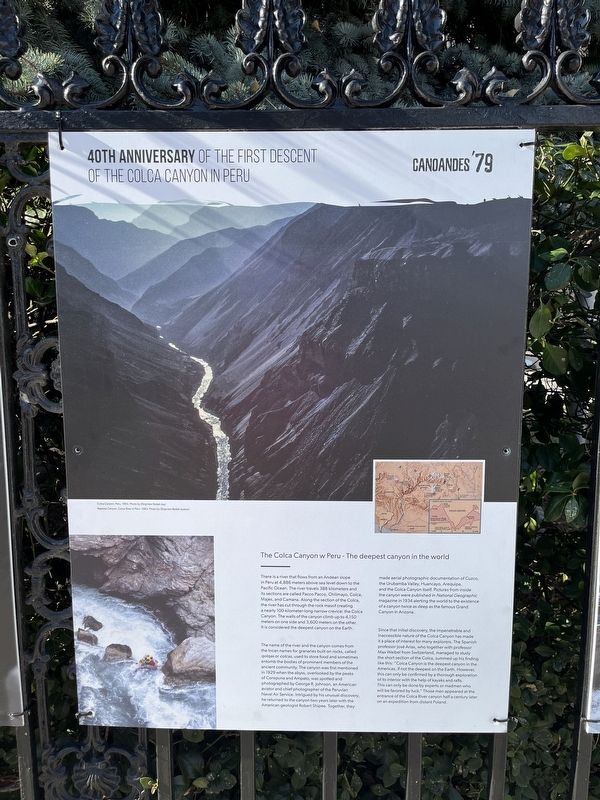
The Colca Canyon w Peru - The deepest canyon in the world
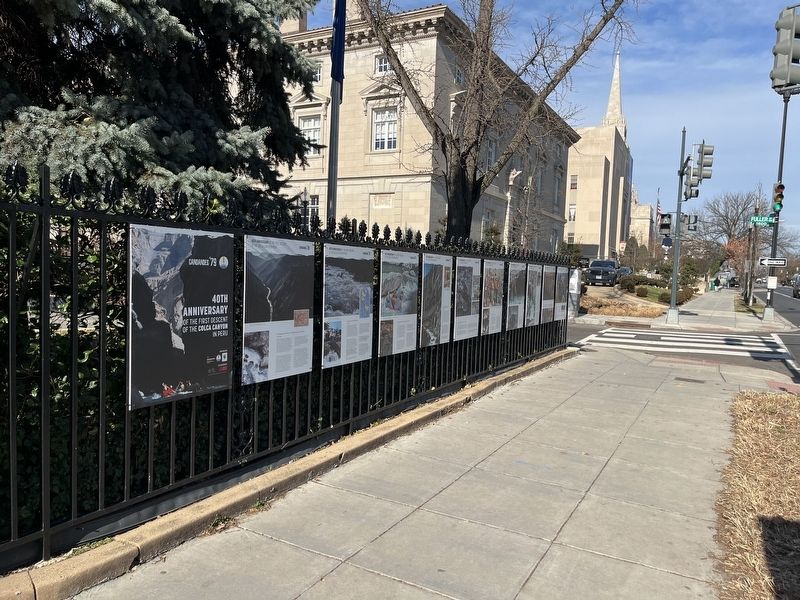
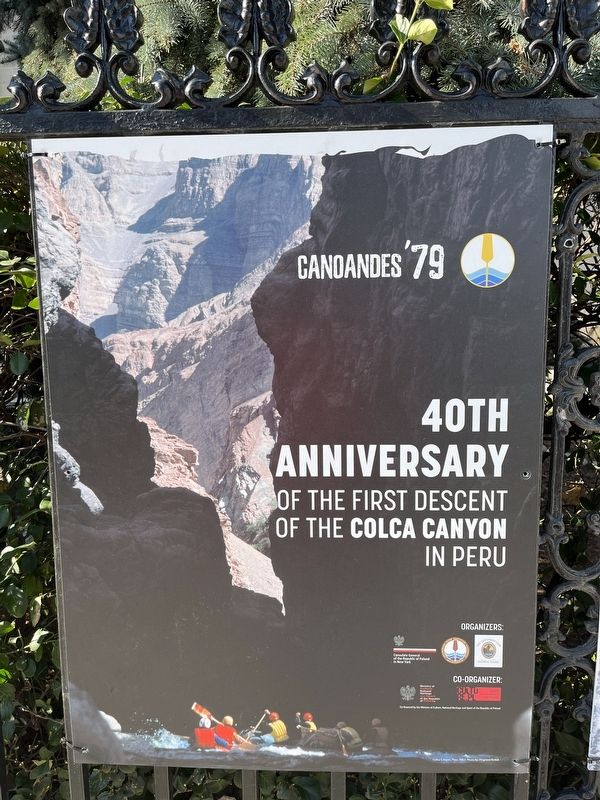
40th Anniversary of the First Descent of the Colca Canyon in Peru
| — | Canoandes '79 | — |
Photographed by Devry Becker Jones (CC0), January 12, 2022
1. The Colca Canyon w Peru - The deepest canyon in the world Marker
There is a river that flows from Andean slope in Peru at 4,886 meters above sea level down to the Pacific Ocean. The river travels 388 kilometers and its sections are called Pacco Pacco, Chilimayo, Colca, Majes, and Camana. Along the section of the Colca, the river has cut through the rock massif creating a nearly 100-kilometer-long narrow crevice: the Colca Canyon. The walls of the canyon climb up to 4,150 meters on one side and 3,600 meters on the other. It is considered the deepest canyon on the Earth.
The name of the river and the canyon comes from the Incan names for granaries built on rocks, called qolqas or colcas, used to store food and sometimes entomb the bodies of prominent members of the ancient community. The canyon was first mentioned in 1929 when the abyss, overlooked by the peaks of Coropuna and Ampato, was spotted and photographed by George R. Johnson, an American aviator and chief photographer of the Peruvian Naval Air Service. Intrigued by his unusual discovery, he returned to the canyon two years later with the American geologist Robert Shipee. Together, they made aerial photographic documentation
this page online
Since that initial discovery, the impenetrable and inaccessible nature of the Colca Canyon has made it a place of interest for many explorers. The Spanish professor José Arias, who together with professor Max Weibel from Switzerland, managed to study the short section of the Colca, summed up his finding like this: "Colca Canyon is the deepest canyon in the Americas, if not the deepest on the Earth. However, this can only be confirmed by a thorough exploration of its interior with the help of kayaks and rafts. This can only be done by experts or madmen who will be favored by luck. Those men appeared at the entrance of the Colca River canyon half a century later on an expedition from distant Poland.
Erected by Consulate General of the Republic of Poland in New York; The Explorers Club; Ministry of Culture, National Heritage and Sport of the Republic of Poland.
Topics.
Photographed by Devry Becker Jones (CC0), January 12, 2022
2. 40th Anniversary of the First Descent of the Colca Canyon in Peru Exhibit
Location. This marker has been replaced by another marker nearby. It was located near 38° 55.479′ N, 77° 2.198′ W. Marker was in Northwest Washington in Washington, District of Columbia. It was in Adams Morgan. It was on 16th Street Northwest just south of Fuller Street Northwest, on the right when traveling south. Touch for map. Marker was at or near this postal address: 2640 Fuller St NW, Washington DC 20009, United States of America. Touch for directions.

Regionally, this marker was in the Washington Metropolitan Area. It was also in the American Northeast, in the Upper South, in the Mid-Atlantic, in the Tidewater, and in the Chesapeake Bay Region. Globally, it was in North America, the Western Hemisphere, the Western World, and the Anglosphere.
Other nearby markers. within walking distance of this location: Touch for a list and map of all markers in Northwest Washington.
Other markers no longer nearby. Mazurkas (was
Credits. This page was last revised on January 30, 2023. It was originally submitted on January 12, 2022, by Devry Becker Jones of Washington, District of Columbia. This page has been viewed 395 times since then and 35 times this year. Photos: 1, 2, 3. submitted on January 12, 2022, by Devry Becker Jones of Washington, District of Columbia.
