Adams Morgan in Northwest Washington in Washington, District of Columbia — The American Northeast (Mid-Atlantic)
On the way to the Colca Canyon
40th Anniversary of the First Descent of the Colca Canyon in Peru
| — | Canoandes '79 | — |
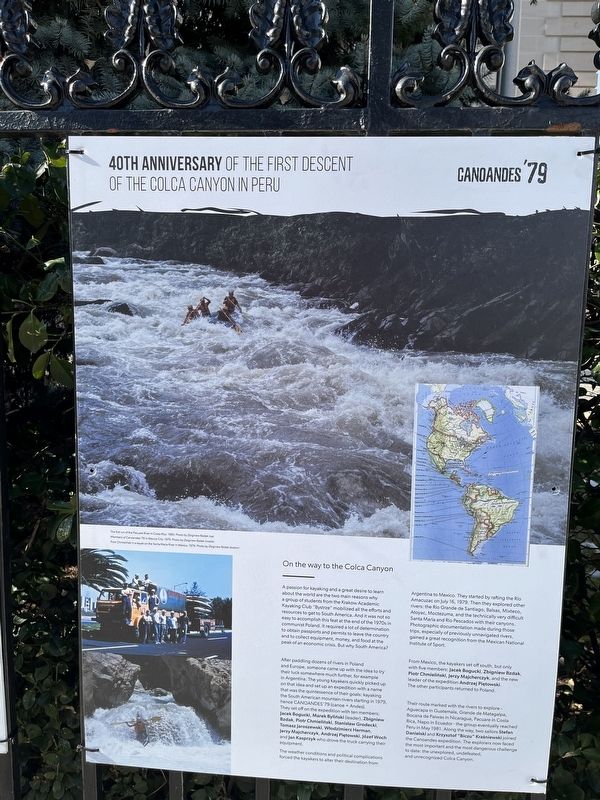
A passion for kayaking and a great desire to learn about the world are the two main reasons why a group of students from the Krakow Academic Kayaking Club "Bystrze" mobilized all the efforts and resources to get to South America. And it was not so easy to accomplish this feat at the end of the 1970s in communist Poland. It required a lot of determination to obtain passports and permits to leave the country and to collect equipment, money, and food at the peak of an economic crisis. But why South America?
After paddling dozens of rivers in Poland and Europe, someone came up with the idea to try their luck somewhere much further, for example in Argentina. The young kayakers quickly picked up on that idea and set up an expedition with a name that was the quintessence of their goals: kayaking the South American mountain rivers in 1979, hence Canoandes'79 (canoe + Andes). The set off on the expedition with ten members: Jacek Bogucki, Marek Byliński (leader), Zbigniew Bzdak, Piotr Chmieliński, Stanisław Grodecki, Tomasz Jaroszeewski, Włlodzimierz Herman, Jerzy Majcherszyk, Andrzej Piętowski, Jósef Woch
this page online
The weather conditions and political complications forced the kayakers to alter their destination from Argentina to Mexico. They started by rafting the Río Amacuzak on July 16, 1979. Then they explored other rivers: the Río Grande de Santiago, Balsas, Mixteco, Atoyac, Moctezuma, and the technically very difficult Santa Maria and Río Pescados with their canyons. Photographic documentation made during those trips, especially of previously unnavigated rivers, gained a great recognition from the Mexican National Institute of Sport.
From Mexico, the kayakers set off south, but only with five members: Jacek Bogucki, Zbigniew Bzdak, Piotr Chmienliński, Jerzy Majcherczyk, and the new leader Andrzej Piętowski. The other participants returned to Poland.
Their route marked with the rivers to explore — Aguacapa in Guatemala, Grande de Matagalpa, Bocana de Paiwas in Nicaragua, Pacuare in Costa Rica, Napo in Ecuador — the group eventually reached Peru in May 1981. Along the way, two sailors Stefan Danielski and Krzysztof "Biczu" Kraśniewski joined the Canoandes
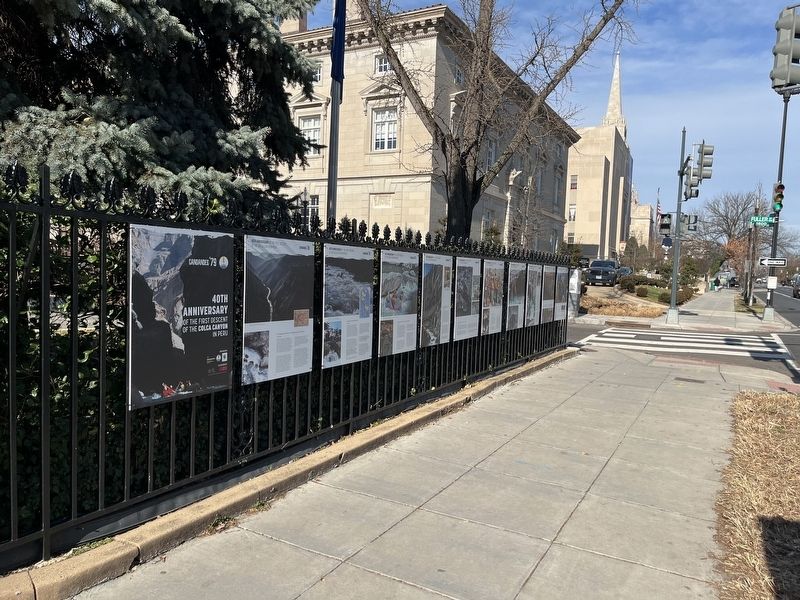
Photographed by Devry Becker Jones (CC0), January 12, 2022
2. 40th Anniversary of the First Descent of the Colca Canyon in Peru Exhibit
Erected by Consulate General of the Republic of Poland in New York; The Explorers Club; Ministry of Culture, National Heritage and Sport of the Republic of Poland.
Topics. This historical marker is listed in these topic lists: Exploration • Sports • War, Cold • Waterways & Vessels. A significant historical month for this entry is May 1981.
Location. This marker has been replaced by another marker nearby. It was located near 38° 55.48′ N, 77° 2.198′ W. Marker was in Northwest Washington in Washington, District of Columbia. It was in Adams Morgan. It was on 16th Street Northwest just south of Fuller Street Northwest, on the right when traveling south. Touch for map. Marker was at or near this postal address: 2640 Fuller St NW, Washington DC 20009, United States of America. Touch for directions.

Regionally, this marker was in the Washington Metropolitan Area. It was also in the American Northeast, in the Upper South, in the Mid-Atlantic, in the Tidewater, and in the Chesapeake Bay Region. Globally, it was in North America, the Western Hemisphere, the Western World, and the Anglosphere.
Other nearby markers. within walking distance of this location: Touch for a list and map of all markers in Northwest Washington.
Other markers no longer nearby. Ernest Malinowski (was here, next to this marker but has been permanently removed); The first run of the Colca Canyon - May/June 1981 (was here, next to this marker but has been replaced with another marker now near it); Polonaises (was here, next to this marker but has been permanently removed); Jacek Karpiński (was here, next to this marker but has been permanently removed); Sonatas (was here, next to this marker but has been permanently removed); Mazurkas (was here, next to this marker but has been permanently removed); a different marker also named The first run of the Colca Canyon - May/June 1981 (was here, next to this marker but has been replaced with another marker now near it); The Colca Canyon w Peru - The deepest canyon in the world (was here, next to this marker but has been replaced with another marker now near it); Solidarność (was here, next to this marker but has been replaced with another marker now near it); a different marker also named The first run of the Colca Canyon - May/June 1981 (was here, next to this marker but has been replaced with another marker now near it); Maria Czaplicka (was here, next to this marker but has been permanently removed); Waltzes (was here, next to this marker but has been permanently removed); Return from the rock abyss (was here, next to this marker but has been replaced with another marker now near it); Jan Czochralski (was here, next to this marker but has been permanently removed); Return to the Colca Canyon (was here, next to this marker but has been replaced with another marker now near it); Historic Expedition (was here, next to this marker but has been replaced with another marker now near it).
Credits. This page was last revised on January 30, 2023. It was originally submitted on January 12, 2022, by Devry Becker Jones of Washington, District of Columbia. This page has been viewed 296 times since then and 19 times this year. Photos: 1, 2. submitted on January 12, 2022, by Devry Becker Jones of Washington, District of Columbia.
