Burkittsville in Frederick County, Maryland — The American Northeast (Mid-Atlantic)
Burkittsville
Houses of Worship Become Houses of Misery
| — | Antietam Campaign 1862 | — |
Photographed by Craig Swain, July 21, 2007
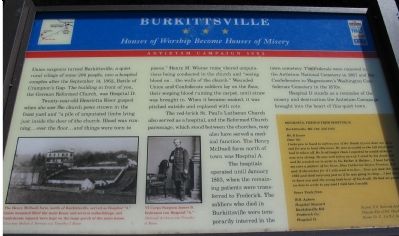
1. Burkittsville Marker
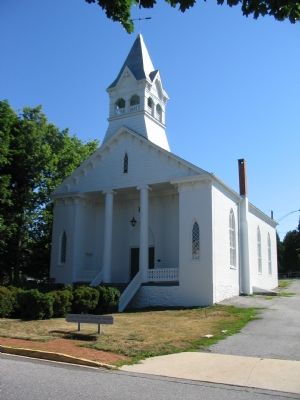
Union surgeons turned Burkittsville, a quiet rural village of some 200 people, into a hospital complex after the September 14, 1862, Battle of Crampton’s Gap. The building in front of you, the German Reformed Church, was Hospital D.
Twenty-year-old Henrietta Biser gasped when she saw the church pews strewn in the front yard and “a pile of amputated limbs lying just inside the door of the church. Blood was running...over the floor...and things were torn to pieces.” Henry M. Wiener remembered amputations being conducted in the church and “seeing blood on...the walls of the church.” Wounded Union and Confederate soldiers lay on the floor, their seeping blood ruining the carpet, until straw was brought in. When it became soaked, it was pitched outside and replaced with cots.
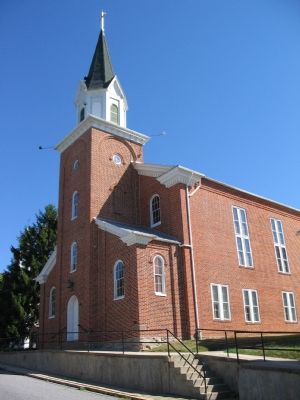
The red brick St. Paul’s Lutheran Church also served as a hospital, and the Reformed Church parsonage, which stood between the churches, may also have served a medical function. The Henry McDuell farm north of town was Hospital A.
The hospitals operated until January 1863, when the remaining patients were transferred to Frederick. The soldiers
this page online
Hospital D stands as a reminder of the misery and destruction the Antietam Campaign brought into the heart of this quiet town.
(captions)
The Henry McDull farm, north of Burkittsville, served as Hospital "A". Union wounded filled the main house and several out buildings, and Confederate injured were kept on the large porch of the main house. Courtesy Melvin J. Berman via Timothy J. Reese.
VI Corps Surgeon James D. Robinson ran Hospital “A”. - National Archives via Timothy J. Reese
Erected by Maryland Civil War Trails.
Topics and series. This historical marker is listed in these topic lists: Religion & Religious Structures • War, US Civil. In addition, it is included in the Maryland Civil War Trails series list. A significant historical date for this entry is September 14, 1862.
Location. This marker has been replaced by another marker nearby. It was located near 39° 23.621′ N, 77° 37.753′ W. Marker was in Burkittsville,
Photographed by Craig Swain, July 21, 2007
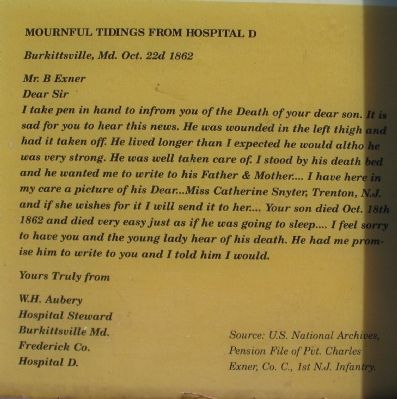
2. Close up of the Letter
Mournful Tidings from Hospital D
Burkittsville, Md. Oct. 22d 1862
Mr. B Exner
Dear Sir
I take pen in hand to inform you of the Death of your dear son. It is sad for you to hear this news. He was wounded in the left thigh and had it taken off. He lived longer than I expected he would altho he was very strong. He was well taken care of. I stood by his death bed and he wanted me to write to his Father & Mother....I have here in my care a picture of his Dear...Miss Catherine Snyter, Trenton, N.J. and if she wishes for it I will send it to her.... Your son died Oct. 18th 1862 and died very easy just as if he was going to sleep.... I feel sorry to have you and the young lady hear of his death. He had me promise him to write you and I told him I would.
Yours Truly from
W.H. Aubery
Hospital Steward
Burkittsville Md.
Frederick Co.
Hospital D.
Source: U.S. National Archives
Pension File of Pvt. Charles Exner, Co. C., 1st N.J. Infantry.
Burkittsville, Md. Oct. 22d 1862
Mr. B Exner
Dear Sir
I take pen in hand to inform you of the Death of your dear son. It is sad for you to hear this news. He was wounded in the left thigh and had it taken off. He lived longer than I expected he would altho he was very strong. He was well taken care of. I stood by his death bed and he wanted me to write to his Father & Mother....I have here in my care a picture of his Dear...Miss Catherine Snyter, Trenton, N.J. and if she wishes for it I will send it to her.... Your son died Oct. 18th 1862 and died very easy just as if he was going to sleep.... I feel sorry to have you and the young lady hear of his death. He had me promise him to write you and I told him I would.
Yours Truly from
W.H. Aubery
Hospital Steward
Burkittsville Md.
Frederick Co.
Hospital D.
Source: U.S. National Archives
Pension File of Pvt. Charles Exner, Co. C., 1st N.J. Infantry.

Regionally, this marker was in the Washington Metropolitan Area and in Central Maryland. It was also in the American Mid-Atlantic. Globally, it was in North America, the Western Hemisphere, the Western World, and the Anglosphere. Historically, it found itself in what was once one of the original Thirteen Colonies and also the Antebellum South.
Other nearby markers. At least 8 other markers are within walking distance of this location: A different marker also named Burkittsville (a few steps from this marker); Cobbled Stagecoach Stop (within shouting distance of this marker); The Arnold Farm (approx. 0.2 miles away); “Sealed With Their Lives” (approx. 0.7 miles away); Chew’s Ashby Artillery (approx. 0.7 miles away); Burkittsville: Henry Burkitt’s Town (approx.
Photographed by Craig Swain, July 21, 2007
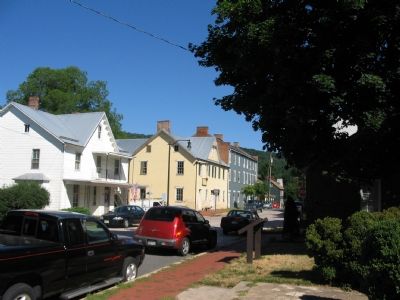
3. Location of Marker near the Intersection of Main and Potomac Streets
Burkittsville features many older structures in addition to the churches mentioned on the marker.
Another marker is no longer nearby. Confederate Forces (was approx. 0.4 miles away but has been confirmed missing).
Related marker. Click here for another marker that is related to this marker. New CWT Marker At This Location also titled "Burkittsville"
Also see . . .
1. Burkittsville Historic District. Wikipedia entry:
Links to National Register of Historic Places Nomination Form (Submitted on October 14, 2025, by Larry Gertner of New York, New York.)
2. Everyday Life in a Civil War Hospital. American Battlefield Trust website entry (Submitted on July 25, 2007.)
3. Burkittsville Preservation Association. Association website homepage (Submitted on January 15, 2022.)
Additional commentary.
1. The Hospitals
As detailed in the marker, Hospital A was the Henry McDull Farm originally standing to the north of town. The St. Paul's Lutheran Church was Hospital B. Hospital C was the parsonage for the German
Photographed by Craig Swain, July 21, 2007
4. Resurrection Reformed Church
Formerly the German Reformed Church
— Submitted July 25, 2007, by Craig Swain of Leesburg, Virginia.
Photographed by Craig Swain, July 21, 2007
5. St. Paul Lutheran Church
Photographed by Craig Swain, July 21, 2007
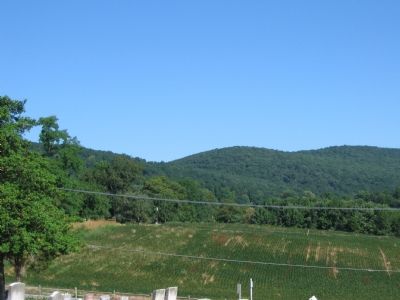
6. View from Union Cemetery towards Crampton's Gap
Winfield Scott Hancock's Brigade occupied this cemetery during the Battle of Crampton's Gap, Sept. 14, 1862. The opening phases played out as skirmishes across the open fields in the background. Federal forces formed there for their full assault upon the Confederate positions along Mountain Church Road (a field beyond the tree line seen beyond the field).
Photographed by Bradley Owen, October 16, 2014
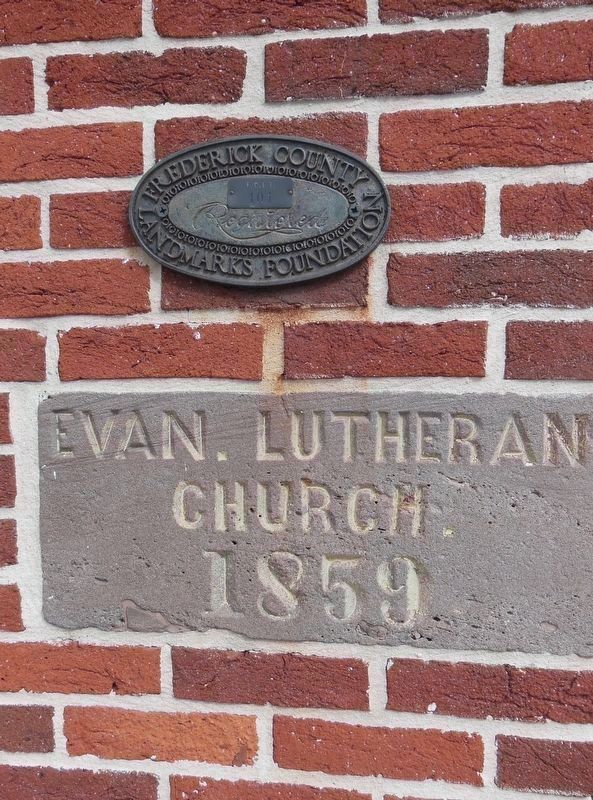
7. St. Paul Lutheran Church Cornerstone and Additional Tablet
Frederick County Landmarks Foundation (F.C.L.F. 104)
Evan. Lutheran Church. 1859
Evan. Lutheran Church. 1859
Credits. This page was last revised on October 14, 2025. It was originally submitted on July 25, 2007, by Craig Swain of Leesburg, Virginia. This page has been viewed 3,433 times since then and 56 times this year. Last updated on January 12, 2022, by Bradley Owen of Morgantown, West Virginia. Photos: 1, 2, 3, 4, 5, 6. submitted on July 25, 2007, by Craig Swain of Leesburg, Virginia. 7. submitted on January 12, 2022, by Bradley Owen of Morgantown, West Virginia. • Bernard Fisher was the editor who published this page.
