Rock Island/Samuels Ave. in Fort Worth in Tarrant County, Texas — The American South (West South Central)
Racial Terror Lynching in America ⎯⎯⎯ Racial Terror Lynching of Mr. Fred Rouse
Community Remembrance Project
Photographed by QuesterMark
1. Racial Terror Lynching in America Marker
Inscription.
Racial Terror Lynching in America
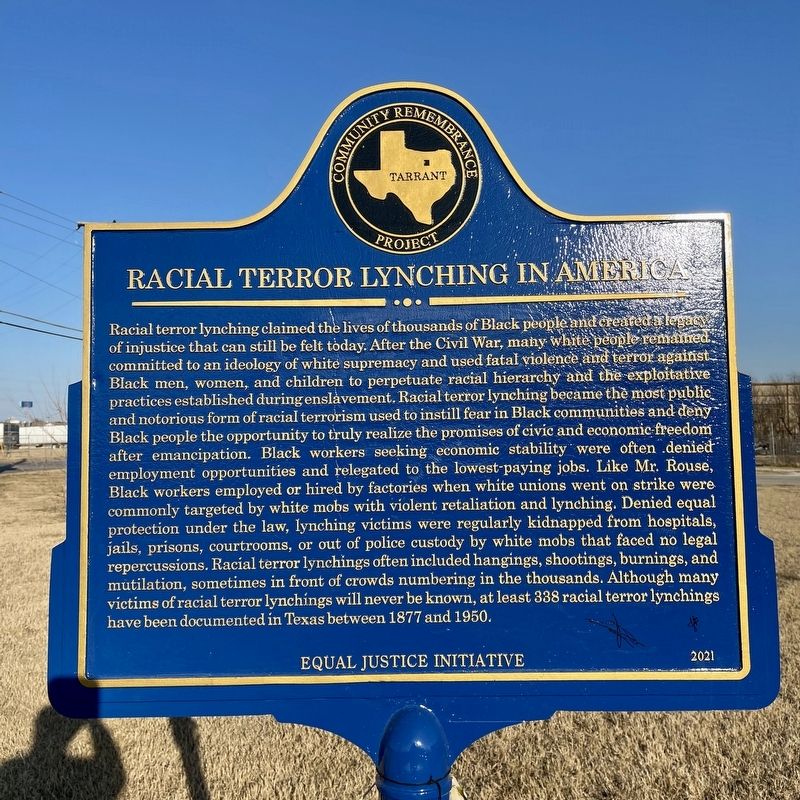
Racial terror lynching claimed the lives of thousands of Black people and created a legacy of injustice that can still be felt today. After the Civil War, many white people remained committed to an ideology of white supremacy and used fatal violence and terror against Black men, women, and children to perpetuate racial hierarchy and the exploitative practices established during enslavement. Racial terror lynching became the most public and notorious form of racial terrorism used to instill fear in Black communities and deny Black people the opportunity to truly realize the promises of civic and economic freedom after emancipation. Black workers seeking economic stability were often denied employment opportunities and relegated to the lowest-paying jobs. Like Mr. Rouse, Black workers employed or hired by factories when white unions went on strike were commonly targeted by white mobs with violent retaliation and lynching. Denied equal protection under the law, lynching victims were regularly kidnapped from hospitals, jails, prisons, courtrooms, or out of police custody by white mobs that
Click or scan to see this page online
faced no legal repercussions, Racial terror lynchings often included hangings, shootings, burnings, and mutilation, sometimes in front of crowds numbering in the thousands. Although many victims of racial terror lynchings will never be known, at least 338 racial terror lynchings have been documented in Texas between 1877 and 1950.
Racial Terror Lynching of Mr. Fred Rouse
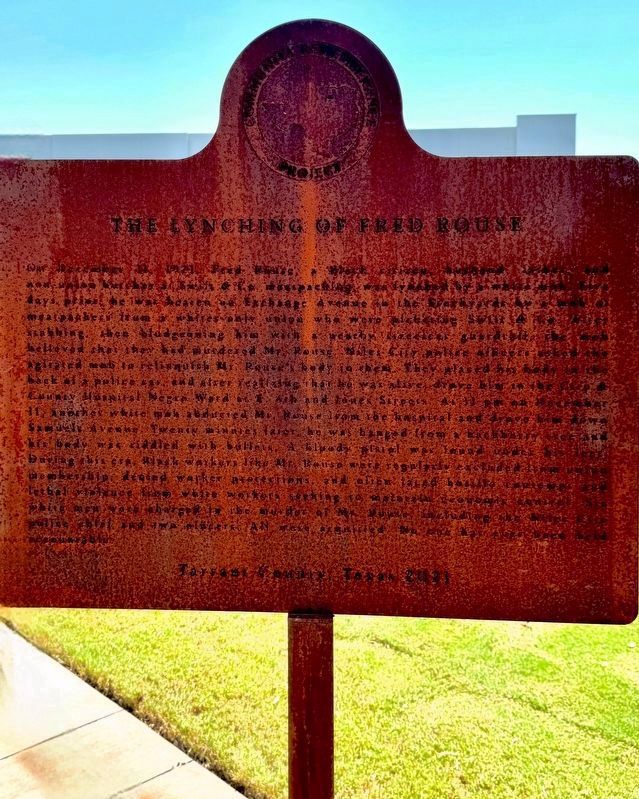
On December 11, 1921, Mr. Fred Rouse, a Black citizen, husband, father, and non-union butcher at Swift & Co. meatpacking, was lynched at this site by a white mob. Five days prior, he was beaten on Exchange Avenue in the Stockyards by a mob of meatpackers from a whites-only union who were picketing Swift & Co. After stabbing, then bludgeoning him with a nearby streetcar guardrail, the mob believed that they had murdered Mr. Rouse. Niles City police officers asked the agitated mob to relinquish Mr. Rouse's body to them. They placed his body in the back of a police car, and after realizing that he was alive, drove him to the City & County Hospital Negro Ward at E. 4th and Jones Streets. At 11 pm on December 11, another white mob abducted Mr. Rouse from the hospital
Photographed by QuesterMark
2. Racial Terror Lynching of Mr. Fred Rouse Marker
and drove him down Samuels Avenue to this site. Twenty minutes later, he was hanged from a hackberry tree and his body was riddled with bullets. A bloody pistol was found under his feet. During this era, Black workers like Mr. Rouse were regularly excluded from union membership, denied worker protections, and often faced hostile contempt and lethal violence from white workers seeking to maintain economic control. Three white men were charged in the murder of Mr. Rouse, including the acting Niles City police chief and another officer. All were acquitted. No one has ever been held accountable. Memorializing Mr. Fred Rouse reminds us to remain vigilant in pursuit of racial justice.
Erected 2021 by Tarrant County Coalition for Peace and Justice, Equal Justice Initiative.
Topics and series. This historical marker is listed in these topic lists: African Americans • Civil Rights • Law Enforcement. In addition, it is included in the Lynching in America series list. A significant historical date for this entry is December 11, 1921.
Location. 32° 46.591′ N, 97° 20.022′ W. Marker is in Fort Worth, Texas, in Tarrant County. It is in Rock Island/Samuels
Photographed by QuesterMark, January 15, 2022
3. Racial Terror Lynching in America / Racial Terror Lynching of Mr. Fred Rouse Marker
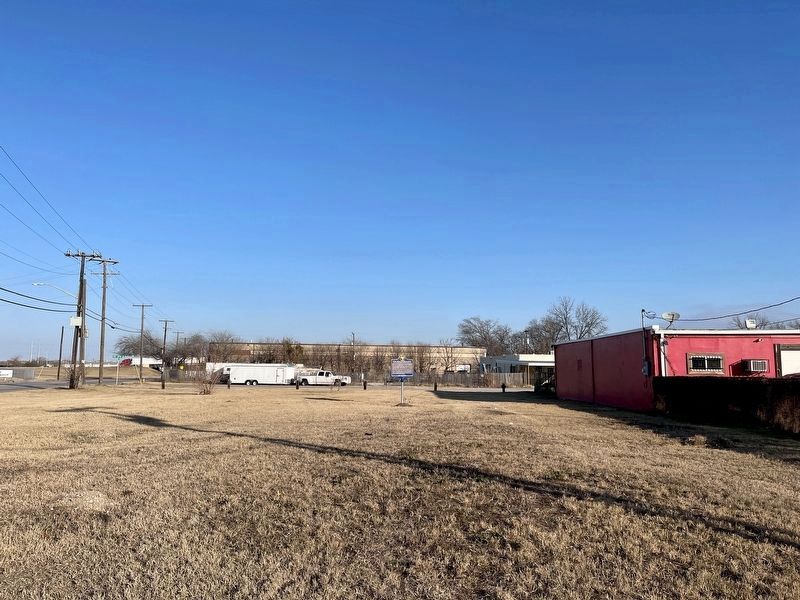
The single two-sided post-mounted marker stands in the center of an otherwise empty lot.
Ave.. It is at the intersection of Samuels Avenue and NE 12th Street, on the right when traveling north on Samuels Avenue. Touch for map. Marker is at or near this postal address: 1000 NE 12th St, Fort Worth TX 76102, United States of America. Touch for directions.
Regionally, this marker is in the Prairies & Lakes Region. It is also in the American South. Globally, it is in North America, a Gulf of Mexico state, the Western Hemisphere, the Western World, and the Anglosphere. Historically, it finds itself in what was once New Spain, the Republic of Texas, and one of the Confederate States of America.
“A Replica marker of one side is located at the Equal Justice Initiatives' National Memorial for Peace and Justice in Montgomery, Alabama. The Equal Justice Initiative supports efforts to locally memorialize documented victims of racial violence and to educate communities about the history of racial injustice.” Mark Hilton
Worth.
Credits. This page was last revised on October 16, 2024. It was originally submitted on January 15, 2022, by QuesterMark of Fort Worth, Texas. This page has been viewed 1,153 times since then and 69 times this year. Last updated on January 15, 2022, by QuesterMark of Fort Worth, Texas. Photos:1, 2, 3. submitted on January 15, 2022, by QuesterMark of Fort Worth, Texas. 4. submitted on October 15, 2024, by Brandon D Cross of Flagler Beach, Florida. • J. Makali Bruton was the editor who published this page.