Strasburg in Shenandoah County, Virginia — The American South (Mid-Atlantic)
Historic Strasburg
Stop # 7
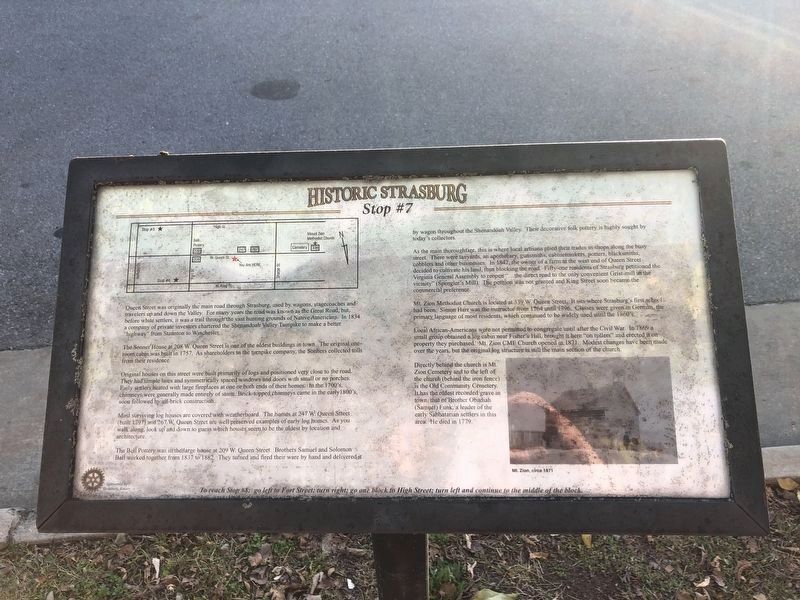
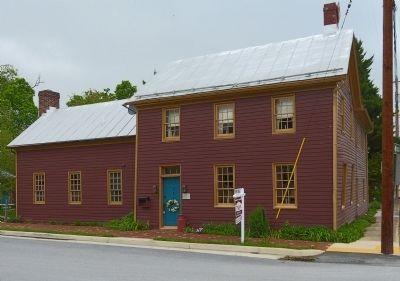
The Sonner House at 208 W. Queen Street is one of the oldest buildings in town. The original one-room cabin was built in 1757. As shareholders in the turnpike company, the Sonners collected tolls from their residence.
Original houses on this street were built primarily of logs and positioned very close to the road. They had simple lines and symmetrically spaced windows and doors with small or no porches. Early settlers heated with large fireplaces at one end or both ends of their homes. In the 1700's, chimneys were generally made entirely of stone. Brick topped chimneys came in the early 1800's, soon followed by all-brick construction.
Most surviving log houses are covered with weatherboard. The homes at
this page online
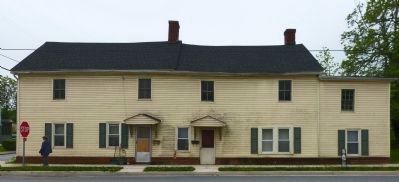
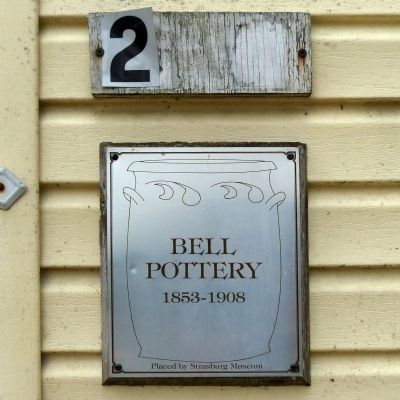
The Bell Pottery was in the large house at 209 W. Queen Street. Brothers Samuel and Soloman Bell worked together from 1837 to 1882. They turned and fired their ware by hand and delivered it by wagon throughout the Shenandoah Valley. Their decorative fold pottery is highly sought by today's collectors.
As the main thoroughfare, this is where local artisans plied their trades in shops along the busy street. There were tanyards, an apothecary, gunsmiths, cabinetmakers, potters, blacksmiths, cobblers and other businesses. In 1842, the owner of a farm at the west end of Queen Street decided to cultivate his land, thus blocking the road. Fifty-one residents of Strasburg petitioned the Virginia General Assembly to reopen “…the direct road to the only convenient Grist-mill in the vicinity” (Spenger's Mill). The petition was not granted and King Street soon became the commercial preference.
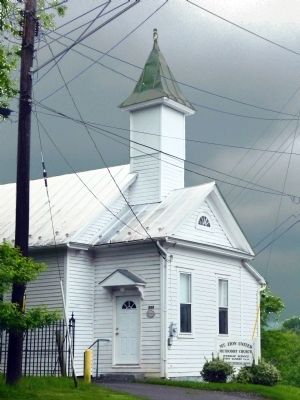
Mt. Zion Methodist Church is located
Photographed by Allen C. Browne, May 14, 2014
2. Historic Strasburg Marker
Local African-Americans were not permitted to congregate until after the Civil War. In 1869 a small group obtained a log cabin near Fisher's Hill, brought it here “on rollers” and erected on the property they purchased. Mt. Zion CME Church opened in 1871. Modest changes have been made over the years, but the original log structure is still the main section of the church.
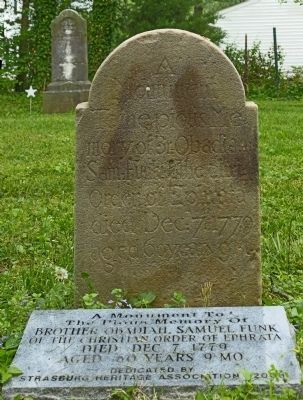
Directly behind the church is Mt. Zion Cemetery and to the left of the church (behind the iron fence) is the Old Community Cemetery. It has the oldest recorded grave in town, that of Brother Obadiah (Samuel) Funk, a leader of the early Sabbatarian settlers in this area. He died in 1779.
Erected by Strasburg Rotary. (Marker Number 7.)
Topics and series. This historical marker is listed in these topic lists: African Americans • Industry & Commerce • Man-Made Features • Roads & Vehicles. In addition,
Photographed by Allen C. Browne, May 14, 2014
3. Sonner House
Location. This marker has been replaced by another marker nearby. It was located near 38° 59.333′ N, 78° 21.885′ W. Marker was in Strasburg, Virginia, in Shenandoah County. It was on West Queen Street west of South Fort Street, on the right when traveling west. Touch for map. Marker was at or near this postal address: 280 W Queen Street, Strasburg VA 22657, United States of America. Touch for directions.

Regionally, this marker was in the Shenandoah Valley. It was also in the American South, specifically in the Upper South, and in the Mid-Atlantic. Globally, it was in North America, the Western Hemisphere, the Western World, and the Anglosphere. Historically, it found itself in what was once the territory of the Mississippian Culture, one of the original Thirteen Colonies, one of the Confederate States of America, and the Antebellum South.
Other nearby markers. At least 8 other markers are within walking distance of this location: Sonner House (within shouting distance
Photographed by Allen C. Browne, May 14, 2014
4. Bell Pottery
Other markers no longer nearby. Historic Strasburg (was about 500 feet away but has been replaced with another marker now near it); a different marker also named Historic Strasburg (was about 800 feet away but has been replaced with another marker now near it); a different marker also named Historic Strasburg (was approx. 0.2 miles away but has been replaced with another marker now near it).
Related marker. Click here for another marker that is related to this marker. This marker has been replaced by another at this location.
Photographed by Allen C. Browne, May 14, 2014
5. Bell Pottery Plaque
Photographed by Allen C. Browne, May 14, 2014
6. Mount Zion Methodist Church
Photographed by Allen C. Browne, May 14, 2014
7. Grave of Obadiah Samuel Funk
A monument to the pious memory of Brother Obadiah Samuel Funk of the Christian order of Ephrata. Died Dec. 7, 1779, Aged 60 years 9 mo.
Dedicated by Strasburg Heritage Association 2008
Dedicated by Strasburg Heritage Association 2008
Credits. This page was last revised on August 7, 2025. It was originally submitted on May 23, 2014, by Allen C. Browne of Silver Spring, Maryland. This page has been viewed 1,779 times since then and 70 times this year. Last updated on January 22, 2022, by Carl Gordon Moore Jr. of North East, Maryland. Photos: 1. submitted on November 7, 2020, by Devry Becker Jones of Washington, District of Columbia. 2, 3, 4, 5, 6, 7. submitted on May 23, 2014, by Allen C. Browne of Silver Spring, Maryland. • J. Makali Bruton was the editor who published this page.
