Brandywine Park in Wilmington in New Castle County, Delaware — The American Northeast (Mid-Atlantic)
Burrowing Owl
Athene cunicalaria
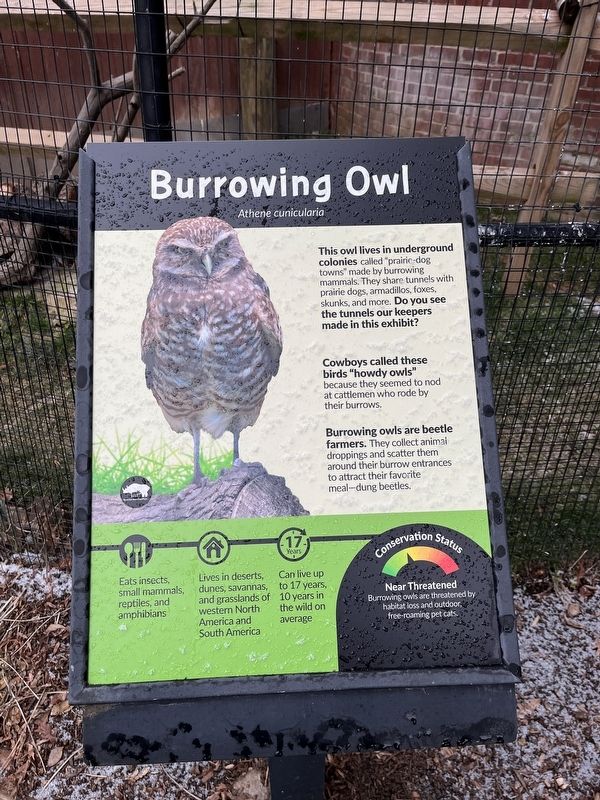
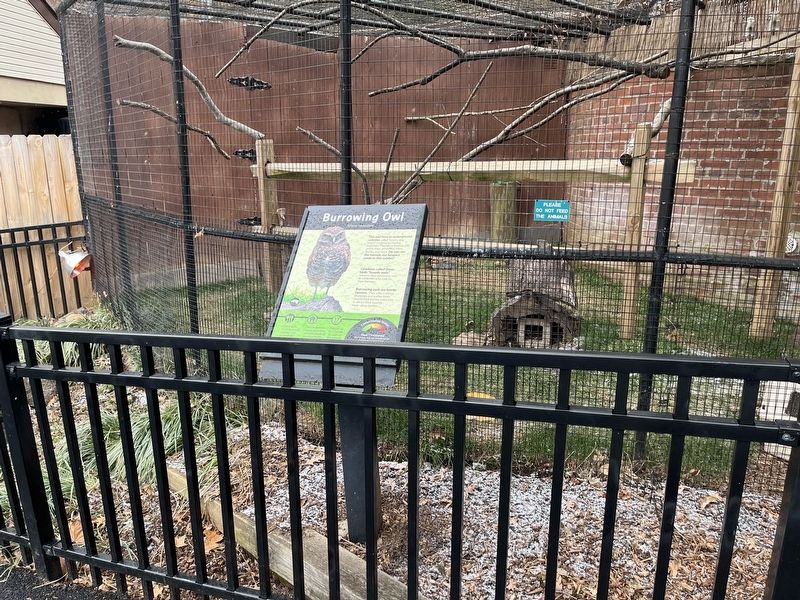
This owl lives in underground colonies called "prairie-god towns" made by burrowing mammals. They share tunnels with prairie dogs, armadillos, foxes, skunks, and more. Do you see the tunnels our keepers made in this exhibit?
Cowboys called these birds "howdy owls" because they seemed to nod at cattlemen who rode their burrows.
Burrowing owls are beetle farmers. They collect animal droppings and scatter them around their burrow entrances to attract their favorite meal—dung beetles.
🍴 Eats insects, small mammals, reptiles, and amphibians.
🏠 Lives in deserts, dunes, savannas, and grassland of western North America and South America.
⏲️ 17 Years. Can live up to 17 years, 10 years in the wild on average.
Conservation Status: Near Threatened
Burrowing owls are threatened by habitat loss and outdoor, free-roaming pet cats.
Erected by Brandywine Zoo; Delaware State Parks.
Topics and series. This historical marker is listed in these topic lists: Agriculture • Animals • Anthropology & Archaeology. In addition, it is included in the Delaware State Parks series
this page online
Location. 39° 45.3′ N, 75° 32.901′ W. Marker is in Wilmington, Delaware, in New Castle County. It is in Brandywine Park. It can be reached from North Park Drive 0.2 miles east of North Van Buren Street, on the left. Touch for map. Marker is at or near this postal address: 900 N Park Dr, Wilmington DE 19802, United States of America. Touch for directions.

Regionally, this marker is in Greater Philadelphia. It is also in the American Mid-Atlantic, on the Delmarva Peninsula, and on the Eastern Seaboard. Globally, it is in the North Atlantic Region, North America, the Western Hemisphere, the Western World, and the Anglosphere. Historically, it finds itself in what was once New Netherland and also one of the original Thirteen Colonies.
Other nearby markers. At least 8 other markers are within walking distance of this marker: Black and White Ruffed Lemur (here, next to this marker); a different marker also named Black and White Ruffed Lemur (a few steps from this marker); Radiated Tortoise (a few steps from this marker); a different marker also named Black and White Ruffed Lemur
Additional commentary.
1. About the marker
This marker qualifies for the database because of the note about how cowboys related to the owls.
— Submitted January 28, 2022, by Devry Becker Jones of Washington, District of Columbia.
Credits. This page was last revised on February 13, 2023. It was originally submitted on January 28, 2022, by Devry Becker Jones of Washington, District of Columbia. This page has been viewed 646 times since then and 109 times this year. Photos: 1, 2. submitted on January 28, 2022, by Devry Becker Jones of Washington, District of Columbia.
