Big Bog State Recreation Area near Waskish in Beltrami County, Minnesota — The American Midwest (Upper Plains)
The Patterned Peatland: Rare and Valuable
Photographed by McGhiever, August 30, 2021
1. The Patterned Peatland: Rare and Valuable Marker
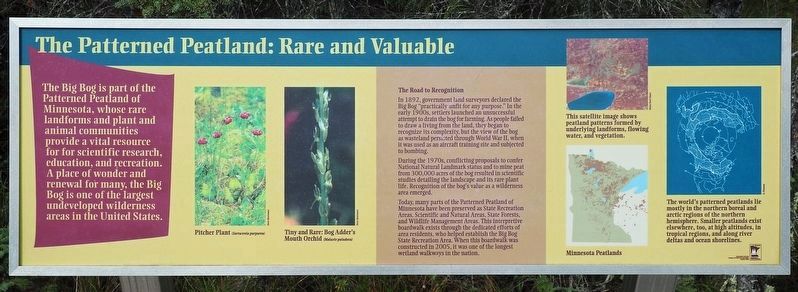
The Big Bog is part of the Patterned Peatland of Minnesota, whose rare landforms and plant and animal communities provide a vital resource for for scientific research, education, and recreation. A place of wonder and renewal for many, the Big Bog is one of the largest undeveloped wilderness areas in the United States.
The Road to Recognition
In 1892, government land surveyors declared the Big Bog "practically unfit for any purpose." In the early 1900s, settlers launched an unsuccessful attempt to drain the bog for farming. As people failed to draw a living from the land, they began to recognize its complexity, but the view of the bog as wasteland persisted through World War II, when it was used as an aircraft training site and subjected to bombing.
During the 1970s, conflicting proposals to confer National Natural Landmark status and to mine peat from 300,000 acres of the bog resulted in scientific studies detailing the landscape and its rare plant life. Recognition of the bog's value as a wilderness area emerged.
Today, many parts of the Patterned Peatland of Minnesota have been preserved as State Recreation
this page online
Captions:
Pitcher Plant (Sarracenia purpurea)
Tiny and Rare: Bog Adder's Mouth Orchid (Malaxis paludosa)
This satellite image shows peatland patterns formed by underlying landforms, flowing water, and vegetation.
Minnesota Peatlands
The world's patterned peatlands lie mostly in the northern boreal and arctic regions of the northern hemisphere. Smaller peatlands exist elsewhere, too, at high altitudes, in tropical regions, and along river deltas and ocean shorelines.
Erected by Minnesota Department of Natural Resources.
Topics. This historical marker is listed in these topic lists: Environment • Parks & Recreational Areas • War, World II. A significant historical year for this entry is 1892.
Location. 48° 17.951′ N, 94° 34.085′ W. Marker is near Waskish, Minnesota, in Beltrami County.
Photographed by McGhiever, August 31, 2021
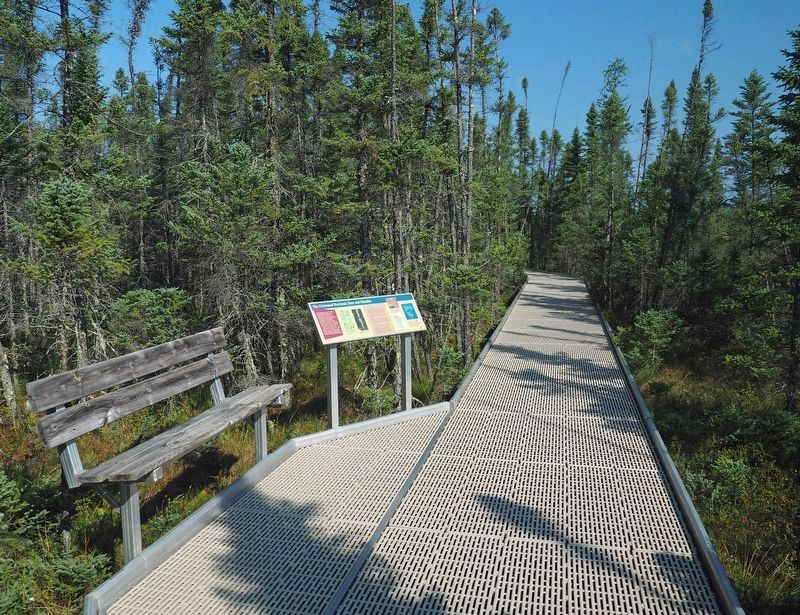
2. The Patterned Peatland: Rare and Valuable Marker along Big Bog State Recreation Area's Bog Boardwalk

Regionally, this marker is in the Northland. It is also in the American Midwest and in the Corn Belt. Globally, it is in North America, the Great North Woods, the Western Hemisphere, the Western World, and the Anglosphere. Historically, it finds itself in what was once Rupert’s Land, the territory of the Mississippian Culture, the Louisiana Purchase, and the Northwest Territory.
Other nearby markers. At least 8 other markers are within 9 miles of this marker, measured as the crow flies: Before the Big Bog: One Big Lake (about 500 feet away, measured in a direct line); The Bog That Couldn't Be Tamed (approx. 0.3 miles away); The Big Bog's Caribou Band (approx. half a mile away); Ludlow Island History (approx. 0.9 miles away); Fire in the Big Bog (approx. 0.9 miles away); The Old Waskish Town Site (approx. 8.9 miles away); Historic Waskish Hatchery 1941–1979 (approx. 9 miles away); Journey along the waters… (approx. 9 miles away). Touch for a list and map of all markers in Waskish.
Credits. This page was last revised on May 16, 2025. It was originally submitted on February 4, 2022, by McGhiever of Minneapolis, Minnesota. This page has been viewed 352 times since then and 24 times this year. Photos: 1, 2. submitted on February 4, 2022, by McGhiever of Minneapolis, Minnesota. • J. Makali Bruton was the editor who published this page.
