Penn's Landing in Philadelphia in Philadelphia County, Pennsylvania — The American Northeast (Mid-Atlantic)
Cruiser Olympia - Submarine Becuna
| — | Independence Seaport Museum | — |
Photographed by Richard E. Miller, May 12, 2009
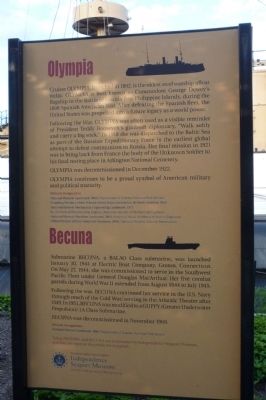
1. USS Olympia - USS Becuna Marker
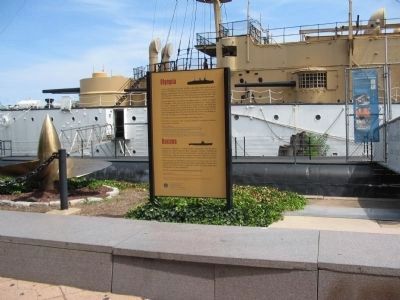
Olympia
Cruiser Olympia, launched in 1892, is the oldest steel warship afloat today. Olympia is best known as Commodore George Dewey’s flagship in the Battle of Manila Bay, Philippine Islands during the 1898 Spanish American War. After defeating the Spanish fleet, the United States was propelled into a future legacy as a world power.
Following the War, Olympia was often used as a visible reminder of President Teddy Roosevelt’s gunboat diplomacy, “Walk softly and carry a big stick.” In 1918 she was dispatched to the Baltic Sea as part of the Russian Expeditionary Force in the earliest global attempt to defeat communism in Russia. Her final mission in 1921 was to bring back from France the body of the Unknown Soldier to his final resting place in Arlington National Cemetery.
Olympia was decommissioned in December 1922.
Olympia continues to be a proud symbol of American military and political maturity.
Historic Designation:
National Historic Landmark, 1964, Department of Interior, National Park Service.
Founding Member of the Historic Naval Ships Association of North America, 1966.
National Historic Mechanical Engineering Landmark, 1977, for the Vertical Reciprocating Engines, American Society of Mechanical Engineers.
National Historic Maritime Landmark, 1983, Society of Naval Architects & Marine Engineers.
Official Project of Save America’s Treasures, 1999, National Trust for Historic Preservation.
Becuna
Submarine Becuna, a Balao Class submarine, was launched January 30, 1944, she was commissioned to serve in the Southwest Pacific Fleet under General Douglas MacArthur. Her five combat patrols during World War II extended from August 1944 to July 1945.
Following the war, Becuna, continued her service in the U.S. Navy through much of the Cold War, serving in the Atlantic Theater after 1949.
this page online
Becuna was decommissioned in November 1969.
Historic Designation:
National Historic Landmark, 1986, Department of Interior, National Park Service.
Today, Olympia and Becuna are maintained by Independence Seaport Museum, and they are open to the public for visitation.
For more Information contact Independence Seaport Museum. 215-925-5439 or www.phillyseaport.org.
Erected by Independence Seaport Museum.
Topics and series. This historical marker is listed in these topic lists: Landmarks • Military • War, Cold • War, Spanish-American • War, World I • War, World II • Waterways & Vessels. In addition, it is included in the Former U.S. Presidents: #26 Theodore Roosevelt, and the National Historic Landmarks series lists. A significant historical date for this entry is January 30, 1944.
Location. Marker has been permanently removed. It was located near 39° 56.618′ N, 75° 8.479′ W. Marker was in Philadelphia, Pennsylvania, in Philadelphia County. It was in Penn's Landing. It could be reached from South Christopher Columbus
Photographed by Richard E. Miller, May 12, 2009
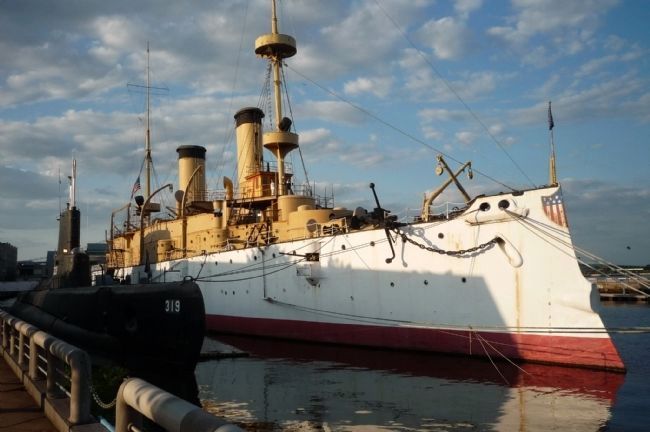
2. Cruiser Olympia - Submarine Becuna
now museum ships, moored together at Penn's Landing, Philadelphia.
We have been informed that this marker is no longer there and will not be replaced. This page is an archival view of what was.
Regionally, this marker was in Southeast Pennsylvania. It was also in the American Northeast and in the Mid-Atlantic. Globally, it was in North America, the Western Hemisphere, the Western World, and the Anglosphere. Historically, it found itself in what was once the Haudenosaunee (Iroquois) Confederacy, New Netherland, and one of the original Thirteen Colonies.

Other nearby markers. At least 8 other markers are within walking distance of this location: Still on Patrol (here, next to this marker); Peace-Time Submariners Memorial (a few steps from this marker); U. S. S. Trigger - SS 237 (a few steps from this marker); The Casket of the American "Unknown Soldier"
Photographed by Richard E. Miller, May 12, 2009
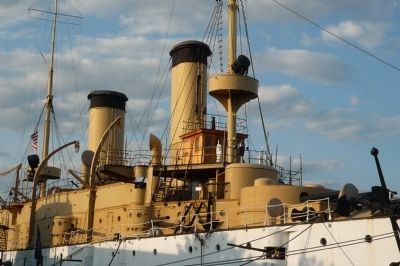
3. Bridge and forward superstructure of Cruiser Olympia
flagship of the victorious U.S. Asiatic Squadron at the Battle of Manila Bay, 1898.
Also see . . .
1. Independence Seaport Museum. (Submitted on May 17, 2009, by Richard E. Miller of Oxon Hill, Maryland.)
2. Moshulu. (Submitted on May 17, 2009, by Richard E. Miller of Oxon Hill, Maryland.)
Additional keywords. C-6; SS-319; USS New Jersey Cruiser Olympia - Submarine Becuna
Photographed by Richard E. Miller, May 12, 2009
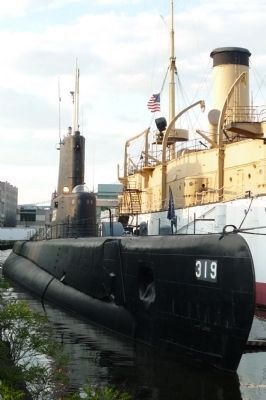
4. Submarine Becuna (SS-319)
the WWII "fleet boat" obtained her Cold War-era appearance after completing extensive modernization in 1951.
Photographed by Richard E. Miller, May 12, 2009
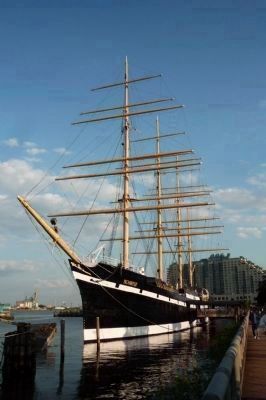
5. View southward toward the historic, Clye-built bark Moshulu (1904)
Permanently moored adjacent to the Cruiser Olympia and Submarine Becuna, and preserved as a floating restaurant.
Photographed by Craig Swain, August 14, 2010
6. Cruiser Olympia - Submarine Becuna Marker
Photographed by Richard E. Miller, May 12, 2009
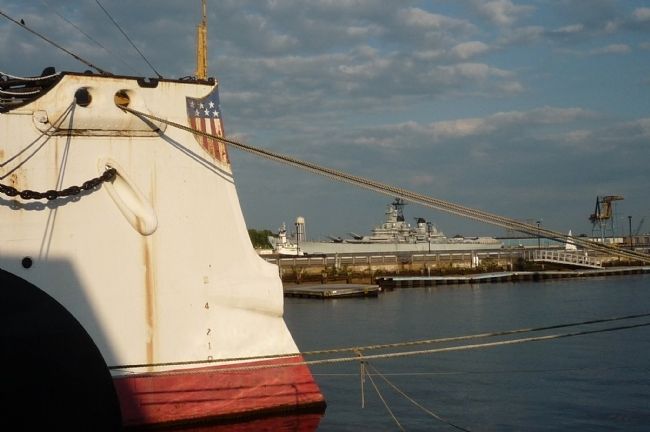
7. View of Cruiser Olympia's ram-style bow - with the WWII battleship USS New Jersey
visible in the background - at her permanent mooring as a museum ship - across the Delaware River in Camden, New Jersey.
Credits. This page was last revised on December 14, 2025. It was originally submitted on May 17, 2009, by Richard E. Miller of Oxon Hill, Maryland. This page has been viewed 3,234 times since then and 43 times this year. Last updated on May 21, 2009, by Richard E. Miller of Oxon Hill, Maryland. Photos: 1, 2, 3, 4, 5. submitted on May 17, 2009, by Richard E. Miller of Oxon Hill, Maryland. 6. submitted on August 16, 2010, by Craig Swain of Leesburg, Virginia. 7. submitted on May 17, 2009, by Richard E. Miller of Oxon Hill, Maryland. • Syd Whittle was the editor who published this page.
