
Spencerville in Leeds and Grenville United Counties, Ontario — Central Canada (North America)
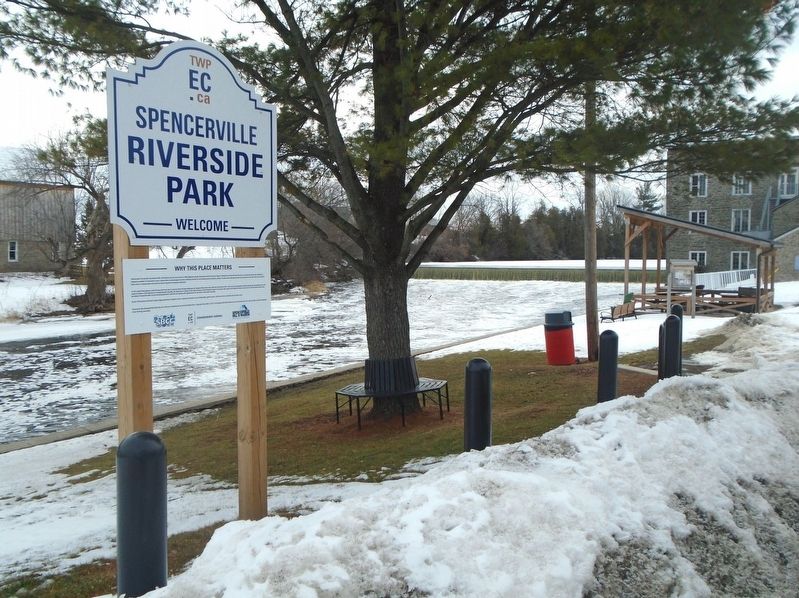
Spencerville Riverside Park
Why This Place Matters
Photographed by William Fischer, Jr., March 11, 2022
1. Spencerville Riverside Park Marker
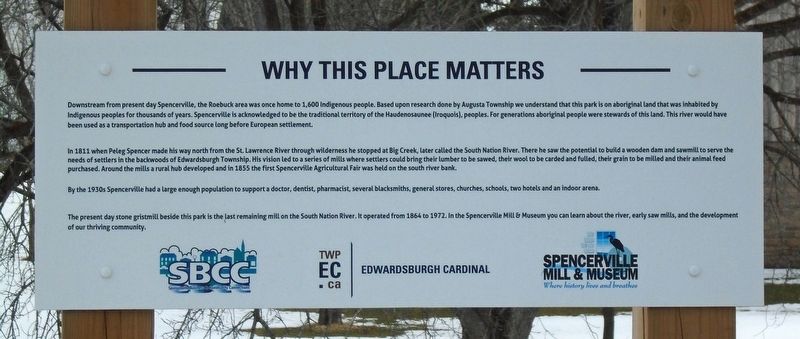
Downstream from present day Spencerville, the Roebuck area was once home to 1,600 Indigenous people. Based upon research done by Augusta Township we understand that this park is on aboriginal land that was inhabited by Indigenous peoples for thousands of years. Spencerville is acknowledged to be the traditional territory of the Haudenosaunee (Iroquois) peoples. For generations aboriginal people were stewards of this land. This river would have been used as a transportation hub and food source long before European settlement.
In 1811 when Peleg Spencer made his way north from the St. Lawrence River through wilderness he stopped at Big Creek, later called the South Nation River. There he saw the potential to build a wooden dam and sawmill to serve the needs of settlers in the backwoods of Edwardsburgh Township. His vision led to a series of mills where settlers could bring their lumber to be sawed, their wool to be carded and fulled, their grain to be milled and their animal feed purchased. Around the mills a rural hub developed and in 1855 the first Spencerville Agricultural Fair was held on the south river bank.
By
this page online
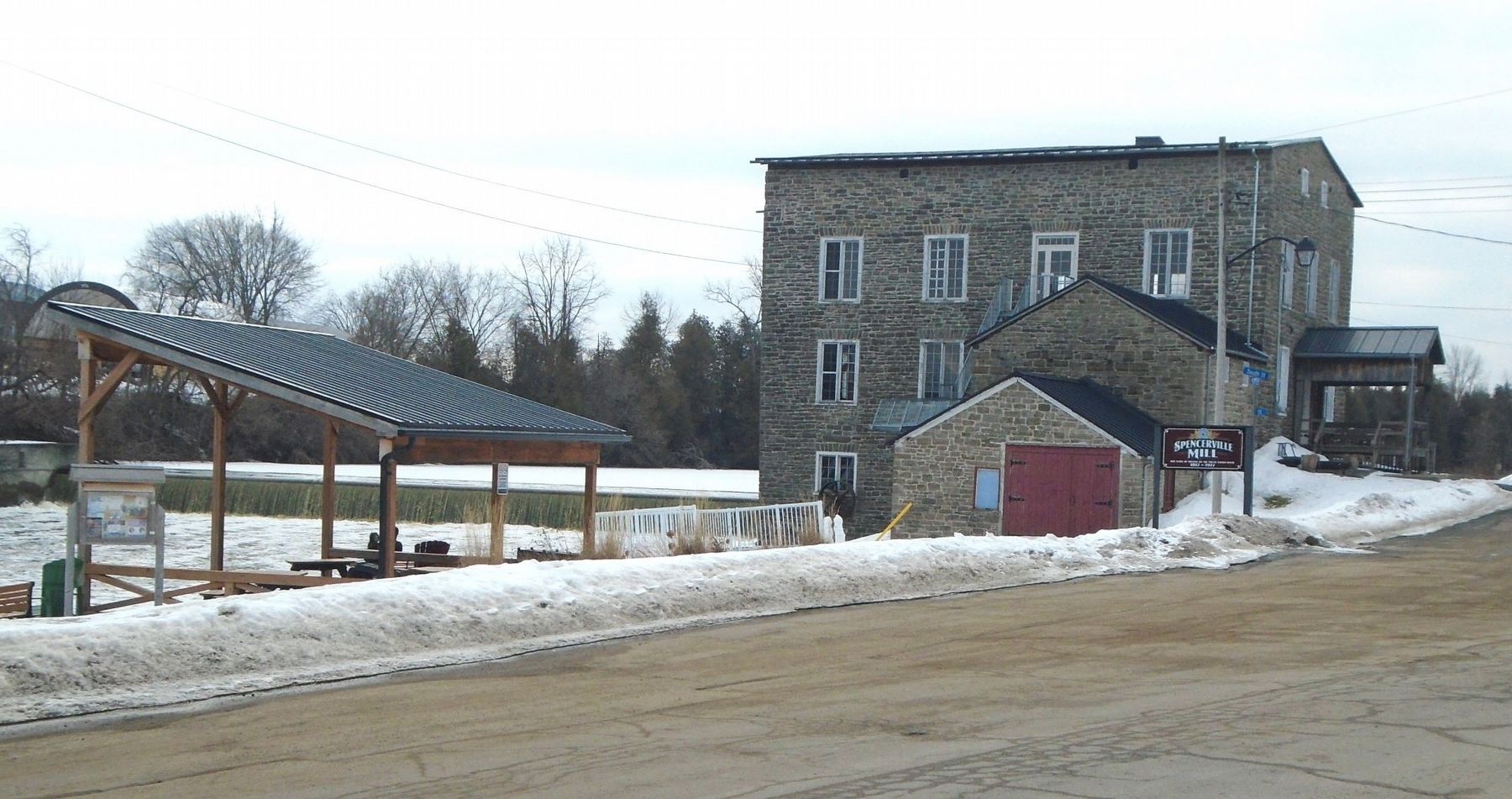
The present day stone gristmill beside this park is the last remaining mill on the South Nation River. It operated from 1864 to 1972. In the Spencerville Mill & Museum you can learn about the river, early saw mills, and the development of our thriving community.
Erected by Township of Edwardsburgh Cardinal, Spencerville Business & Community Connections, and Spencerville Mill & Museum.
Topics. This historical marker is listed in these topic lists: Indigenous Peoples and Communities • Parks & Recreational Areas • Settlements & Settlers • Waterways & Vessels. A significant historical year for this entry is 1811.
Location. 44° 50.523′ N, 75° 32.691′ W. Marker is in Spencerville, Ontario, in Leeds and Grenville United Counties. It is on Water Street south of Spencer Street (County Highway 44), on the left when traveling south. Touch for map. Marker is at or near this postal address: 11 Water Street, Spencerville ON K0E 1X0, Canada.
Photographed by William Fischer, Jr., March 11, 2022
2. Spencerville Riverside Park Marker

Regionally, this marker is in Eastern Ontario and specifically in Southeastern Ontario. It is also in Central Canada. Globally, it is in North America, the Western Hemisphere, the Western World, and the Anglosphere. Historically, it finds itself in what was once a British colony, the Viceroyalty of New France, the Haudenosaunee (Iroquois) Confederacy, and Rupert’s Land.
Other nearby markers. At least 8 other markers are within 14 kilometers of this marker, measured as the crow flies: War Memorial (about 240 meters away, measured in a direct line); The Founding of Spencerville (approx. 0.2 kilometers away); Township Hall Clock (approx. 0.2 kilometers away); Roebuck Indian Village Site (approx. 5.5 kilometers away); Fort de Levis (approx. 12.4 kilometers away); Eastern Ontario's First Court House and Gaol (approx. 12.5 kilometers away); Johnstown 1789 (approx. 12.5 kilometers away); Prescott Cemetery Gates (approx. 13.9 kilometers away). Touch for a list and map of all markers in Spencerville.
Also see . . . Spencerville Mill & Museum: Our History. (Submitted on March 19, 2022, by William Fischer, Jr. of Reynoldsburg, Ohio.)
Photographed by William Fischer, Jr., March 11, 2022
3. Spencerville Mill and Riverside Park
Credits. This page was last revised on January 19, 2026. It was originally submitted on March 19, 2022, by William Fischer, Jr. of Reynoldsburg, Ohio. This page has been viewed 626 times since then and 17 times this year. Photos: 1, 2, 3. submitted on March 19, 2022, by William Fischer, Jr. of Reynoldsburg, Ohio.
