Araby View near Frederick in Frederick County, Maryland — The American Northeast (Mid-Atlantic)
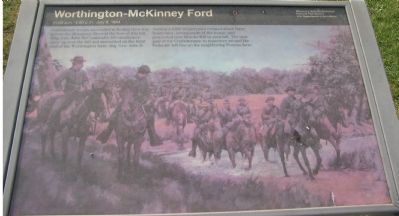
Worthington-McKinney Ford
11:00 a.m.-3:00 p.m. July 9, 1864
| — | Monocacy National Battlefield, National Park Service, U.S. Department of the Interior | — |
Photographed by Craig Swain, September 9, 2007
1. Worthington-McKinney Ford Marker
Erected by National Park Service, U.S. Department of the Interior.
Topics. This historical marker is listed in this topic list: War, US Civil. A significant historical month for this entry is July 1846.
Location. Marker has been reported permanently removed. It was located near 39° 21.702′ N, 77° 24.131′ W. Marker was near Frederick, Maryland, in Frederick County. It was in Araby View. It could be reached from Baker Valley Road when traveling south. Located at stop three of the auto-tour of Monocacy Battlefield. This marker set is at the trail head for the Worthington Farm walking tour. To reach the stop, from Baker Valley Road, turn northwest onto
this page online
We have been informed that this marker is no longer there and will not be replaced. This page is an archival view of what was.
Regionally, this marker was in the Washington Metropolitan Area and in Central Maryland. It was also in the American Mid-Atlantic. Globally, it was in North America, the Western Hemisphere, the Western World, and the Anglosphere. Historically, it found itself in what was once one of the original Thirteen Colonies and also the Antebellum South.

Other nearby markers. At least 8 other markers are within walking distance of this location: Through a Child's Eyes (within shouting distance of this marker); Ambush (within shouting distance of this marker); A Bold Plan (about 400 feet away, measured in a direct line); Caught in the Crossfire (approx. 0.6 miles away); L'Hermitage (approx. 0.6 miles away); 1862 Antietam Campaign (approx. 0.6 miles
Photographed by Bill Coughlin, April 12, 2011
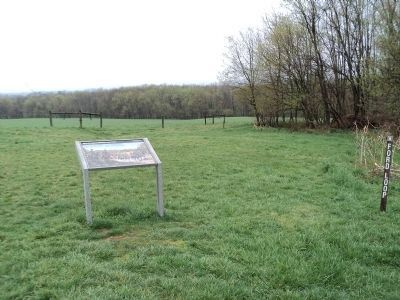
2. Worthington-McKinney Ford Marker
This marker is at stop 3 of the Monocacy Battlefield driving tour, near the Worthington House. The trail to the ford site can be seen on the right.
Other markers no longer nearby. Worthington House (was a few steps from this marker but has been permanently removed); McCausland’s Attack (was a few steps from this marker but has been permanently removed); Gordon’s Decisive Attack (was approx. 0.6 miles away but has been confirmed missing); Confederates Invade Maryland (was approx. 0.6 miles away but has been reported to have been replaced with another marker now near it); Best Family Farm (was approx. 0.6 miles away but has been reported to have been replaced with another marker now near it); Thick of the Battle (was approx. 0.7 miles away but has been confirmed missing); Thomas Farm (was approx. 0.7 miles away but has been permanently removed); Federal Retreat (was approx. 0.7 miles away but has been permanently removed).
More about this marker. The background image on the marker shows Confederate cavalry crossing at the ford.
Also see . . . Battle of Monocacy. National Park Service site. (Submitted on November 4, 2007, by Craig Swain of Leesburg, Virginia.)
Photographed by Craig Swain, November 3, 2007
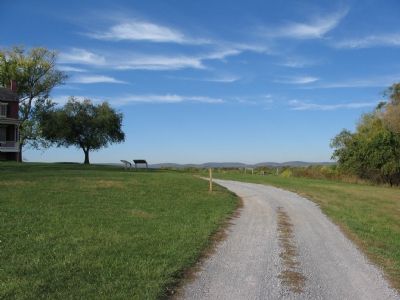
3. Worthington Farm Tour Stop
The Worthington-McKinney Ford marker is on the right side of the trail.
Photographed by Craig Swain, November 3, 2007
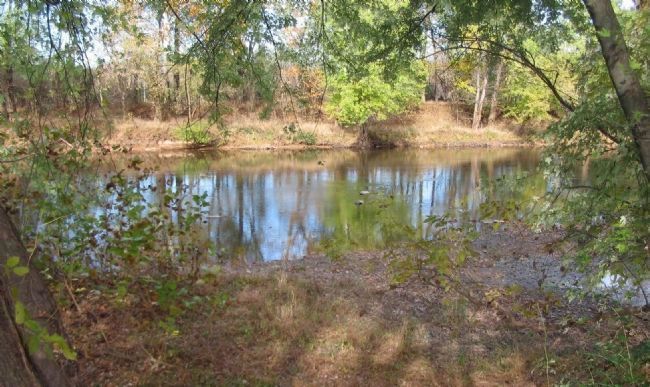
4. Worthington-McKinney Ford
The exact location of the ford cannot be plotted accurately as the river course has changed somewhat since the battle. Primary sources locate it near the mouth of Ballenger Creek, which has been diverted somewhat due to development on the west bank.
While the Monocacy is not a terribly deep course, nor very wide, from a military perspective just simply being able to cross a river is not enough. Military units require ground to stage prior to crossing, a wide enough trace to afford multi-file or two way traffic, and finally ground to reassemble the unit on the far side. Additionally, the crossing point should have some nearby terrain feature, such as a ridge or hill, to place artillery in order to suppress the enemy resistance to the crossing. Lastly, if possible, the crossing site should allow some degree of concealment from the enemy, lest the unit be attacked in mid-crossing. The commander's reports of the Monocacy Battle underscores these requirements as leaders struggled to locate proper military fords to bring their units into action.
While the Monocacy is not a terribly deep course, nor very wide, from a military perspective just simply being able to cross a river is not enough. Military units require ground to stage prior to crossing, a wide enough trace to afford multi-file or two way traffic, and finally ground to reassemble the unit on the far side. Additionally, the crossing point should have some nearby terrain feature, such as a ridge or hill, to place artillery in order to suppress the enemy resistance to the crossing. Lastly, if possible, the crossing site should allow some degree of concealment from the enemy, lest the unit be attacked in mid-crossing. The commander's reports of the Monocacy Battle underscores these requirements as leaders struggled to locate proper military fords to bring their units into action.
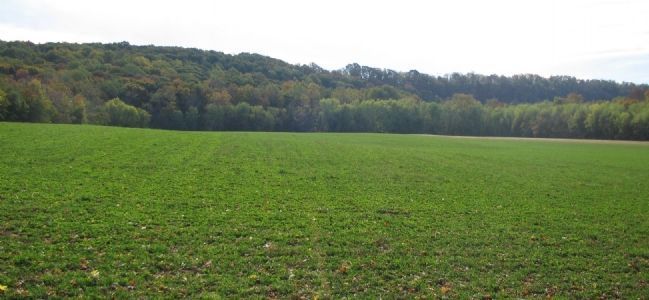
Photographed by Craig Swain, November 3, 2007
5. Confederate Staging Area
Around this field, and several others on the banks of the Monocacy to the southwest of Worthington House, Confederates under Gen. John B. Gordon re-assembled after crossing the ford. In the background looms Brooks Hill, which concealed them from Federal artillery and observers.
Credits. This page was last revised on June 28, 2024. It was originally submitted on November 4, 2007, by Craig Swain of Leesburg, Virginia. This page has been viewed 2,229 times since then and 39 times this year. Last updated on March 23, 2022, by Connor Olson of Menomonee Falls, Wisconsin. Photos: 1. submitted on November 4, 2007, by Craig Swain of Leesburg, Virginia. 2. submitted on April 23, 2011, by Bill Coughlin of Woodland Park, New Jersey. 3, 4, 5. submitted on November 4, 2007, by Craig Swain of Leesburg, Virginia. • J. Makali Bruton was the editor who published this page.
