Araby View near Frederick in Frederick County, Maryland — The American Northeast (Mid-Atlantic)
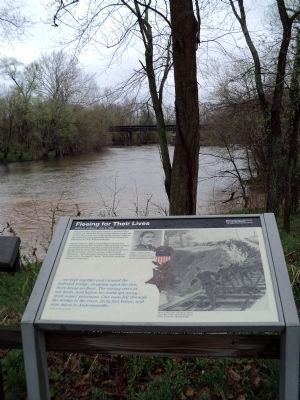
Fleeing for Their Lives
8:30 a.m. - 5:00 p.m. July 9, 1864
| — | Monocacy National Battlefield, National Park Service, U.S. Department of the Interior | — |

Photographed by Craig Swain, September 9, 2007
1. Fleeing for Their Lives Marker
Distressed that their main escape route had been burned, the stranded Federal skirmishers fought on as they faced periodic Confederate attacks. Late in the afternoon, they gradually fell back towards the Baltimore & Ohio bridge.
About 5:00 p.m., they noticed their compatriots retreating across the Gambrill Mill property toward the Baltimore Pike and fled across the railroad bridge to join them. The skirmishers had protected the Union center and the escape route toward Baltimore. "Your people," Maj. Gen. Lew Wallace wrote 1st Lt. George E. Davis, "held their position with great tenacity."
… we kept together and crossed the railroad bridge, stepping upon the ties, there being no floor. The enemy were at our heels, and before we could get away…[took some] prisoners. One man fell through the bridge to the river, forty feet below, and was taken to Andersonville.
1st Lt. George E. Davis
Erected by National Park Service, U.S. Department of the Interior.
Topics. This historical marker is listed in this topic list: War, US Civil. A significant historical month for this entry is July 1864.
Location. This marker has been replaced by another marker nearby. It was located
this page online

Regionally, this marker was in the Washington Metropolitan Area and in Central Maryland. It was also in the American Mid-Atlantic. Globally, it was in North America, the Western Hemisphere, the Western World, and the Anglosphere. Historically, it found itself in what was once one of the original Thirteen Colonies and also the Antebellum South.
Other nearby markers. At least 8 other markers are within walking distance of this location: Burning the Bridge (within shouting distance of this marker); Desperate Escape
Photographed by Bill Coughlin, April 12, 2011
2. Fleeing for Their Lives Marker
The Baltimore & Ohio Railroad bridge over the Monocacy River can be seen in the background of the photo.
Other markers no longer nearby. Burning of the Bridge (was a few steps from this marker but has been replaced with another marker now near it); Monocacy National Battlefield (was about 700 feet away, measured in a direct line but has been replaced with another marker now near it); a different marker also named Monocacy National Battlefield (was about 700 feet away but has been replaced with another marker now near it); Bush Creek Crossing (was about 700 feet away but has been reported to have been replaced with another marker now near it); Gambrill Mill (was about 700 feet away but has been replaced with another marker now near it); A Bold Plan (was approx. 0.2 miles away but has been replaced with another marker now near it); Gambrill House (was approx.
Photographed by Craig Swain, September 9, 2007
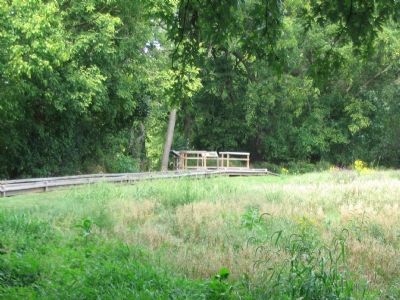
3. Trail Stop Overlooking the River
More about this marker. Beside the text is a portrait of "First Lt. George E. Davis of the 10th Vermont Infantry," who "received the Medal of Honor for his heroic leadership in defense of the bridges." The portrait is complemented by an image of the Medal of Honor. On the right of the marker is a drawing of the Union skirmishers retreating, "After holding off Confederates most of the day, Union skirmishers fled to safety across the railroad bridge."
This marker was replaced by a new one named Desperate Escape (see nearby markers).
Related markers. Click here for a list of markers that are related to this marker. This marker is among several describing the battle of Monocacy, to "tour" the battlefield using the related HMBd markers sites.
Also see . . . Battle of Monocacy. National Park Service site. (Submitted on November 2, 2007, by Craig Swain of Leesburg, Virginia.)
Photographed by Craig Swain, January 29, 2007
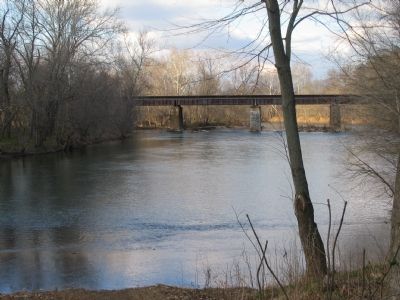
4. The Modern Day B&O Bridge
Photographed by Craig Swain, July 7, 2007
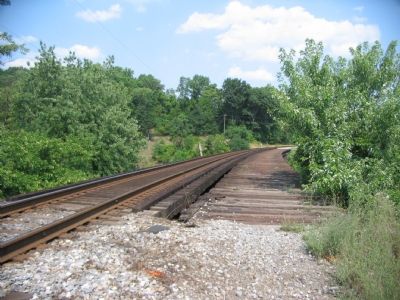
5. View of the Bridge from the West Side
The modern day view of the route Davis and his men took across the Monocacy.
Credits. This page was last revised on April 27, 2022. It was originally submitted on November 2, 2007, by Craig Swain of Leesburg, Virginia. This page has been viewed 1,760 times since then and 32 times this year. Last updated on March 28, 2022, by Connor Olson of Menomonee Falls, Wisconsin. Photos: 1. submitted on November 2, 2007, by Craig Swain of Leesburg, Virginia. 2. submitted on April 23, 2011, by Bill Coughlin of Woodland Park, New Jersey. 3, 4, 5. submitted on November 2, 2007, by Craig Swain of Leesburg, Virginia. • Devry Becker Jones was the editor who published this page.
