Riverfront in Wilmington in New Castle County, Delaware — The American Northeast (Mid-Atlantic)
The New World
Riverfront Wilmington
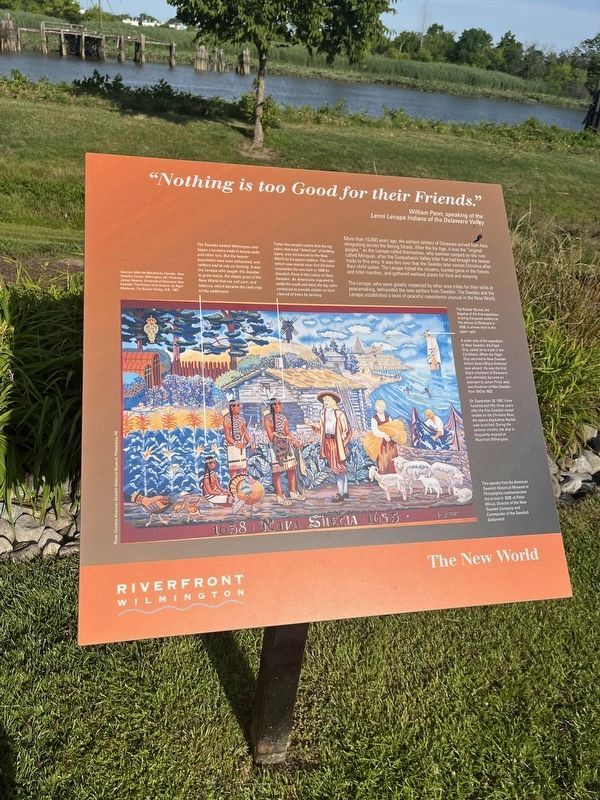
"Nothing is too Good for their Friends."
William Penn, speaking of the Lenni Lenape Indians of the Delaware Valley
More than 10,000 years ago, the earliest settlers of Delaware arrived from Asia emigrating across the Bering Straits. After the the Ice Age, it was the "original people," as the Lenape called themselves, who summer-camped on the river called Minquas, after the Susquehanni Valley tribe that had brought the beaver trade to this area. It was this river that the Swedes later named Christina after their child queen. The Lenape fished the streams, hunted game in the forests and tidal marshes, and gathered wetland plants for food and weaving. The Lenape, who were greatly respected by other area tribes for their skills at peacemaking, befriended the new settlers from Sweden. The Swedes and the Lenape established a level of peaceful coexistence unusual in the New World.
[Captions, clockwise from top]
The Swedes settled Wilmington and began a lucrative trade in beaver pelts and other furs. But the beaver population was soon exhausted, and settlers had to rely on farming. It was the Lenape who taught the Swedes
this page online
Today few people realize that the log cabin, the most "American" of building types, was introduced to the New World by European settlers. The cabin which now stands near Fort Christina resembles the one built in 1638 by Swedish-Finns in the colony of New Sweden. As Americans migrated to settle the south and west, the log cabin continued to provide shelter on land cleared of trees for farming.
The Kalmar Nyckel, the flagship of the first expedition to bring European settlers to the shores of Delaware in 1638, is shown here in the upper right.
A sister ship of the expedition to New Sweden, the Fögel Grip, sailed on to trade in the Caribbean. When the Fögel Grip returned to New Sweden Antoni Swart (Black Anthony) was aboard. He was the first black inhabitant of Delaware, and ultimately became an assistant to Johan Printz, who was Governor of New Sweden from 1643 to 1653.
On September 28, 1997, three hundred and fifty-three years after the first Swedish vessel landed on the Christina River, the replica

Photographed by Devry Becker Jones (CC0), March 1, 2019
2. The New World Marker
This is a previous iteration of the marker. While the inscription is identical there are slight differences in formatting and background coloring.
The tapestry from the American Swedish Historical Museum in Philadelphia commemorates the arrival in 1638, of Peter Minuit, Director of the New Sweden Company and Commander of the Swedish Settlement.
Erected by Riverfront Wilmington.
Topics. This historical marker is listed in these topic lists: Indigenous Peoples and Communities • Settlements & Settlers • Waterways & Vessels.
Location. 39° 43.956′ N, 75° 33.646′ W. Marker is in Wilmington, Delaware, in New Castle County. It is in Riverfront. It can be reached from Justison Stret south of Shipyard Drive, on the right when traveling north. Touch for map. Marker is at or near this postal address: 720 Justison Street, Wilmington DE 19801, United States of America. Touch for directions.

Regionally, this marker is in Greater Philadelphia. It is also in the American Mid-Atlantic, on the Delmarva Peninsula, and on the Eastern Seaboard. Globally, it is in the North Atlantic Region, North America, the
Other nearby markers. At least 8 other markers are within walking distance of this marker: Michael S. Purzycki Riverwalk (about 700 feet away, measured in a direct line); a different marker also named Michael S. Purzycki Riverwalk (about 700 feet away); World War II (approx. 0.2 miles away); Military Veterans Memorial (approx. 0.2 miles away); Points of Remembrance (approx. 0.2 miles away); a different marker also named World War II (approx. 0.2 miles away); Rocks in the Show (approx. 0.2 miles away); William Julius "Judy" Johnson (approx. 0.2 miles away). Touch for a list and map of all markers in Wilmington.
Another marker is no longer nearby. World War II (was approx. 0.2 miles away but has been replaced with another marker now near it).
Credits. This page was last revised on July 4, 2024. It was originally submitted on March 2, 2019, by Devry Becker Jones of Washington, District of Columbia. This page has been viewed 325 times since then and 17 times this year. Last updated on April 25, 2022, by Carl Gordon Moore Jr. of North East, Maryland. Photos: 1. submitted on July 4, 2024, by Devry Becker Jones of Washington, District of Columbia. 2. submitted on March 2, 2019, by Devry Becker Jones of Washington, District of Columbia. 3. submitted on July 4, 2024, by Devry Becker Jones of Washington, District of Columbia.
