Downtown Decatur in DeKalb County, Georgia — The American South (South Atlantic)
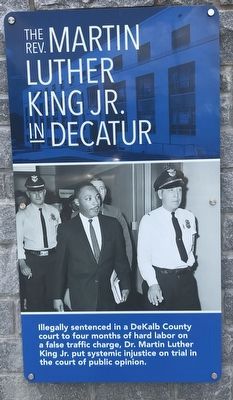
The Rev. Martin Luther King Jr. in Decatur
Photographed by Duane and Tracy Marsteller, May 6, 2022
1. The Rev. Martin Luther King Jr. in Decatur Marker (First panel)
Illegally sentenced in a DeKalb County court to four months of hard labor on a false traffic charge, Dr. Martin Luther King Jr. put systemic injustice on trial in the court of public opinion.
[Second panel]
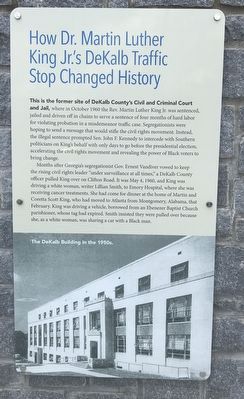
How Dr. Martin Luther King Jr.'s DeKalb Traffic Stop Changed History
This is the former site of DeKalb County's Civil and Criminal Court and Jail, where in October 1960 the Rev. Martin Luther King Jr. was sentenced, jailed and driven off in chains to serve a sentence of four months of hard labor for violating probation in a misdemeanor traffic case. Segregationists were hoping to send a message that would stifle the civil rights movement. Instead, the illegal sentence prompted Sen. John F. Kennedy to intercede with Southern politicians on King's behalf with only days to go before the presidential election, accelerating the civil rights movement and revealing the power of Black voters to bring change.
Months after Georgia's segregationist Gov. Ernest Vandiver vowed to keep the rising civil rights leader “under surveillance at all times,” a DeKalb County officer pulled King over on Clifton Road. It was May 4, 1960, and King was driving a white woman, writer Lillian Smith, to Emory Hospital, where she was receiving cancer treatments. She had come for dinner at the home of Martin and Coretta Scott King, who had moved to Atlanta from Montgomery, Alabama, that February. King was driving a vehicle, borrowed from an Ebenezer Baptist Church parishioner, whose tag had expired. Smith insisted they were pulled over because she, as a white woman, was sharing a car with a Black man.
Caption: The DeKalb Building in the 1950s.
[Third panel]
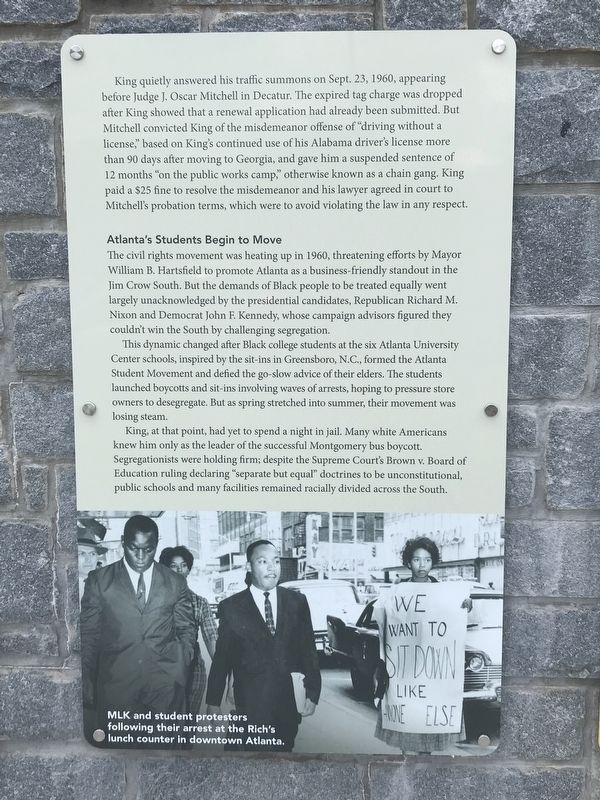
King quietly answered his traffic summons on Sept. 23, 1960, appearing before Judge J. Oscar Mitchell in Decatur. The expired tag charge was dropped after King
this page online
Atlanta's Students Begin to Move
The civil rights movement was heating up in 1960, threatening efforts by Mayor William B. Hartsfield to promote Atlanta as a business-friendly standout in the Jim Crow South. But the demands of Black people to be treated equally went largely unacknowledged by the presidential candidates, Republican Richard M. Nixon and Democrat John F. Kennedy, whose campaign advisors figured they couldn't win the South by challenging segregation.
This dynamic changed after Black college students at the six Atlanta University Center schools, inspired by the sit-ins in Greensboro, N.C., formed the Atlanta Student
Photographed by Duane and Tracy Marsteller, May 6, 2022
2. The Rev. Martin Luther King Jr. in Decatur Marker (Second panel)
King, at that point, had yet to spend a night in jail. Many white Americans knew him only as the leader of the successful Montgomery bus boycott. Segregationists were holding firm; despite the Supreme Court's Brown vs. Board of Education ruling declaring “separate but equal” doctrines to be unconstitutional, public schools and many facilities remained racially divided across the South.
Caption: MLK and student protestors following their arrest at the Rich's lunch counter in downtown Atlanta.
[Fourth panel]
Meanwhile, the NAACP discouraged the civil disobedience tactics of King's Southern Christian Leadership Conference. Even Martin Luther King Sr., nationally influential as senior pastor of the Ebenezer Baptist Church, urged his son to stay out of the sit-ins.
A ‘Betrayal’ Sends King to ‘Klan Country’
But the students' leader, Lonnie King, reminded Martin Luther King of his father's sermon,
Photographed by Duane and Tracy Marsteller, May 6, 2022
3. The Rev. Martin Luther King Jr. in Decatur Marker (Third panel)
The students were taken to the Fulton County Jail, and with King among them, their treatment became national news. Hartsfield began negotiating, describing Atlanta as “a city too busy … to hate,” which would become the city's enduring motto. Eager to end the Black community's boycott of the segregated stores and keep the sit-ins from escalating, Hartsfield brokered a deal: The department store owners would drop the charges and promise to eventually desegregate lunch counters in exchange for a moratorium on the sit-ins. But cries of betrayal rang out when the activists realized that King remained in jail after everyone else was released. Unknown to
Photographed by Duane and Tracy Marsteller, May 6, 2022
4. The Rev. Martin Luther King Jr. in Decatur Marker (Fourth panel)
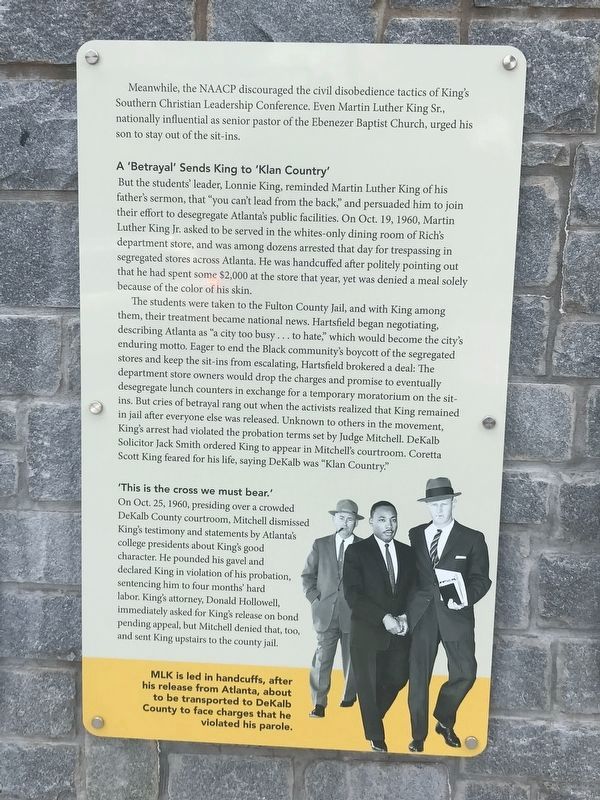
‘This is the Cross We Must Bear’
On Oct. 25, 1960, presiding over a crowded DeKalb County courtroom, Mitchell dismissed King's testimony and statements by Atlanta's college presidents about King's good character. He pounded his gavel and declared King in violation of his probation, sentencing him to four months' hard labor. King's attorney, Donald Hollowell, immediately asked for King's release on bond pending appeal, but Mitchell denied that, too, and sent King upstairs to the county jail.
Caption: MLK is led in handcuffs, after his release from Atlanta, about to be transported to DeKalb County to face charges that he violated his parole.
[Fifth panel]
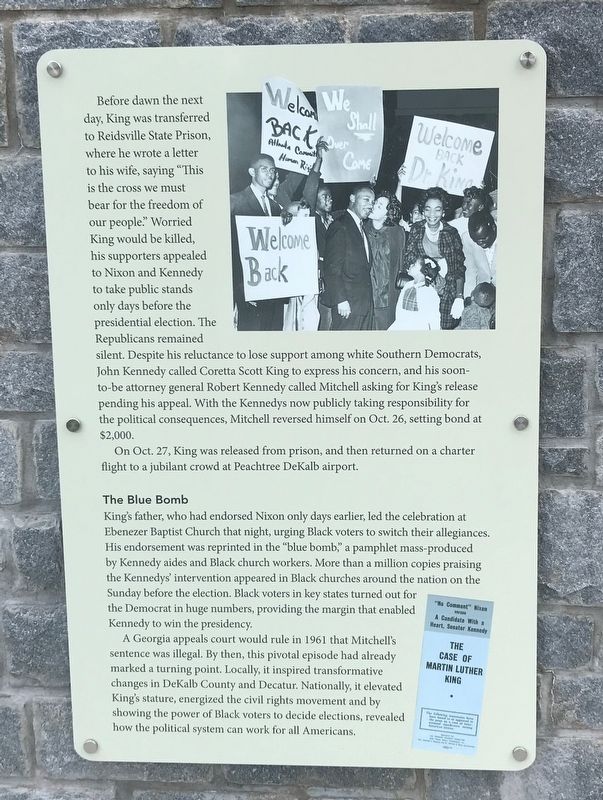
Before dawn the next day, King was transferred to Reidsville State Prison, where he wrote a letter to his wife, saying “This is the cross we must bear for the freedom of our people.” Worried King would be killed, his supporters appealed to
Photographed by Duane and Tracy Marsteller, May 6, 2022
5. The Rev. Martin Luther King Jr. in Decatur Marker (Fifth panel)
On Oct. 27, King was released from prison, and then returned on a charter flight to a jubilant crowd at Peachtree DeKalb airport.
The Blue Bomb
King's father, who had endorsed Nixon only days earlier, led the celebration at Ebenezer Baptist Church that night, urging Black voters to switch their allegiances. His endorsement was reprinted in the “blue bomb,” a pamphlet mass-produced by Kennedy aides and Black church workers. More than a million copies praising the Kennedys' intervention appeared in Black churches around the nation on the Sunday before the election. Black voters in key states turned out for the Democrat in huge numbers,
Photographed by Duane and Tracy Marsteller, May 6, 2022
6. The Rev. Martin Luther King Jr. in Decatur Marker (Sixth panel)
A Georgia appeals court would rule in 1961 that Mitchell's sentence was illegal. By then, this pivotal episode had already marked a turning point. Locally, it inspired transformative changes in DeKalb County and Decatur. Nationally, it elevated King's stature, energized the civil rights movement and by showing the power of Black voters to decide elections, revealed how the political system can work for all Americans.
[Sixth panel]
The Commemorating King Campaign
Decatur High School Students Advocate for Georgia Historical Marker
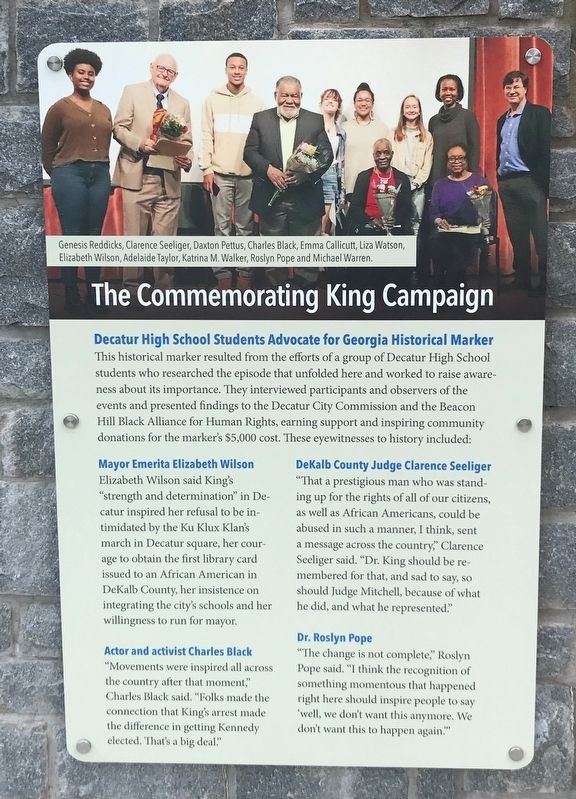
This historical marker resulted from the efforts of a group of Decatur High School students who researched the episode that unfolded here and worked to raise awareness about its importance. They interviewed participants and observers of the events and presented findings to the Decatur City Commission and the Beacon Hill Black Alliance for Human Rights, earning support and inspiring community donations for the marker's $5,000 cost. These eyewitnesses to history included:
Mayor Emerita Elizabeth Wilson
Elizabeth Wilson said King's “strength
Photographed by Duane and Tracy Marsteller, May 6, 2022
7. The Rev. Martin Luther King Jr. in Decatur Marker
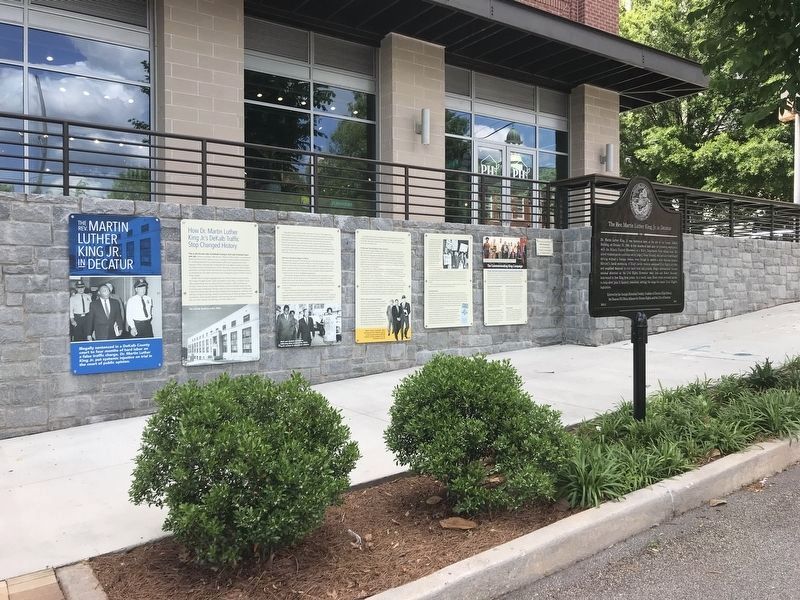
The state historical marker about the episode is on the right.
Actor and activist Charles Black
“Movements were inspired all across the country after that moment,” Charles Black said. “Folks made the connection that King's arrest made the difference in getting Kennedy elected. That's a big deal.”
DeKalb County Judge Clarence Seeliger
“That a prestigious man who was standing up for the rights of all our citizens, as well as African Americans, could be abused in such a manner, I think sent a message across the country,” Clarence Seeliger said. “Dr. King should be remembered for that, and sad to say, so should Judge Mitchell, because of what he did, and what he represented.”
Dr. Roslyn Pope
“The change is not complete,” Roslyn Pope said. “I think the recognition of something momentous that happened right here should inspire people to say, ‘well, we don't want this anymore. We don't want this to happen again.’”
Caption: Genesis Reddicks, Clarence Seeliger, Daxton Pettus, Charles Black, Emma Callicutt, Liza Watson, Elizabeth Wilson, Adelaide Taylor, Katrina M. Walker, Roslyn Pope and Michael Warren.
Topics. This historical marker is listed in these topic lists: Civil Rights • Government & Politics • Law Enforcement. A significant historical date for this entry is May 4, 1960.
Location. 33° 46.402′ N, 84° 17.801′ W. Marker is in Decatur, Georgia, in DeKalb County. It is in Downtown Decatur. It is at the intersection of North McDonough Street and West Trinity Place, on the right when traveling south on North McDonough Street. Touch for map. Marker is at or near this postal address: 112 W Trinity Pl, Decatur GA 30030, United States of America. Touch for directions.

Regionally, this marker is in the Piedmont and in Metro Atlanta. It is also in the American South and specifically in the Deep South. Globally, it is in North America, the Western Hemisphere, the Western World, and the Anglosphere. Historically, it finds itself in what was once the territory of the Mississippian Culture, one of the original Thirteen Colonies, one of the Confederate States of America, and the Antebellum South.
Other nearby markers. At least 8 other markers are within walking distance of this marker: The Rev. Martin Luther King, Jr. in Decatur (here, next to this marker); Lynching in America / Lynching in DeKalb County (within shouting distance of this marker); Marion Footman Wilson (about 500 feet away, measured in a direct line); DeKalb County Confederate Monument Contextualization (about 500 feet away); Indian Trails of Dekalb County (about 600 feet away); Garrard’s Cavalry Raid (about 600 feet away); Old Dekalb County Courthouse (about 600 feet away); The Stoneman Raid (about 600 feet away). Touch for a list and map of all markers in Decatur.
Also see . . . Remembering Kennedy's micro-targeting in the 1960 election. NBC news website entry (Submitted on November 2, 2024, by Larry Gertner of New York, New York.)
Credits. This page was last revised on November 2, 2024. It was originally submitted on May 11, 2022, by Duane and Tracy Marsteller of Murfreesboro, Tennessee. This page has been viewed 638 times since then and 60 times this year. Photos: 1, 2, 3, 4, 5, 6, 7. submitted on May 11, 2022, by Duane and Tracy Marsteller of Murfreesboro, Tennessee.
