Near Fountain Inn in Greenville County, South Carolina — The American South (South Atlantic)
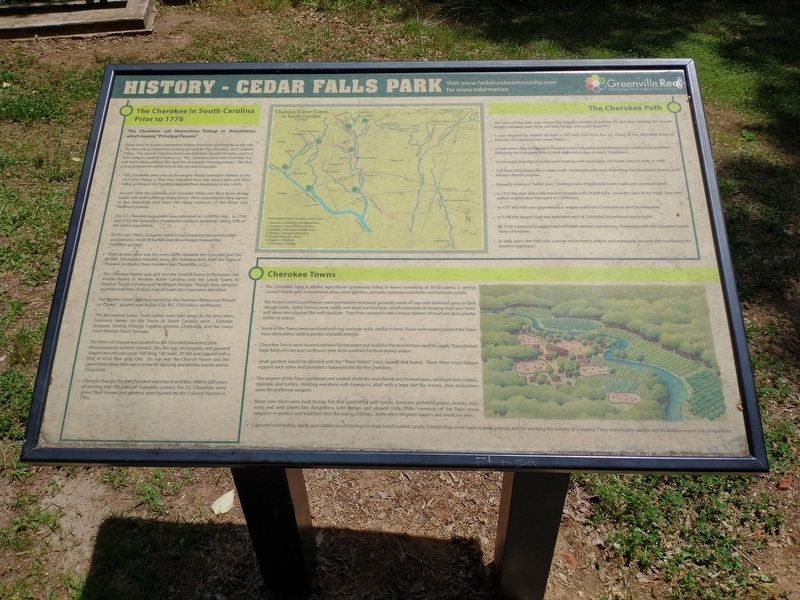
History - Cedar Falls Park
Photographed by Tom Bosse, May 14, 2022
1. History - Cedar Falls Park Marker
The Cherokee call themselves Tsalagi or Aniyunwiya which means “Principal People”.
There were no known permanent Native American settlements at this site. The area was a wilderness hunting ground for Cherokee and Catawba Tribes. The closet Cherokee Town was Eastatoe, located 30 miles west in a river valley in northern Pickens Co. The Catawbas lived near Charlotte, N.C. and both tribes utilized this land for temporary hunting camps. The first actual permanent settlement at this site was European.
• The Cherokees were one of the largest Native American Nations in the USA. One theory is that they migrated from the Great Lakes and Ohio Valley, arriving in the Southern Appalachian Mountains in the 1400s.
• Around 1600 the Catawba and Cherokee Tribes met for a fierce all-day battle with both suffering heavy losses. After reconciliation they agreed to live peacefully and share the may resources of the forest and Piedmont prairies.
• The S.C. Cherokee population was estimated at 15,000 in 1685. In 1738 and 1753 the Europeans introduced smallpox epidemics killing 50% of
this page online
• By the mid 1700’s, European settlers had converted the land to fields and pastures. Herds of buffalo and elk no longer roamed the Piedmont prairies.
• Trade in deer skins was the main traffic between the Cherokee and the British. The natives traveled along the Cherokee Path from the Town of Keowee to Charles Town (modern day Charleston, S.C.).
• The Cherokee Nation was split into the Overhill Towns in Tennessee, the Middle Towns in Western North Carolina, and the Lower Towns in Western South Carolina and Northeast Georgia. Though they varied in number from time to time, over 64 town sites have been identified.
• The “Mother Town” (spiritual capital) for the Cherokee Nation was “Kituah” or “Chota”, located near Bryson City, N.C. (150+ miles northwest).
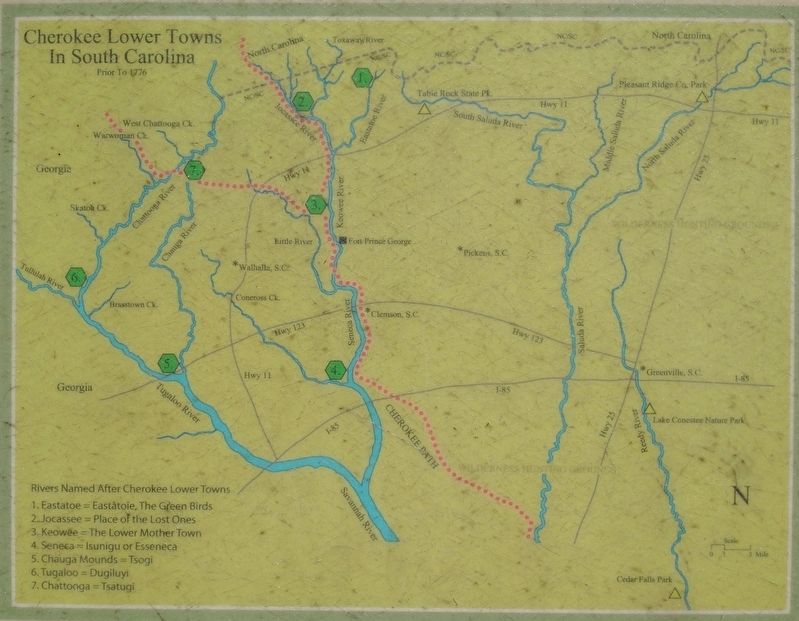
• The permanent Lower Town names were given to the area rivers. Commo names for the Towns in South Carolina were: Easatoe, Jocassee, Seneca, Chauga, Tugaloo, Oconee, Chattooga, and the Lower Town “Mother Town”, Keowee.
• The Town of Chauga was located on the Cherokee ancestor’s (the Mississippians) earthen mound. This flat top, rectangular, and
Photographed by Tom Bosse, May 14, 2022
2. Cherokee Lower Towns in South Carolina
• Lifestyle changes for the Cherokee were harsh and fast. Within 350 years of arriving and 100 years of European contact, the S.C. Cherokees were gone. Their homes and gardens were burned by the Colonial Patriots in 1776.
The Cherokee Path
• The spine of the path was created by migratory herds of buffalo, elk and deer seeking the easiest linkage between river fords, salt licks, forage, and water resources.
• It was adapted by natives to form a 130 mile trail from the S.C. Coast the Cherokee Town of Keowee, the capital of the Lower Towns.
• It took seven days to hike from Keowee to the Columbia area following the Saluda River, and then following the Congaree River, it took eight more days to reach Charleston.
• It is thought that the Cherokee were trading with the English at Charles Town as early as 1690.
• The Town of Keowee was a major trace crossroads with trails branching in to
Photographed by Tom Bosse, May 14, 2022
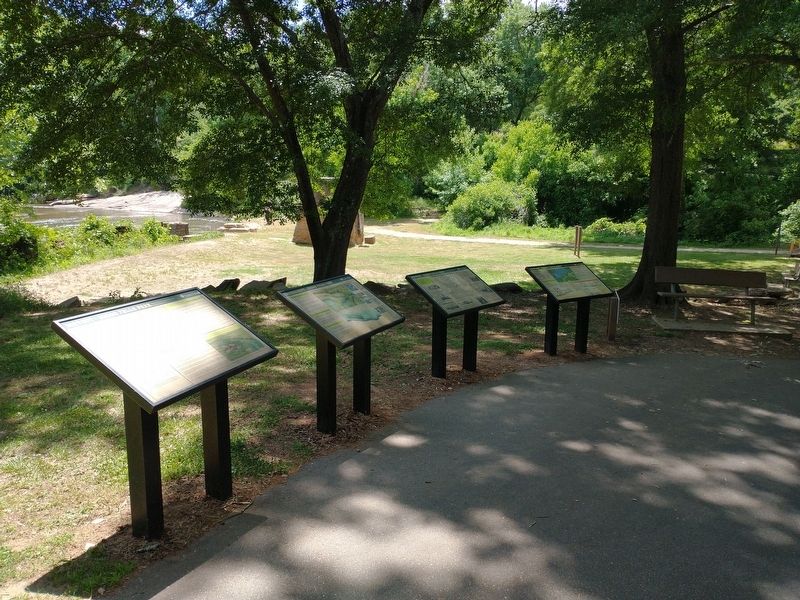
3. History - Cedar Falls Park Marker
Marker located on far left.
• Primarily used as a “fur for guns” trading route, it facilitated travel, trade, and communication.
• In 1715 the deer skin trade reached its peak with 54,000 skins. Since the start of the trade, over one million animal skins had gone to Charleston.
• In 1737 the Path was upgraded to a wagon road from Charleston to the Columbia area.
• In 1748 the wagon road was extended west of Columbia, but without any bridges.
• By 1759 it became a wagon road with mile markers connecting Charleston with the Cherokee Lower Town of Keowee.
• In later years, the Path was used to move Patriot armies and eventually became the foundation for modern highways.
Cherokee Towns
• The Cherokee were a settled, agricultural community living in towns consisting of 30-60 cabins, a central Council House with a ceremonial plaza, small gardens, orchards, extensive cornfields and livestock corrals.
• The homes and Council House were permanent structures generally made of logs with thatched grass or bark shingle roofs. Some homes were wattle and daub construction, which consisted of weaving rivercane,
Photographed by Tom Bosse, May 14, 2022
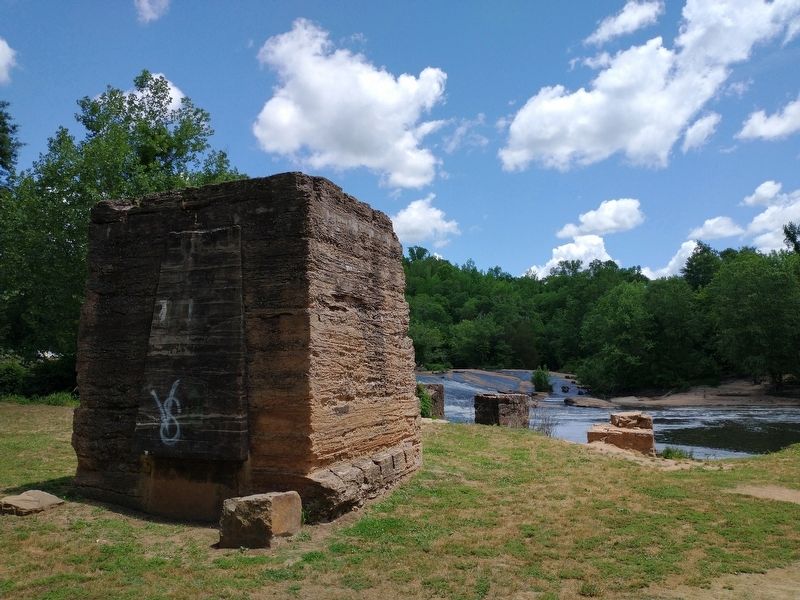
4. Cedar Falls Park
• Some towns were enclosed with log stockade walls, similar to forts. These were used to protect the Town from other tribes’ raiding parties and wild animals.
• Cherokee Towns were located on rivers for the water and available float river bottom land for crops. They planted large fields of corn and sunflowers that were sundried for food during winter.
• Small gardens would be planted with the “Three Sisters” (corn, squash and beans). These three crops helped support each other and provided a balanced diet for the Cherokee.
• The women of the Town gardened and cooked while the men fished and hunted bears, whitetail deer, rabbits, squirrels, and turtles. Hunting was done with blowguns, atlatl with large dart like arrows. Bow and arrows were the preferred weapon.
• Stone river dams were built to trap fish that were killed with spears. Everyone gathered grapes, berries, nuts, roots and wild plants like dandelions, wild onions and yaupon holly. Older members of the Town made weapons or pottery
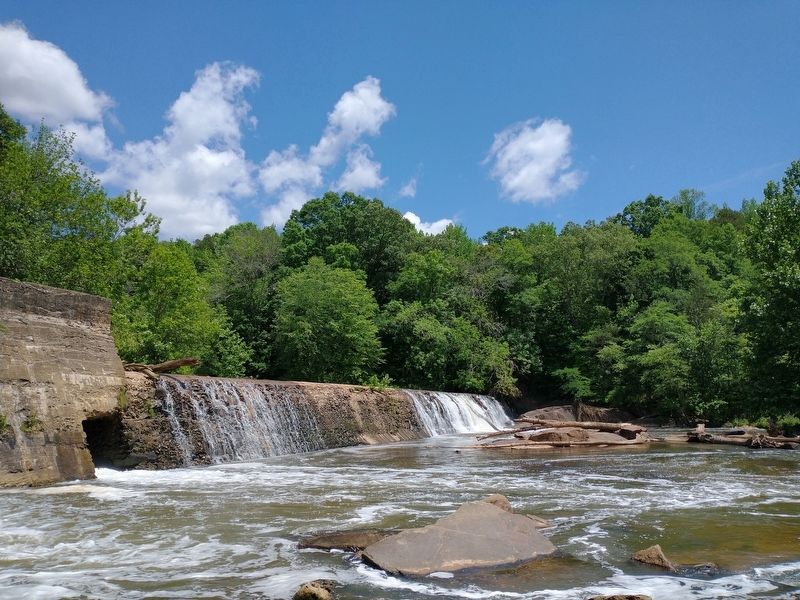
Photographed by Tom Bosse, May 14, 2022
5. Cedar Falls Park
• Captured wild turkey, ducks and rabbits would be kept in small brush walled corrals. Trusted dogs were used as pack animals and for warning the natives of invaders. They were highly valued and treated as respected companions.
Erected by Greenville County Recreation District.
Topics. This historical marker is listed in these topic lists: Indigenous Peoples and Communities • Parks & Recreational Areas. A significant historical year for this entry is 1776.
Location. 34° 36.724′ N, 82° 17.908′ W. Marker is near Fountain Inn, South Carolina, in Greenville County. It can be reached from the intersection of Cedar Falls Road and Turner Road, on the right when traveling north. Marker located in Cedar Falls Park. Touch for map. Marker is at or near this postal address: 201 Cedar Falls Road, Fountain Inn SC 29644, United States of America. Touch for directions.

Regionally, this marker is in Upstate and in the Greater Greenville-Spartanburg Area. It is also in the American South, specifically in the Deep South, in Appalachia, and specifically in Southern
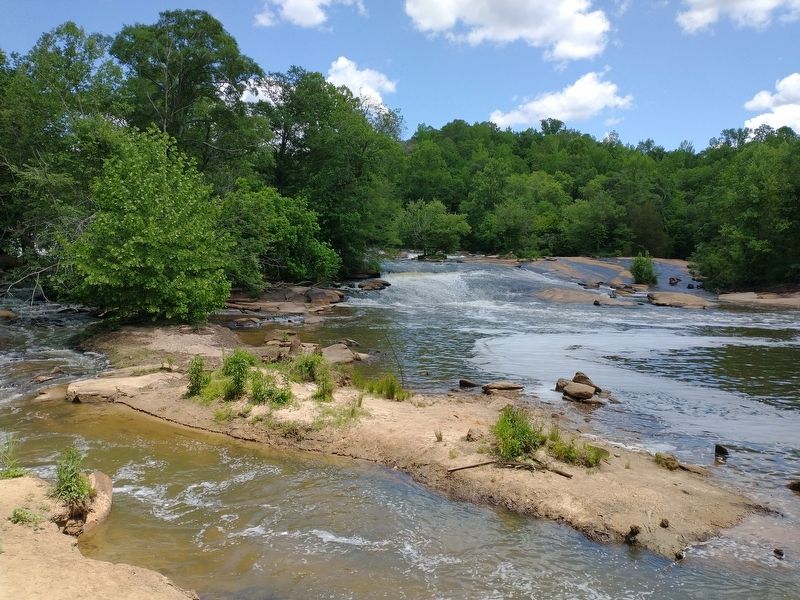
Photographed by Tom Bosse, May 14, 2022
6. Cedar Falls Park
Other nearby markers. At least 8 other markers are within 4 miles of this marker, measured as the crow flies: History – Cedar Falls Park (a few steps from this marker); a different marker also named History - Cedar Falls Park (a few steps from this marker); Environment – Cedar Falls Park (a few steps from this marker); Fork Shoals School (approx. one mile away); Fork Shoals Baptist Church (approx. one mile away); Hopkins Farm (approx. 3.2 miles away); Toney's Store / Militia Muster Ground (approx. 3.2 miles away); Battle of Great Cane Brake (approx. 3.2 miles away). Touch for a list and map of all markers in Fountain Inn.
Related markers. Click here for a list of markers that are related to this marker.
Credits. This page was last revised on May 26, 2022. It was originally submitted on May 25, 2022, by Tom Bosse of Jefferson City, Tennessee. This page has been viewed 892 times since then and 62 times this year. Photos: 1, 2, 3, 4, 5, 6. submitted on May 25, 2022, by Tom Bosse of Jefferson City, Tennessee. • Bernard Fisher was the editor who published this page.
