Fort Jefferson in Darke County, Ohio — The American Midwest (Great Lakes)
Fort Jefferson
Photographed by Dale K. Benington, June 5, 2009
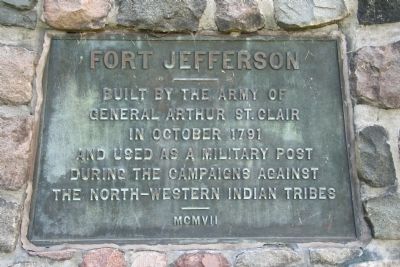
1. Fort Jefferson Marker
General Arthur St. Clair
in October 1791
and used as a military post
during the campaigns against
the North-Western Indian tribes
MCMVII
Erected 1907.
Topics. This historical marker is listed in these topic lists: Forts and Castles • Indigenous Peoples and Communities • Wars, US Indian. A significant historical month for this entry is October 1791.
Location. 40° 1.546′ N, 84° 39.401′ W. Marker is in Fort Jefferson, Ohio, in Darke County. It can be reached from Weavers-Fort Jefferson Road 0.1 miles west of Ohio Route 121, on the left when traveling west. This historic marker is located in the state park maintained by the Ohio Historical Society. It is attached to the stacked stone memorial that is featured in this park. Touch for map. Marker is in this post office area: Greenville OH 45331, United States of America. Touch for directions.

Regionally, this marker is in Ohio’s Till Plains. It is also in the American Midwest and in the Corn Belt. Globally, it is in North America, the Western Hemisphere, the Western World, and the Anglosphere. Historically, it finds itself in what
this page online
Other nearby markers. At least 8 other markers are within walking distance of this marker: Dedicated in Memory to All American Soldiers Who Died at or Near Fort Jefferson, Northwest Territory (here, next to this marker); Well or Magazine Pit (a few steps from this marker); a different marker also named Ash Pit (a few steps from this marker); Firepit (a few steps from this marker); a different marker also named Excavation (within shouting distance of this marker); Underground Passage (within shouting distance of this marker); Fort Jefferson / St. Clair’s Defeat (within shouting distance of this marker); William Noble (about 500 feet away). Touch for a list and map of all markers in Fort Jefferson.
Other markers no longer nearby. Ash Pit (was here, next to this marker but has been permanently removed); Trench (was within shouting distance of this marker but has been permanently removed); Excavation (was within shouting distance of this marker but has been permanently removed); a different marker also
Photographed by Dale K. Benington, June 5, 2009
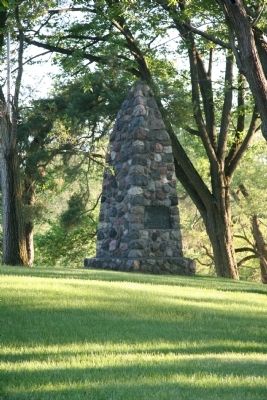
2. Fort Jefferson Marker
View of the historical marker affixed to the state memorial monument.
More about this marker. To get to this historic marker take State Route 121 to Fort Jefferson, Ohio, and turn west onto Weavers-Fort Jefferson Road and travel one block (less than 0.1 mile). The state park that is situated on the site of Fort Jefferson will be on your left and the historic marker is featured at the top of the hill in the center of the park.
Also see . . . "Seeking Site of Fort Jefferson". Ohio Memory website entry (Submitted on April 28, 2022, by Larry Gertner of New York, New York.)
Photographed by J. Wesley Baker, June 3, 2016
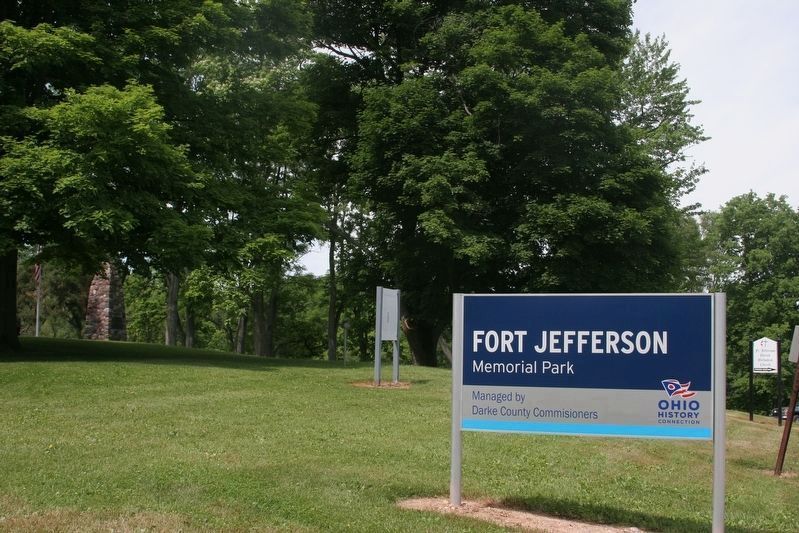
3. Fort Jefferson Memorial Park
The Ohio History Connection sign for the site. The St. Clair's Defeat sign can be seen in the near background to the left of the sign and the stone monument is visible at the top of the knoll at the far left of the picture.
Credits. This page was last revised on November 6, 2024. It was originally submitted on June 12, 2009, by Dale K. Benington of Toledo, Ohio. This page has been viewed 2,025 times since then and 73 times this year. Photos: 1, 2. submitted on June 12, 2009, by Dale K. Benington of Toledo, Ohio. 3. submitted on December 8, 2018, by J. Wesley Baker of Springfield, Ohio. • Craig Swain was the editor who published this page.
