
North Capitol in Nashville in Davidson County, Tennessee — The American South (East South Central)
French Lick Creek
| — | French Lick Creek Greenway | — |
Photographed by Darren Jefferson Clay, June 11, 2022
1. French Lick Creek Marker
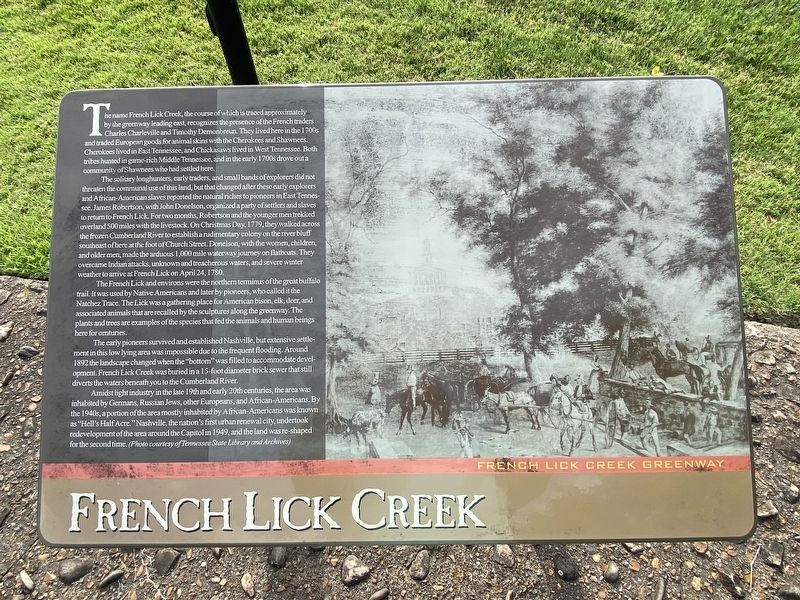
The name French Lick Creek, the course of which is traced approximately by the greenway leading east, recognizes the presence of the French traders Charles Charleville and Timothy Demonbreun. They lived here in the 1700s and traded European goods for animal skins with the Cherokees and Shawnees. Cherokees lived in East Tennessee, and Chickasaws lived in West Tennessee. Both tribes hunted in game-rich Middle Tennessee, and in the early 1700s drove out a community of Shawnees who had settled here.
The solitary longhunters, early traders, and small bands of explorers did not threaten the communal use of this land, but that changed after these early explorers and African-American slaves reported the natural riches to pioneers in East Tennessee. James Robertson, with John Donelson, organized a party of settlers and slaves to return to French Lick. For two months, Robertson and the younger men trekked overland 500 miles with the livestock. On Christmas Day, 1779, they walked across the frozen Cumberland River to establish a rudimentary colony on the river bluff southeast of here at the foot of Church Street. Donelson,
this page online
The French Lick and environs were the northern terminus of the great buffalo trail. It was used by Native Americans and later by pioneers, who called it the Natchez Trace. The Lick was a gathering place for American bison, elk, deer, and associated animals that are recalled by the sculptures along the greenway. The plants and trees are examples of the species that fed the animals and human beings here for centuries.
The early pioneers survived and established Nashville, but extensive settlement in this low lying area was impossible due to the frequent flooding. Around 1892 the landscape changed when the "bottom” was filled to accommodate development. French Lick Creek was buried in a 15-foot diameter brick sewer that still diverts the waters beneath you to the Cumberland River.
Amidst light industry in the late 19th and early 20th centuries, the area was inhabited by Germans, Russian Jews, other

Photographed by Darren Jefferson Clay, June 11, 2022
2. French Lick Creek Marker
Topics. This historical marker is listed in these topic lists: Indigenous Peoples and Communities • Settlements & Settlers • Waterways & Vessels.
Location. 36° 10.236′ N, 86° 47.158′ W. Marker is in Nashville, Tennessee, in Davidson County. It is in North Capitol. It is on 6th Avenue North, on the right when traveling north. Located north of the Tennessee Capitol Complex Service Center parking lot. Touch for map. Marker is in this post office area: Nashville TN 37219, United States of America. Touch for directions.

Regionally, this marker is in Middle Tennessee. It is also in the American South and specifically in the Upper South. Globally, it is in North America, the Western Hemisphere, the Western World, and the Anglosphere. Historically, it finds itself in what was once the territory of the Mississippian Culture, one of the Confederate States of America, and the Antebellum South.
Other nearby markers. At least 8 other markers are within walking distance of this marker: Wayne County (within shouting distance of this marker); Houston County (within shouting distance of this marker); Perry County (within shouting distance of this marker); Humphreys County (within shouting distance of this marker); Chester County (within shouting distance of this marker); Decatur County (within shouting distance of this marker); McNairy County (within shouting distance of this marker); Stewart County (within shouting distance of this marker). Touch for a list and map of all markers in Nashville.
Additional commentary.
1. This interpretive panel contains incorrect information.
Following are six misstatements I found, with the corrected bulletins.
1.) It says on the marker that Charles Charleville and Timothy Demonbreun, lived here and traded with the Shawnees and Cherokees. That is impossible since the Cherokees were bitter enemies with the Shawnees. They traded with only the Shawnees since they had several settlements up and down the Cumberland River originally named Le Rivierie des Chaouanons which translates to The River of the Shawnees.If you want to read the truth to the matter about Nashville’s early founding just read Paul Clements “Chronicles of the Cumberland Settlements 1779 - 1796.” Paul Clements not only talked with true historians but also found early papers and records and diaries that were kept by the pioneers who first came to the Cumberland country that are on file by the Tennessee State Archives and also consulted the Lyman Draper papers. By the way the fort was never called Nashborough but rather the “Bluff Station” or “the French Lick.” — Maury Miller III Note To Editor only visible by Contributor and editor
2.) The marker points out that “early explorers and African-American slaves reported to James Robertson (who was up at Watauga at Sycamore Shoals in East Tennessee) about the natural riches of the territory.” James Robertson, who by the way was a very poor woodsman had earlier traveled to Middle Tennessee and most likely with Daniel Boone and others and saw for himself the beauty of the territory.
3.), 4.) and 5.) “For two months, Robertson and the younger men trekked overland 500 miles with the livestock. On Christmas Day, 1779, they walked across the frozen Cumberland River to establish a rudimentary colony on the river bluff southeast of here at the foot of Church Street.” Robertson with a handful of men and young boys left Watauga at Sycamore Shoals in East Tennessee in October and arrived at the North bank of the Cumberland in Mid -January. This is when a part of the party crossed over the frozen Cumberland. Another part of the party stayed on the North Bank and traveled a little ways further down the Cumberland. This is more than two months. Robertson and the men and young boys tried to build a fort on the south side of the square. The sap in the trees was so frozen that axes would not even cut the trees. Rough brush shelters were built from Cedar and Elm trees that were found on site.
6.) “The French Lick and environs were the northern terminus of the great buffalo trail. It was used by Native Americans (Full blood Americans do not like this word, nor Indigenous, and want to be called American Indians) and later by pioneers, who called it the Natchez Trace.” The French Lick was not the northern terminus of the Buffalo Trail which continued on to the Green River country of Kentucky. The Buffalo Trail never ever became the Natchez Trace. These two trails are totally separate according to historians!
— Submitted October 1, 2025.
Credits. This page was last revised on October 1, 2025. It was originally submitted on June 11, 2022, by Darren Jefferson Clay of Duluth, Georgia. This page has been viewed 1,852 times since then and 153 times this year. Photos: 1, 2. submitted on June 11, 2022, by Darren Jefferson Clay of Duluth, Georgia. • Mark Hilton was the editor who published this page.
