Augusta in Richmond County, Georgia — The American South (South Atlantic)
The Riot of May 11-12, 1970
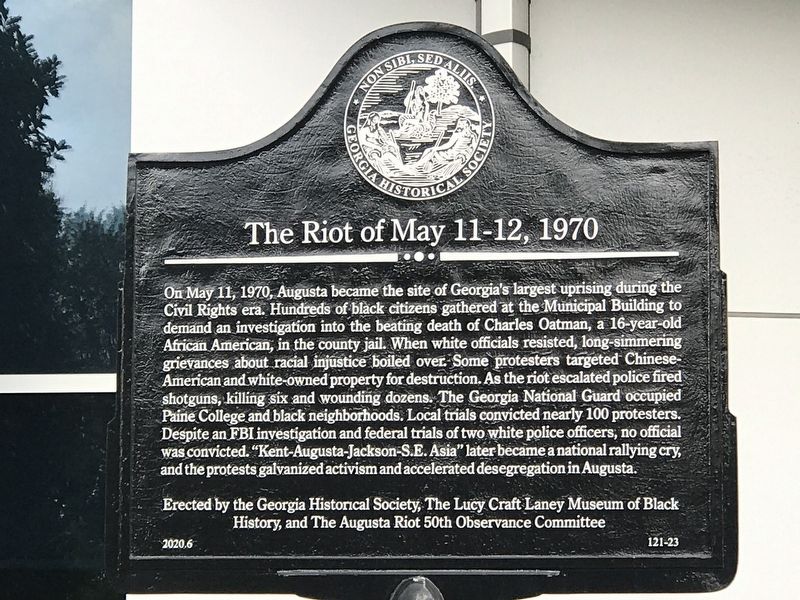
Photographed by Duane and Tracy Marsteller, June 11, 2022
1. The Riot of May 11-12, 1970 Marker
On May 11, 1970, Augusta became the site of Georgia's largest uprising during the Civil Rights era. Hundreds of black citizens gathered at the Municipal Building to demand an investigation into the beating death of Charles Oatman, a 16-year-old African American, in the county jail. When white officials resisted, long-simmering grievances about racial injustice boiled over. Some protesters targeted Chinese-American and white-owned property for destruction. As the riot escalated police fired shotguns, killing six and wounding dozens. The Georgia National Guard occupied Paine College and black neighborhoods. Local trials convicted nearly 100 protesters. Despite an FBI investigation and federal trials of two white police officers, no official was convicted. “Kent-Augusta-Jackson-S.E. Asia” later became a national rallying cry, and the protests galvanized activism and accelerated desegregation in Augusta.
Erected 2020 by Georgia Historical Society • The Lucy Craft Laney Museum of Black History • The Augusta Riot 50th Observance Committee. (Marker Number 121-23.)
Topics and series. This historical marker is listed
this page online
Location. 33° 28.259′ N, 81° 57.714′ W. Marker is in Augusta, Georgia, in Richmond County. It can be reached from Telfair Street 0.1 miles west of Button Gwinnett Street, on the right when traveling west. Marker is in front of the Augusta-Richmond County Municipal Building. Touch for map. Marker is at or near this postal address: 535 Telfair St, Augusta GA 30901, United States of America. Touch for directions.

Regionally, this marker is in the American South and specifically in the Deep South. Globally, it is in North America, the Western Hemisphere, the Western World, and the Anglosphere. Historically, it finds itself in what was once the territory of the Mississippian Culture, one of the original Thirteen Colonies, one of the Confederate States of America, and the Antebellum South.
Other nearby markers. At least 8 other markers are within walking distance of this marker: Richmond County (within shouting distance of this

Photographed by Duane and Tracy Marsteller, June 11, 2022
2. The Riot of May 11-12, 1970 Marker
Other markers no longer nearby. Old Richmond Academy Building (was within shouting distance of this marker but has been confirmed missing); Congregation Children of Israel (was about 300 feet away, measured in a direct line but has been confirmed missing).
Also see . . .
1. Remembering The Augusta Civil Rights Riot, 50 Years Later. Despite the death, damage and news coverage it caused, the riot — and the causes behind it — had largely been forgotten in the decades afterward. ("All Things Considered," National Public Radio, Oct. 1, 2020) (Submitted on June 17, 2022, by Duane and Tracy Marsteller of Murfreesboro, Tennessee.)
2. Shots in the Back: Exhuming the 1970 Augusta Riot.

Photographed by J.T. Lambrou, April 10, 2025
3. The Riot of May 11-12, 1970 Marker
3. Photos: May 11, 1970 Augusta Riots. Collection of photographs taken by The Augusta Chronicle photojournalists. (Submitted on June 17, 2022, by Duane and Tracy Marsteller of Murfreesboro, Tennessee.)
Credits. This page was last revised on June 6, 2025. It was originally submitted on June 17, 2022, by Duane and Tracy Marsteller of Murfreesboro, Tennessee. This page has been viewed 1,028 times since then and 44 times this year. Photos: 1, 2. submitted on June 17, 2022, by Duane and Tracy Marsteller of Murfreesboro, Tennessee. 3. submitted on May 31, 2025, by J.T. Lambrou of New Boston, Michigan.
