Bushnell in Sumter County, Florida — The American South (South Atlantic)
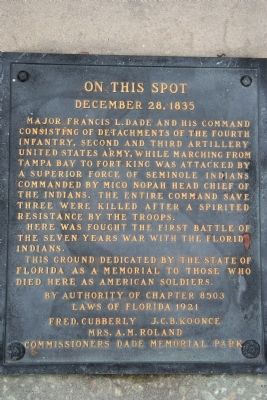
On This Spot
December 28, 1835
| — | Dade Battlefield | — |
Photographed by Dale K. Benington, June 6, 2009
1. Dade Battlefield Marker
Here was fought the first battle of the Seven Years War with the Florida Indians.
This ground dedicated by the state of Florida as a memorial to those who died here as American soldiers.
Laws of Florida 1921
Fred Cubberly - - - - - - J.C.B. Koonce
Mrs. A.M. Roland
Commissioners Dade Memorial Park
Erected 1921.
Topics and series. This historical marker is listed in these topic lists: Indigenous Peoples and Communities • Wars, US Indian. In addition, it is included in the National Historic Landmarks series list.
Location. 28° 39.072′ N, 82° 7.551′ W. Marker is in Bushnell, Florida, in Sumter County. It can be reached from Battlefield Parkway (County Road 603) 0.2 miles south of County Road 605. To view this historical marker exit Interstate 75 at the Bushnell exit (County Road 48) and proceed east approximately 1.1 miles until you come to County Road 603 (Battlefield Parkway), and then you turn right (south). Head south on County Road 603 for about 1.0 miles and right after the intersection of CR 603 with CR 605, the roadway becomes the entrance to Dade Battlefield Memorial Park. Enter the park and proceed about 0.2 miles to the parking lot and you will find this historical marker located in front of the park museum which is immediately adjacent to the parking lot. Touch for map. Marker is in this post office area: Bushnell FL 33513, United States
this page online

Regionally, this marker is in the American South. Globally, it is in the North Atlantic Region, North America, a Gulf of Mexico state, the Western Hemisphere, the Western World, and the Anglosphere. Historically, it finds itself in what was once New Spain, the territory of the Mississippian Culture, one of the Confederate States of America, and the Antebellum South.
Other nearby markers. At least 8 other markers are within 6 miles of this marker, measured as the crow flies: Ft. Armstrong (approx. half a mile away); Bushnell Veterans Memorial (approx. 1.3 miles away); Pilaklikaha / Abraham's Town (approx. 4½ miles away); Sumter County Farmers Market (approx. 4.9 miles away); Parson Brown Orange Tree (approx. 5.3 miles away); Wild Cow Prairie Cemetery (approx. 5.8 miles away); Florida National Cemetery (approx. 6 miles away); The Ultimate Sacrifice (approx. 6.1 miles away). Touch for a list and map of all markers in Bushnell.
Related marker. Click here for another marker that is related to this marker. the relationship, see marker shown.
Also see . . .
1. Dade Battlefield Historic State Park History.
Photographed by Dale K. Benington, June 5, 2009
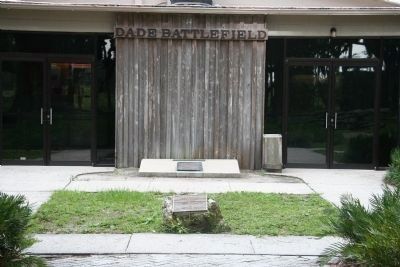
2. Dade Battlefield Marker
View of historical markers in front of Dade Battlefield Museum.
2. The "Dade Massacre" , Wikipedia entry. ... was an 1835 defeat for the United States Army that started the Second Seminole War, which lasted until 1842. ... Decisive Seminole victory (Submitted on March 26, 2011, by Mike Stroud of Bluffton, South Carolina.)
3. A Battle of the Seminole Wars. On December 28, 1835, Seminole warriors attacked a column of 107 U.S. soldiers led by Major Francis Dade, sparking a battle that would bring the United States fully into the costliest Indian war in its history. (Submitted on March 26, 2011, by Mike Stroud of Bluffton, South Carolina.)
4. (Major) Francis Langhorne Dade, Wikipedia entry. a Major in the U.S. 4th Infantry Regiment, United States Army, during the Second Seminole War. Dade was killed in a battle with Seminole Indians that came to be known as the "Dade Massacre". Dade was born in Virginia, ...
Dade County, Missouri, Miami-Dade County, Florida, Dade County, Georgia, and Dade City, Florida are all named after Major
Photographed by Dale K. Benington, June 6, 2009
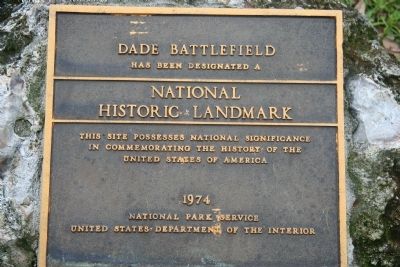
3. Dade Battlefield Marker
View of historic marker that designates this site as being a National Landmark.
National Register of Historic Places: Dade Battlefield Historic Memorial *** (added 1972 - Site - #72000353) • Also known as Dade's Massacre; Dade Battlefield • 1 mi. W of Bushnell off U.S. 301, Bushnell Historic Significance: Event Area of Significance: Native American, Military, Politics/Government • Period of Significance: 1825-1849 • Owner: State • Historic Function: Defense • Historic Sub-function: Battle Site •
National Register of Historic Places: Dade Battlefield Historic Memorial *** (added 1972 - Site - #72000353) • Also known as Dade's Massacre; Dade Battlefield • 1 mi. W of Bushnell off U.S. 301, Bushnell Historic Significance: Event Area of Significance: Native American, Military, Politics/Government • Period of Significance: 1825-1849 • Owner: State • Historic Function: Defense • Historic Sub-function: Battle Site •
Additional commentary.
1. Annual Commemoration
There is an annual and very realistic reenactment of the Dade's Battle each year during the week between Christmas and New Year's Day. It is very much worth the small fee to observe one of the most historically accurate battle scenarios, not a simple open field event but actually done in palmetto and scrub forest as was present during the real thing. An amphitheatre has been created and the scrub cleared so that the battle appears to be IN the scrub.
— Submitted November 2, 2009, by Warren W Johns of Groveland, Florida.
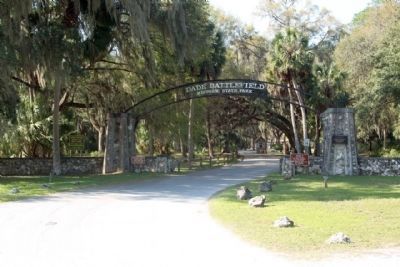
Photographed by Mike Stroud, March 20, 2011
4. Dade Battlefield
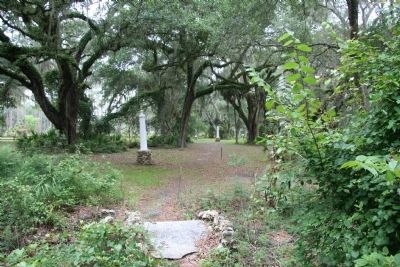
Photographed by Dale K. Benington, June 6, 2009
5. On This Spot Marker
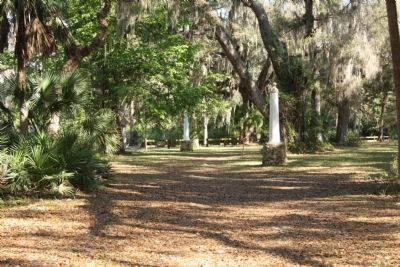
View of the area that made up the initial site of the Indian attack (tall white pillars are situated on spots where individual officers were killed).
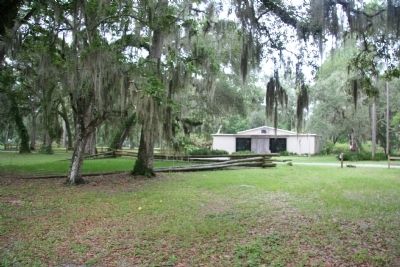
Photographed by Dale K. Benington, June 6, 2009
6. Dade Battlefield
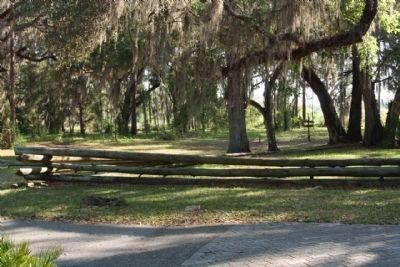
The triangular formation of logs in front of the museum building represents the spot where the US troops threw up a log defensive formation and made their last stand.
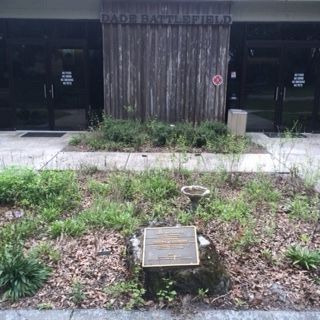
Photographed by James R. Murray, September 25, 2014
7. On This Spot Marker
The featured marker is still missing as of today's visit, Sept 25, 2014. The Park Ranger was also missing, so it was not determined what became of it.
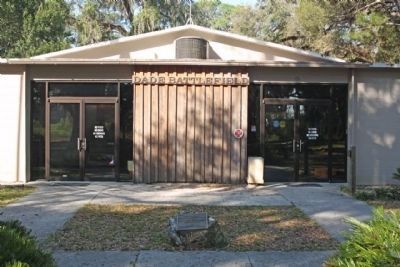
Photographed by Mike Stroud, March 20, 2011
8. On This Spot Marker, missing in 2011
Photographed by Mike Stroud, March 20, 2011
9. Dade Battlefield...
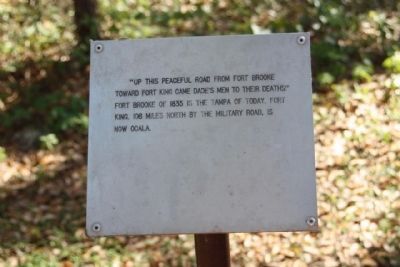
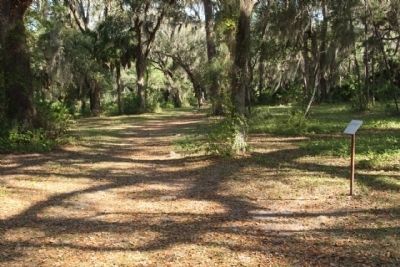
"Up this peaceful road from Fort Brooke toward Fort King came Dade's men to their Deaths." Fort Brooke of 1835 is the Tampa of today, Fort King, 106 miles north by the military road, is now Ocala.
Photographed by Mike Stroud, March 20, 2011
10. Dade Battlefield
Photographed by Mike Stroud, March 20, 2011
11. Dade Battlefield
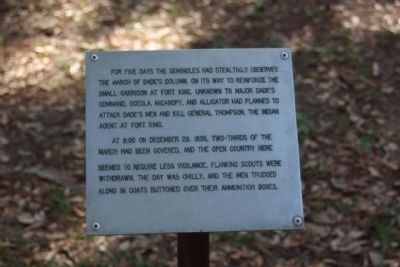
For five days the Seminoles had stealthly observed the march of Dade's column, on its way to reinforce the small garrison at Fort King. Unknown to Major Dade's command, Oceola, Micanopy, and Alligator had planned to attack Dade's men and kill General Thompson, the Indian Agent at Fort King.
At 8:00 on December 28, 1835, two- thirds of the march had been covered, and the open country here seemed to require less vigilance. Flanking scouts were withdrawn, the day was chilly, and the men trudged along in coats buttoned over their ammunition boxes.
At 8:00 on December 28, 1835, two- thirds of the march had been covered, and the open country here seemed to require less vigilance. Flanking scouts were withdrawn, the day was chilly, and the men trudged along in coats buttoned over their ammunition boxes.
Photographed by Mike Stroud, March 20, 2011
12. Dade Battlefield
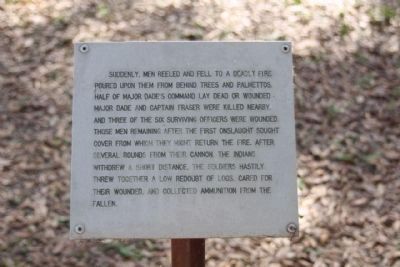
Suddenly, men reeled and fell to a deadly fire poured upon them from behind trees and Palmettos. Half of Major Dade's command lay dead or wounded. Major Dade and Captain Fraser were killed nearby, and three of the six surviving officers were wounded. Those men remaining after the first onslaught sought cover from which they might return the fire. After several rounds from their cannon, the Indians withdrew a short distance. The soldiers hastily threw together a low redoubt of logs, cared for their wounded, and collected ammunition from the fallen.
Photographed by Mike Stroud, March 20, 2011
13. Dade Battlefield
The soldiers hastily threw together a low redoubt
of logs, cared for their wounded, and collected ammunition from the fallen.
Later, bodies of the enlisted men were buried in two graves within the redoubt. Later relocated to St. Augustine
Later, bodies of the enlisted men were buried in two graves within the redoubt. Later relocated to St. Augustine
Photographed by Mike Stroud, March 20, 2011
14. Dade Battlefield
Photographed by Mike Stroud, March 20, 2011
15. Dade Battlefield
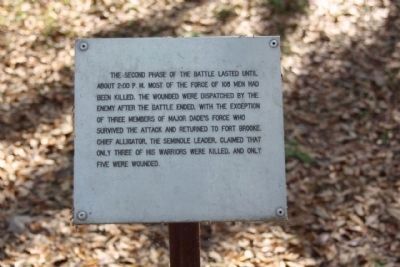
The second phase of the battle lasted until about 2:00 P.M. Most of the force of 108 men had been killed. The wounded were dispatched by the enemy after the battle ended, with the exception of three members of Major Dade's force who survived the attack and returned to Fort Brooke. Chief Alligator, the Seminole leader, claimed that only three of his warriors were killed, and only five were wounded.
Photographed by Mike Stroud, March 20, 2011
16. Dade Battlefield
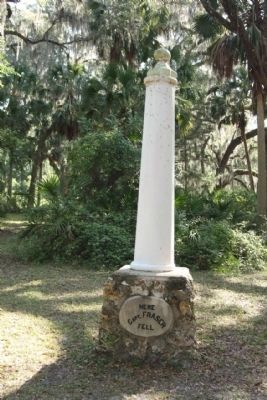
Photographed by Mike Stroud, March 20, 2011
17. Dade Battlefield
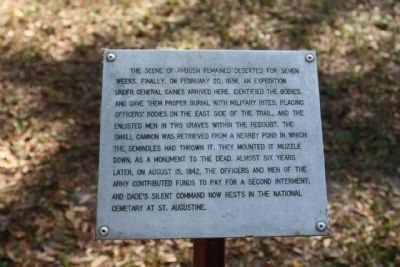
Photographed by Mike Stroud, March 20, 2011
18. Dade Battlefield
The scene of the ambush remained deserted for seven weeks. Finally, on February 20, 1836, an expedition under General Gains arrived here, identified the bodies, and gave them proper burial with military rites, placing officers' bodies on the east side of the trail, and the enlisted men in two graves within the redoubt. The small cannon was retrieved from a nearby pond in which the Seminoles had thrown it. They mounted it muzzle down, as a monument to the dead. Almost six years later, on August 15, 1842, the officers and men of the army contributed funds to pay for a second interment; and Dade's silent command now rests in the National Cemetery at St. Augustine.
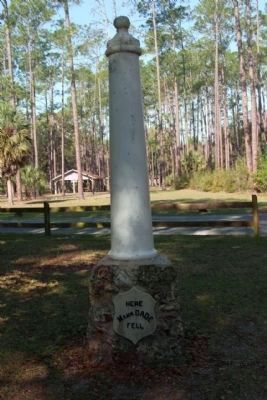
Photographed by Mike Stroud, March 20, 2011
19. Dade Battlefield
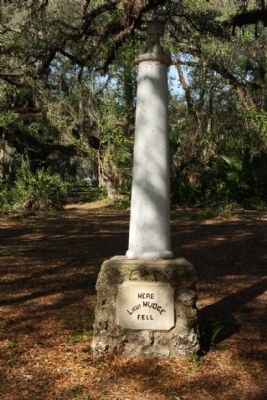
Here Major Dade fell.
When the smoke finally cleared, virtually the entire army force had been wiped out. Dade, his officers and at least 103 men were dead.
A beautiful monument was erected at West Point to his memory and that of his command.
Click for more information.
When the smoke finally cleared, virtually the entire army force had been wiped out. Dade, his officers and at least 103 men were dead.
A beautiful monument was erected at West Point to his memory and that of his command.
Click for more information.
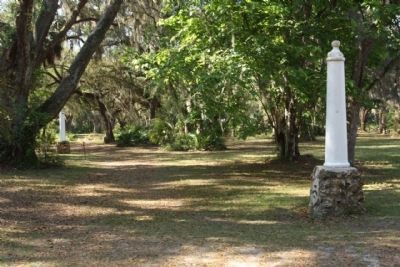
Photographed by Mike Stroud, March 20, 2011
20. Dade Battlefield
Dade Monument in foreground, Capt. Fraser Monument in background
Photographed by Mike Stroud, March 20, 2011
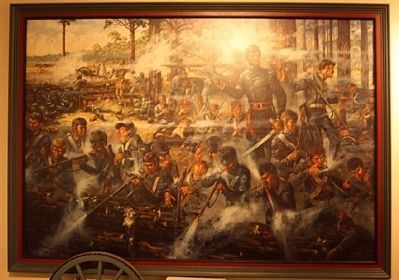
21. Dade Battlefield painting at Visitor Center
Photographed by Mike Stroud, March 20, 2011
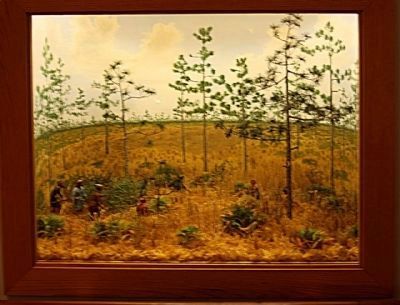
22. Dade Battlefield Diorama at the Visitor Center, showing Seminoles in attack position
Photographed by Mike Stroud, March 20, 2011
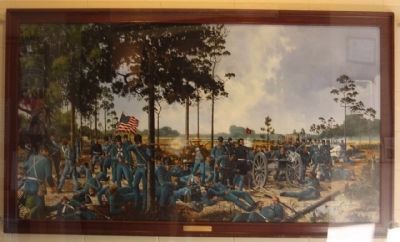
23. Dade Battlefield, Visitor Center painting
Credits. This page was last revised on September 25, 2020. It was originally submitted on June 17, 2009, by Dale K. Benington of Toledo, Ohio. This page has been viewed 3,291 times since then and 129 times this year. Photos: 1, 2, 3. submitted on June 17, 2009, by Dale K. Benington of Toledo, Ohio. 4. submitted on March 26, 2011, by Mike Stroud of Bluffton, South Carolina. 5, 6. submitted on June 17, 2009, by Dale K. Benington of Toledo, Ohio. 7. submitted on September 25, 2014, by James R. Murray of Elkton, Florida. 8, 9, 10, 11, 12, 13, 14, 15, 16, 17, 18, 19, 20, 21, 22, 23. submitted on March 26, 2011, by Mike Stroud of Bluffton, South Carolina. • Craig Swain was the editor who published this page.
