Wheeling in Ohio County, West Virginia — The American South (Appalachia)
Wheeling Custom House
West Virginia Independence Hall
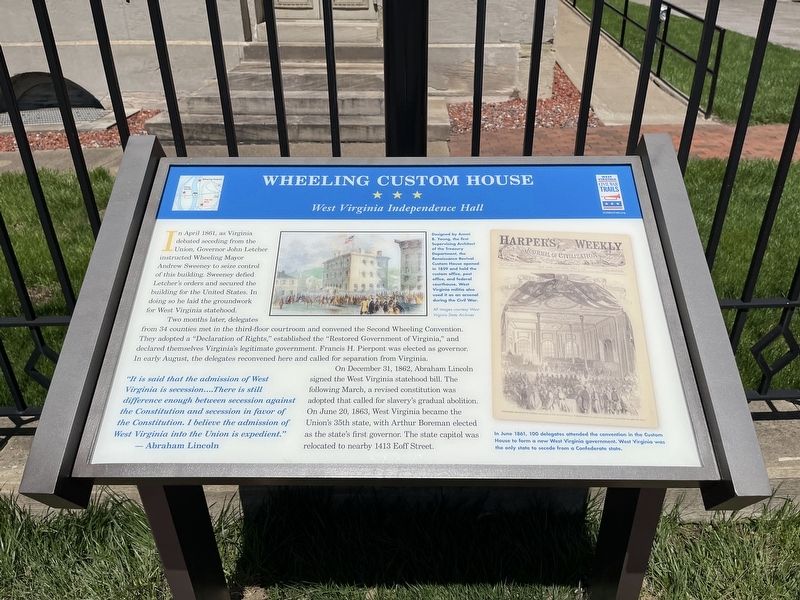
In April 1861, as Virginia debated seceding from the Union, Governor John Letcher instructed Wheeling Mayor Andrew Sweeney to seize control of this building. Sweeney defied Letcher's orders and secured the building for the United States. In doing so he laid the ground for West Virginia statehood.
Two months later, delegates from 34 counties met in the third-floor courtroom and convened the Second Wheeling Convention. They adopted a "Declaration of Rights," established the "Restored Government of Virginia," and declared themselves Virginia's legitimate government. Francis H. Peirpont was elected as governor. In early August, the delegates reconvened here and called for separation from Virginia.
On December 31, 1862, Abraham Lincoln signed the West Virginia statehood bill. The following March, a revised constitution was adopted that called for slavery's gradual abolition. On June 20, 1863, West Virginia became the Union's 35th state, with Arthur Boreman elected as the state's first governor. The state capitol was relocated to nearby 1413 Eoff Street.
"It is said that the admission of West Virginia is secession....There is still difference enough between secession against the Constitution and secession in favor of the Constitution. I believe the admission of West Virginia into the Union is expedient."
—Abraham Lincoln
Click or scan to see
this page online
[Captions:]
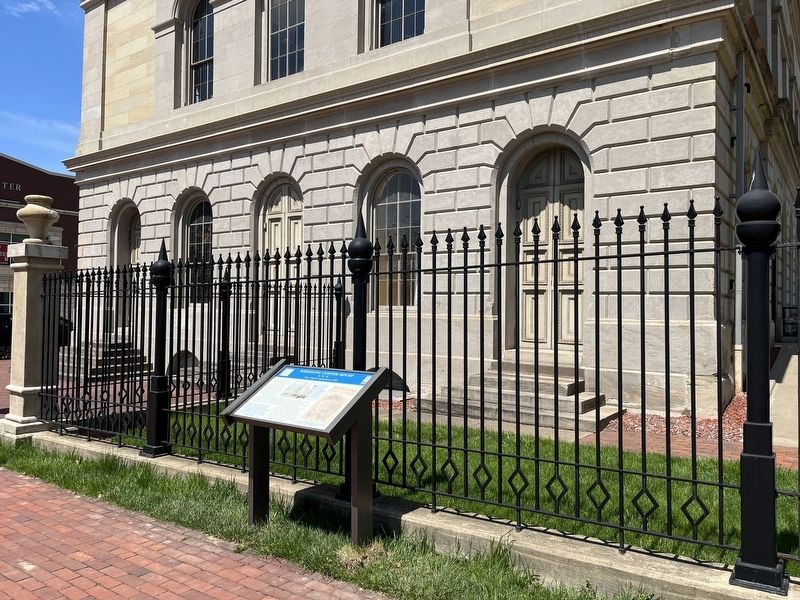
Designed by Ammi B. Young, the first Supervising Architect of the Treasury Department, the Renaissance Revival Custom House opened in 1859 and held the custom office, post office, and federal courthouse. West Virginia militia also used it as an arsenal during the Civil War.
In June 1861, 100 delegates attended the convention in the Custom House to form a new West Virginia government. West Virginia was the only state to secede from a Confederate state.
Erected 2022 by West Virginia Civil War Trails.
Topics and series. This historical marker is listed in these topic lists: Abolition & Underground RR • Government & Politics • Political Subdivisions • War, US Civil. In addition, it is included in the Former U.S. Presidents: #16 Abraham Lincoln, and the West Virginia Civil War Trails series lists. A significant historical month for this entry is April 1861.
Location. 40° 3.843′ N, 80° 43.298′ W. Marker is in Wheeling, West Virginia, in Ohio County. It is on 16th Street (West Virginia Route 2) just east of Market Street ( Route 2), on the right when traveling west. Touch for map. Marker is

Regionally, this marker is in the Northern Panhandle and in the High Valley. It is also in the American South, specifically in the Upper South, in the Ohio River Valley, in Appalachia, and specifically in Northern Appalachia. Globally, it is in North America, the Western Hemisphere, the Western World, and the Anglosphere. Historically, it finds itself in what was once the territory of the Mississippian Culture.
Other nearby markers. At least 8 other markers are within walking distance of this marker: Old Garibaldi (here, next to this marker); The Athenaeum (a few steps from this marker); Francis H. Pierpont (a few steps from this marker); a different marker also named The Athenaeum (a few steps from this marker); Old Custom House (within shouting distance of this marker); Restored Government of Virginia (within shouting distance of this marker); Baltimore and Ohio Passenger Station (within shouting distance of this marker); First Wheeling Convention / Second Wheeling Convention (within shouting distance of this marker). Touch for a list and map of all markers in Wheeling.
Other markers no longer nearby. Independence Hall (was here, next to this marker but has been replaced with another marker now near it); The First Campaign (was here, next to this marker but has been permanently removed).
Related marker. Click here for another marker that is related to this marker. This marker has replaced the linked marker.
Credits. This page was last revised on June 23, 2022. It was originally submitted on April 24, 2022, by Devry Becker Jones of Washington, District of Columbia. This page has been viewed 425 times since then and 28 times this year. Last updated on June 23, 2022, by Bradley Owen of Morgantown, West Virginia. Photos: 1, 2. submitted on April 24, 2022, by Devry Becker Jones of Washington, District of Columbia.
