Liberty Township near Powell in Delaware County, Ohio — The American Midwest (Great Lakes)
Canada Lynx
Lynx canadensis
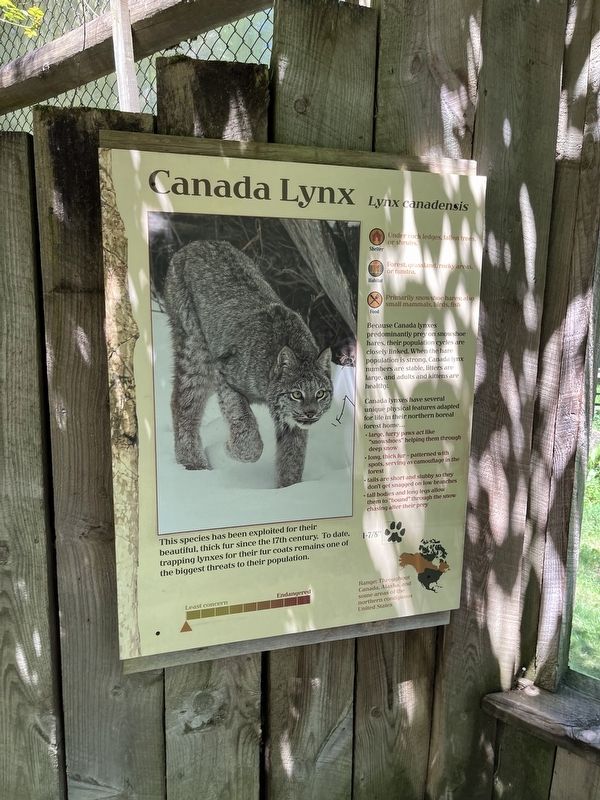
🏠 Shelter: Under rock ledges, fallen trees, or shrubs.
🏞️ Habitat: Forest, grassland, rocky areas, or tundra.
🍴 Food: Primarily snowshoe hares; also small mammals, birds, fish.
Because Canada lynxes predominately prey on snowshoe hares, their population cycles are closely linked. When the hare population is strong, Canada lynx numbers are stable, litters are large, and adults and kittens are healthy.
Canada lynxes have several unique physical features adapted for life in their northern boreal forest home…
• large, furry paws act like "snowshoes" helping them through deep snow
• long, thick fur - patterned with spots, serving as camouflage in the forest
• tails are short and stubby so they don't get snagged on low branches
• tall bodies and long legs allow them to "bound" through the snow chasing after their prey
This species has been exploited for their beautiful, thick fur since the 17th century. To date, trapping lynxes for their fur coats remains one of the biggest threats to their population.
Range: Throughout Canada, Alaska, and some areas of the northern contiguous United States.
Erected by Columbus
this page online
Topics. This historical marker is listed in these topic lists: Animals • Colonial Era • Environment • Industry & Commerce • Natural Resources.
Location. 40° 9.493′ N, 83° 6.984′ W. Marker is near Powell, Ohio, in Delaware County. It is in Liberty Township. It can be reached from West Powell Road (Ohio Route 750) east of Route 257, on the left when traveling east. Touch for map. Marker is in this post office area: Powell OH 43065, United States of America. Touch for directions.

Regionally, this marker is in the Scioto Valley and in the Columbus Metropolitan Area. It is also in the American Midwest and in the Corn Belt. Globally, it is in North America, the Western Hemisphere, the Western World, and the Anglosphere. Historically, it finds itself in what was once the Haudenosaunee (Iroquois) Confederacy, the territory of the Mississippian Culture, and the Northwest Territory.
Other nearby markers. At least 8 other markers are within walking distance of this marker: Little House on the Prairie (a few steps from this marker); Profile of a Prairie Dog
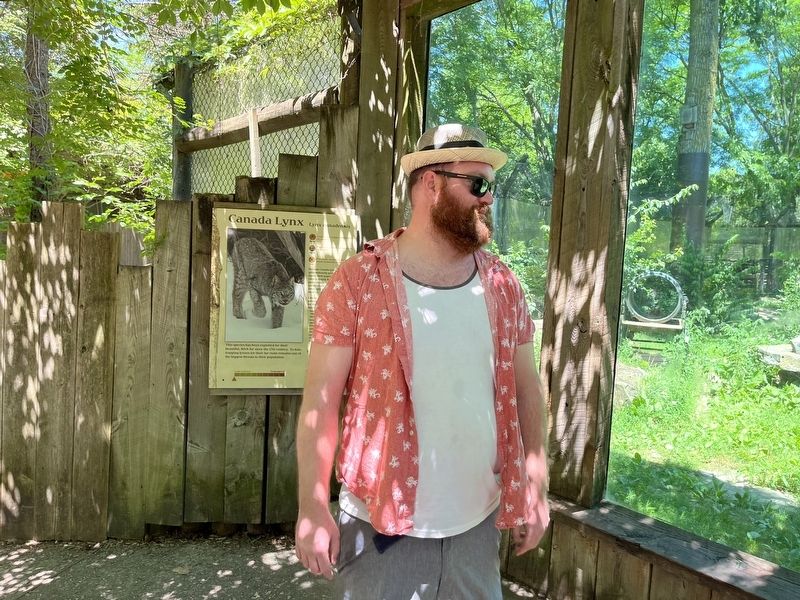
Other markers no longer nearby. North American River Otter (was within shouting distance of this marker but has been replaced with another marker now near it); Dr. Bernard Master (was about 300 feet away but has been permanently removed); Federal Conservation History of the Bald Eagle (was about 300 feet away but has been permanently removed).
Photographed by Devry Becker Jones (CC0), June 24, 2022
3. Additional nearby signage
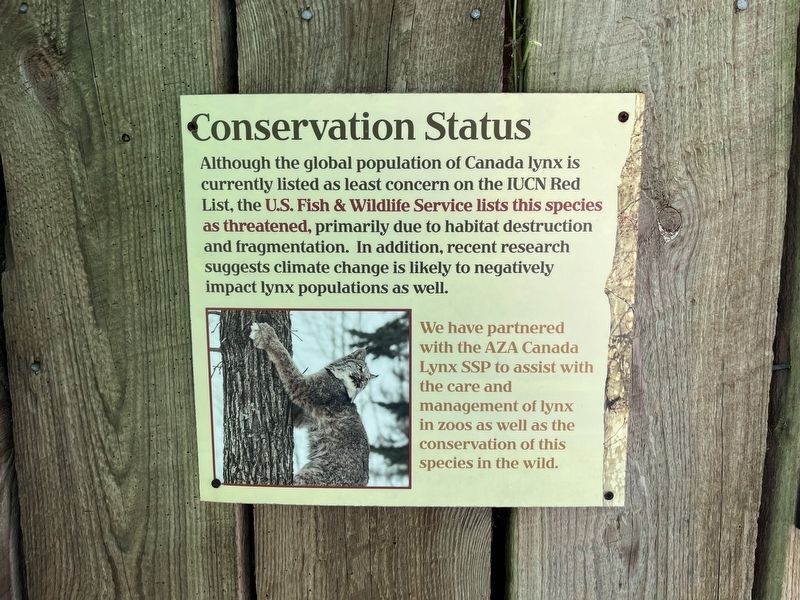
Conservation Status
Although the global population of Canada lynx is currently listed as least concern on the IUCN Red List, the U.S. Fish & Wildlife Service lists this species as threatened, primarily due to habitat destruction and fragmentation. In addition, recent research suggests climate change is likely to negatively impact lynx populations as well.
We have partnered with the AZA Canada Lynx SSP to assist with the care and management of lynx in zoos as well as the conservation of this species in the wild.
Although the global population of Canada lynx is currently listed as least concern on the IUCN Red List, the U.S. Fish & Wildlife Service lists this species as threatened, primarily due to habitat destruction and fragmentation. In addition, recent research suggests climate change is likely to negatively impact lynx populations as well.
We have partnered with the AZA Canada Lynx SSP to assist with the care and management of lynx in zoos as well as the conservation of this species in the wild.
Credits. This page was last revised on February 6, 2023. It was originally submitted on June 28, 2022, by Devry Becker Jones of Washington, District of Columbia. This page has been viewed 316 times since then and 42 times this year. Photos: 1, 2, 3. submitted on June 28, 2022, by Devry Becker Jones of Washington, District of Columbia.
